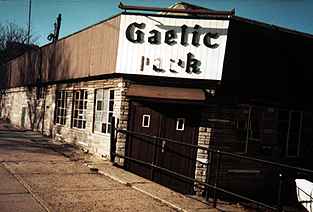
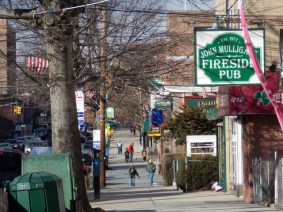
 It was the Summer of 1994 I was working in New York. It was my first time to fly on a plane and it was good to get away from Ireland for a little while. It was exciting, it was exhilarating, an amazing experience for a young buck from the west of Ireland who thought he knew it all. I lived in Elmhurst, Queens in a diverse ethnic neighbourhood but where the majority seemed to be either Colombians or Koreans. I had secured a Doorman’s job in a large Manhattan Apartment building and a couple of day jobs as well. Earning plenty of dollars I was able to pay the rent and have plenty of beer money. Mid-week we got the train up to Van Cortland Park for pretty basic Gaelic football training. I remember there was a rock on an outcrop overlooking the playing fields and Broadway with an Irish Tricolour painted on it. At weekends we played matches in Gaelic Park and met people from home in the bar afterwards. I threw myself completely into the City and when I was off work into Irish-Americana. An Irish-American friend gave me tours of old Bronx Irish neighbourhoods such as Fordham, Kingsbridge, and Bainbridge and regaled me with stories of famous local characters. We drank together in neighbourhood bars. With one ear we listened respectfully to ‘old-timers’ and with the other it was all Nirvana and Pearl Jam from the jukebox.
In many ways that summer was a rite of passage for me and my first real foray into the a wider world. I still longed for news from home. Occasionally I bought the Leitrim Observer in an Irish shop in Jackson heights. For national news I sometimes bought the Irish Independent from a Yemeni man who had a small kiosk not far from where I worked.
The start of the summer for us was the World Cup and that memorable game in Giants Stadium. Who can forget that moment Ray Houghton chipped Pagliuca. It was a great day to be Irish. It also gave us bragging rights in a City which culturally was so dominated up to that time by the Irish and Italian communities. It felt strange at the time defeating a big time soccer nation like Italy.
Later in the summer my native County also made history by winning the Connacht Championship for the first time in sixty seven years. The previous year Derry had won their first All-Ireland. There was much new ground broken in those crucial years, the collapse of communism, the fall of the Berlin Wall, the break-up of the USSR. All these things were unimaginable and improbable just a short time earlier.
Despite all these new beginnings the Troubles in the North lingered on. A number of events stood out for me in 1993; the IRA bomb in the Shankill, the UFF massacre at Greysteel and the naked sectarianism on display in Windsor Park on the night Ireland qualified for USA ’94.
One other atrocity earlier that year had a huge effect on me. It happened in a town called Warrington which is about half way between Liverpool and Manchester. The IRA made a warning call to the Samaritans in Liverpool saying that they had planted a bomb outside Boots Chemist. The authorities still maintain that the caller never said what Boots shop the bomb had been placed at. Just 30 minutes later a bomb exploded outside Boots in Warrington. As people ran from the scene they were caught up in a second bomb planted outside Argos.
The bombs were placed in cast iron bins which ensured there was lots of shrapnel. Johnathan Ball died at the scene, only 3 years old he was in town with his babysitter. She was buying him a Mother’s Day card. About fifty people were injured and maimed by the explosions. 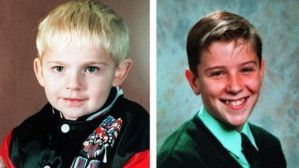
A few days later the parents of 12 year old Tim Parry had to make the awful decision to turn off his life support machine. The aftermath consisted of the IRA blaming the Police for not acting on precise warnings and the Police and most right thinking people blaming the bombers. The weeks following the bombing were punctuated by even more sectarian killings in the North. Tim Parry’s father made a huge impression on me when I heard him speak about reconciliation and conflict resolution on TV.
One morning late in my summer sojourn I was walking south on 3rd Avenue. I had walked past Hunter College and The Armoury. Suddenly I heard someone calling me. It was Asil the Yemeni kiosk owner. He was shouting ‘Irishman, Irishman, look, look, peace in your country’. He was holding up the latest edition of the Irish Independent an in big back letters I could clearly read the words ‘ITS OVER FOR GOOD’. 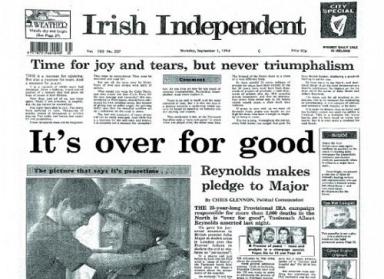
He looked like Neville Chamberlain come back from Munich. Of course my reaction was that this can’t be true and I think I actually said this to Asil. I was certainly dismissive. Nevertheless I bought the paper, which is probably what Asil really wanted. I read it as I walked and read it again several times on the subway home. It slowly began to sink in. It was true. It really was. Peace in our time. Ironically the roles are now reversed and I wish peace for Asil’s home country of Yemen.
The only reason I’m recalling those crazy days of 1993 and 1994 is the sad passing of Dolores O’Riordan. The Cranberries were the soundtrack of that period for thousands of young Irish people like me. The Band released the album ‘Everyone else is doing it why can’t we’ in 1993. In a way the title sums up how we felt when we beat the Italians over in New Jersey. The Cranberries were heading for rock stardom. They were touring the UK when the Warrington bomb went off. In the aftermath Dolores apparently penned the words to the song ‘Zombie’ . It would be released on the 1994 Album ‘No need to argue’ and later be a number one single. The song would also win best song at the MTV Music awards.
Another head hangs lowly
Child is slowly taken
And the violence caused such silence
Who are we mistaken
It’s not necessarily the Cranberries best song and is very much a departure from their songbook even if the instantly recognisable grungy riffs are still to the fore. It is at its heart a quintessential anti-war song and it struck a note big time with many of us, expressing as it did how we had come to feel about the Troubles. It was also marvellous that it was this feisty little rock chick from Limerick telling the World how we felt. There will be enough commentary about the premature passing of Ireland’s first global female rock star. For many of us she will always be simply the voice of the generation who lived either side of the watershed of peace on this Island. That’s how I’ll remember her.
life, Is changing every day,
In every possible way.
And oh, my dreams,
It’s never quite as it seems
 So it begins, our worst storm in fifty years, poised and ready to unleash its fury. News stations have no problem filling their schedules, feeding our puerile interest in natural disaster. Meteorologists and Weather forecasters, typically born to bloom unseen, take centre stage today.
 As usual I digress. The person I most want to discuss is a man named Phil Fitzpatrick who was born in Aughavas, Co. Leitrim in 1892. Phil emigrated to New York just after independence and he joined New York’s finest as a Patrolman in 1926. He spent most of his career in the mounted section patrolling precincts around Midtown and Central Park.
 Last night I had a pleasant dream, I woke up with a smile
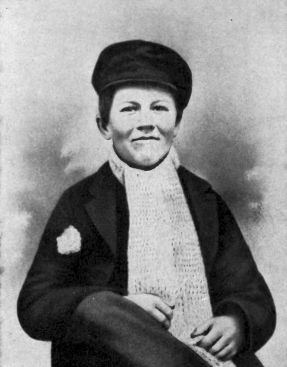 Let me introduce you to a young boy. His name is Thomas and he is naturally bright, savvy and streetwise. He is not afraid of hard work or long hours and is innovative and enterprising. His story is very relative to what we see happening in America today.
 The majority of the residents of the US are the descendants of refugees of some kind or another – they might be like Edison’s father, a political refugee, or perhaps their ancestry lies with some of the millions of Irish and Italians, fleeing famine and poverty. America has benefitted from these refugees; it is they who made America great. Trump’s malignant narcissism will destroy America and diminish whatever small bit of light she has left as a beacon for the rest of the world. America cannot hide away in isolated paranoia, no more than Trump can solve its problems by creating scapegoats to prop up his alternative truths. Perhaps the better policy to pursue is the one the great Walt Whitman counselled ‘Keep your face always toward the sunshine – and shadows will fall behind you’. A big wall creates a big shadow and soon America will need a new Edison to take them out of this darkness.
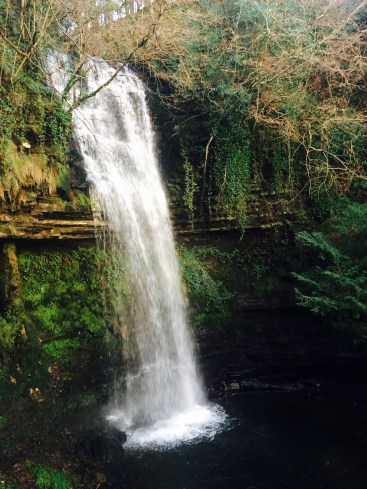 “Where the wandering water gushes
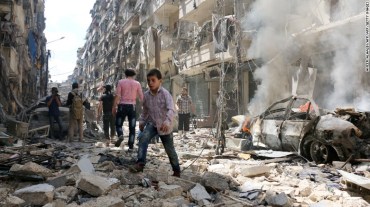 My memories of Aleppo are beginning to fade. It is now eleven years since I was there. I have kept many notes of my travels but somehow those on Aleppo are either lost or perhaps they never existed. It is almost irrelevant now as the city I saw no longer exists save for in old photographs and the fading memories of its former residents scattered across the world. Every time I see an image of this once magnificent City’s crumbling Dresdenesque cityscape I weep. I can remember enjoying Syria; savouring the warmth and hospitality of its people, its magnificent historical sites, its layers upon layers of history from Greeks to Crusaders, Assyrians to the Mamluks. Who could not swoon at the impressive ruins of Palmyra, the awe inspiring Krak-des-Chevaliers, the Orontes Valley or wandering around Bar Touma Neighbourhood in Damascus (birthplace of half a dozen Popes). I cannot forget the hum of Homs, the noisy water wheels (or Noria) of Hama, and the majestic Ummayad Mosque. The Souks of Damascus and Aleppo were places of wonder for me, the trade carried on in their arched cubicles seemed to provide a snapshot of an ancient and unbroken tradition. Throughout all this I can also remember being aware of the regime and it’s all seeing eyes and ears but otherwise (bar this obvious erosion of what we in the West call civil liberties) I remember a place that was hustle, bustle and full of life.
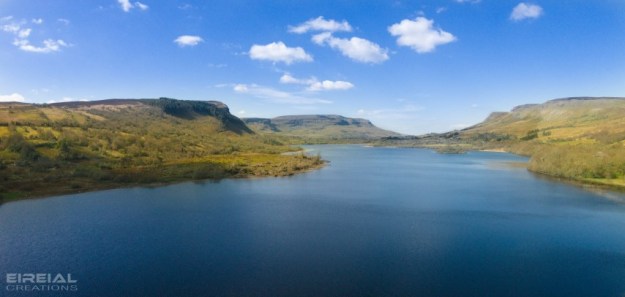
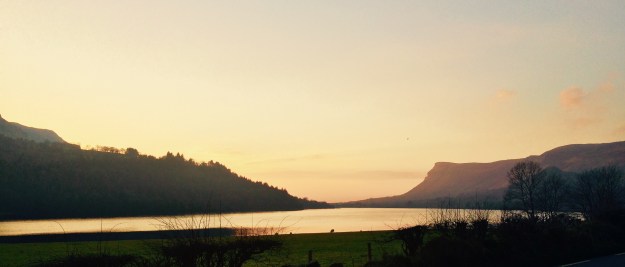
 I was recently reading up on ancient tales on Irish Lake monsters and came across this interesting piece on the death of a woman in 1722 in Glenade Lake. Apparently the woman who was named Grace or Grainne, and married to a Turlough McLoghlin, was washing clothes in the lake when she was attacked by the Dobhar-Chu.