A Loop in the River

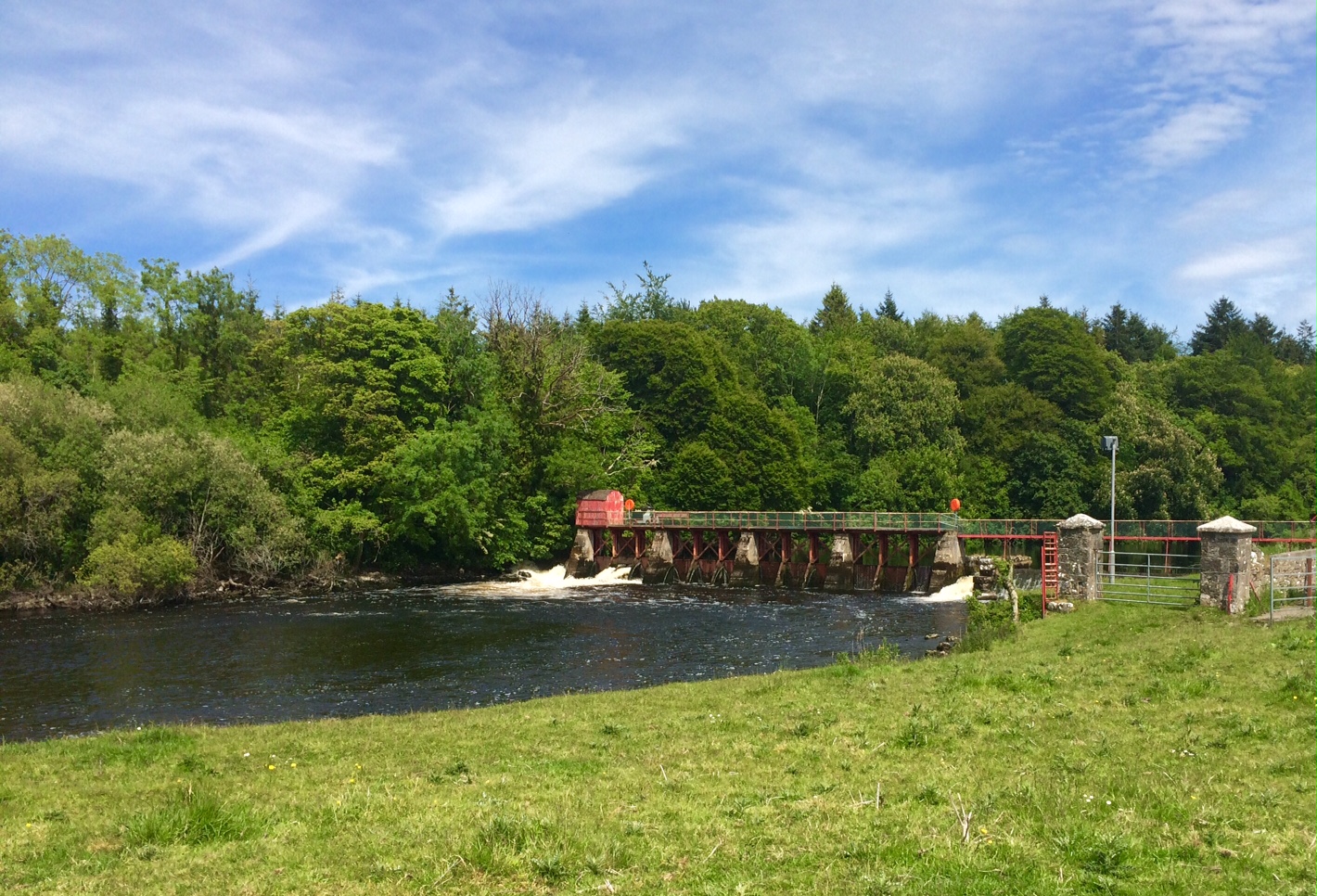
The Weir at Jamestown

The Weir

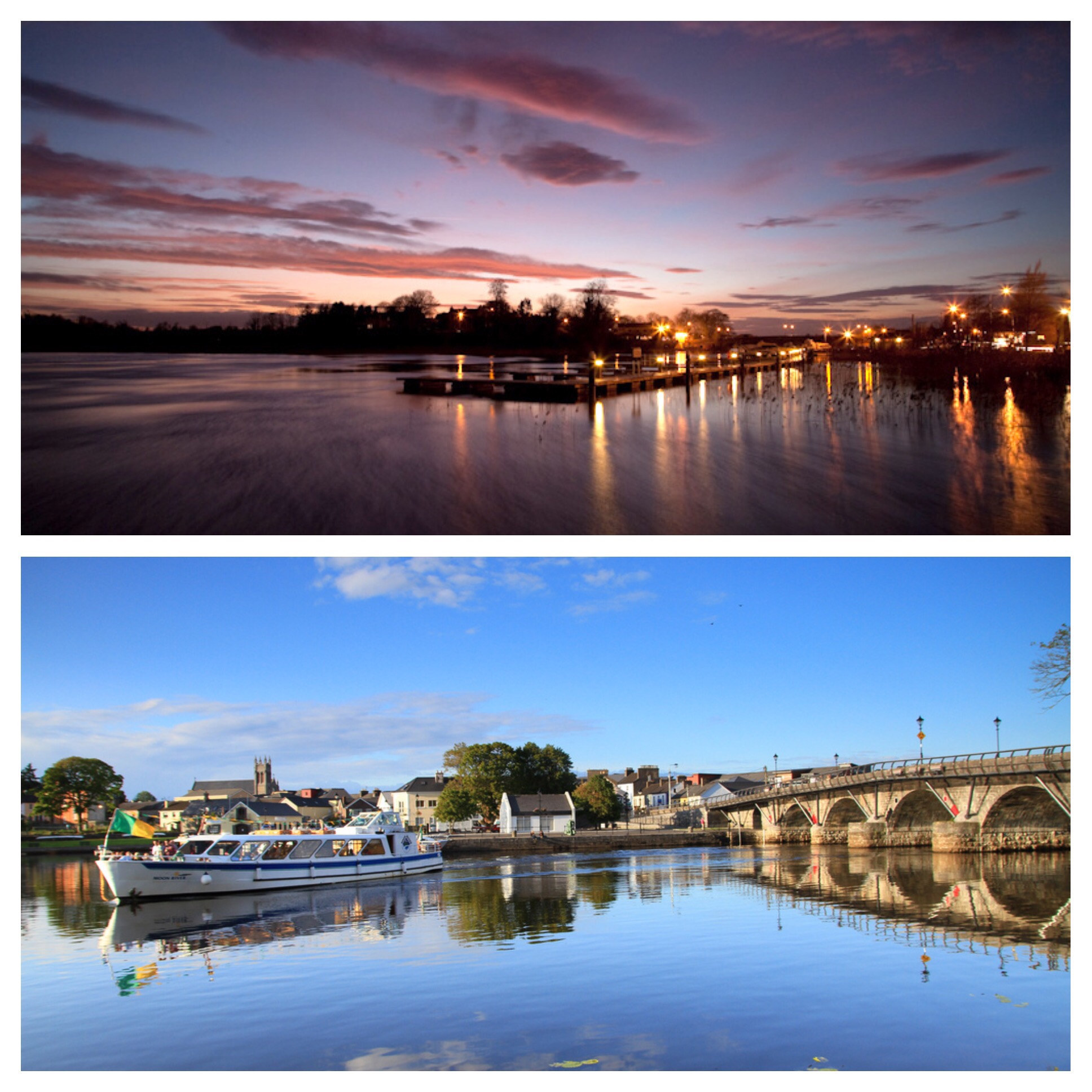
This Blog’s title owes itself to the River Shannon. The river meanders its way through the countryside and provides us with some beautiful backdrops. Today the sun was shining brightly which can be rarity hereabouts, at least of late. I was smiling to myself after a friend told me a little anecdote about Rick Santorum the US Republican Senator. Apparently Santorum had said that Pope Francis ought to leave climate change to the scientists! Poor Rick however was apparently unaware that the Pope, prior to taking orders was a trained chemical lab technician. Little matters like Ricks oversight can make you feel happy sometimes. As I was passing through Jamestown the river came into view.  I just had to stop the car to admire the beautiful Weir and the sound of the cascading waters. I was reminded of those beautifully crafted lines of Kavanagh:-

“Where by a lock Niagariously roars

The falls for those who sit in the tremendous silence

Of mid-July. No one will speak in prose

Who finds his way to these Parnassian islands.”

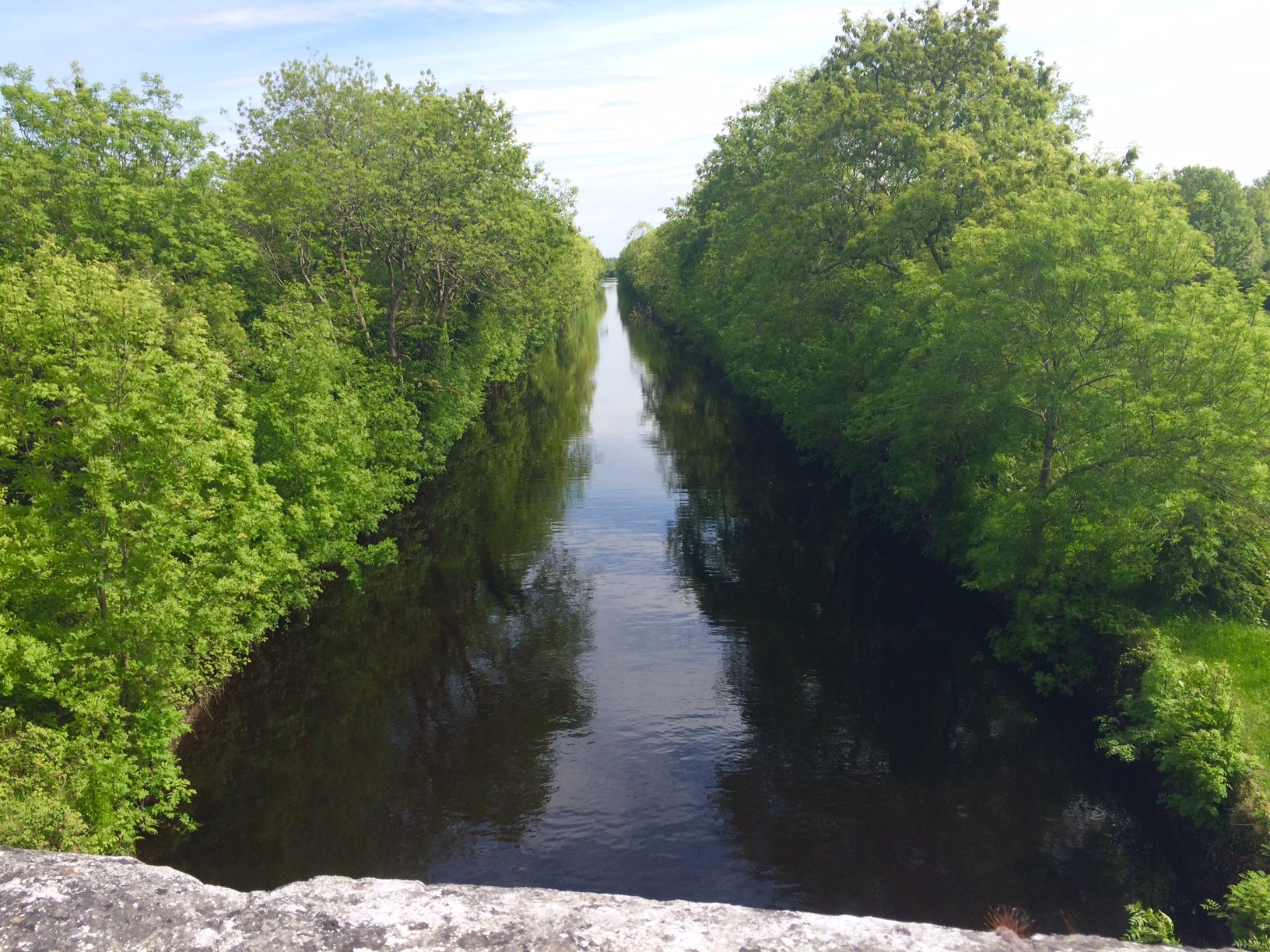
A few minutes later I stopped at one of the bridges that traverse the Albert Lock and Canal. This stretch of water is likely to be very familiar to the boating fraternity on the Upper Shannon.  It is also an area rich in history ancient and modern. The canal is also known as the ‘Jamestown Cut’ and it bypasses an un-navigable part of the river in the loop between the neat villages of Jamestown and Drumsna.

The Albert Canal

The Albert Canal

Jamestown itself was founded in 1622 as a walled plantation town and remarkably, as a recognised borough, it returned two MP’s up until the Act of Union in 1801 . The town itself never really flourished in the manner envisaged by its founders. Its prominence peaked in the mid seventeenth century when it was fought over during the 1641 Rebellion. In 1650 a famous Synod of the Bishops was held here but from then on the town declined although it retained a modest river trade and was still a significant fording point over the Shannon. The importance of the crossing point has long been recognised. The area marked the traditional fording area and point of demarcation between the ancient provinces of Connacht and Ulster. The ‘Doon’ of Drumsna stretched for over 1.6 km between the villages of Drumsna and Jamestown.The Doon consisted of a large earthenwork rampart up to six metres high on its northern side. The ramparts also had a fortified gate or entrance and was effectively an ancient ‘Checkpoint Charlie’. It is believed that the Doon was in use in the period 500BC to 400AD.

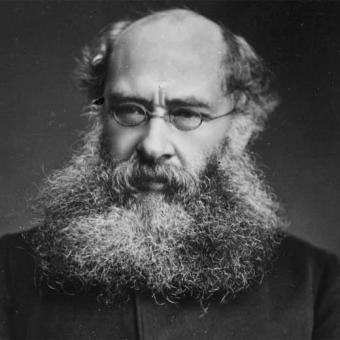
Drumsna is also a picturesque riverside village. Up until the mid Nineteenth Century it was of huge significance as the main postal town of the southern part of the County of Leitrim. The Novelist Anthony Trollope lived for a time in the Village and penned one of his earliest novels ‘The Macdermotts of Ballycloran’ here.

Trollope

Trollope

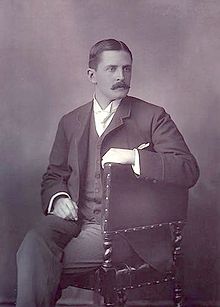
Another famous person associated with the area is the famous Surgeon and Explorer Thomas Heazle Parke who was born in nearby Clogher House. Parke made a name for himself in the relief of Gordon at Khartoum in 1885. He also worked with Henry Morton Stanley in the Emin Pash Relief Expedition. Whilst in Central Africa Parke is said to have purchased a pygmy girl, a strange act in modern terms but one which saved his life. When he contracted malaria the girl nursed him back from death. Unfortunately he could not bring her with him as her eyes could not adjust to the sunlight after coming out of the dark of the forest.

Thomas Heazle Parke

Thomas Parke

The Canal was first mooted in the 1600’s as part of an overall scheme to make the Shannon navigable. A canal was not constructed however until 1769. The original canal was much smaller and narrower than what we see today and its depth averaged only 1.2 metres. The Shannon Commissioners approved new works in 1844 and much of the construction work was carried out by Poor Relief Committees during the famine. On average 300 men worked on the Canal daily at this time. The new Lock was named after the Prince Consort and husband of Queen Victoria. The canal served the area well commercially until the late 1950’s by which time increased use of road haulage made the river barges obsolete. From a highway of commerce the river has now become a leisure route . I hope today’s  canal users take just a moment to think of the local labourers whose backbreaking toil, with hand tools, built this fine canal, all for the measly sum of six pence a day.

All the toil of man is for his mouth, yet his appetite is not satisfied

Ecclesiastes 6:7

Archaeology of Leitrim

I see a new Facebook page dedicated to the extensive Archaeology of County Leitrim. This is the link:- https://www.facebook.com/pages/The-Archaeology-of-Co-Leitrim/937361499659406

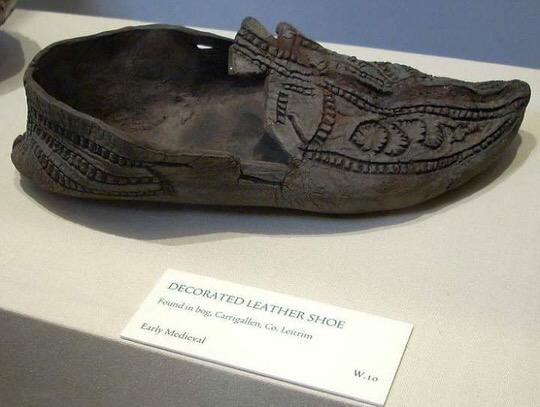
This is my favourite picture; some fancy footwear from medieval Carrigallen, found near the Ringfort in Kilahurk apparently.

  
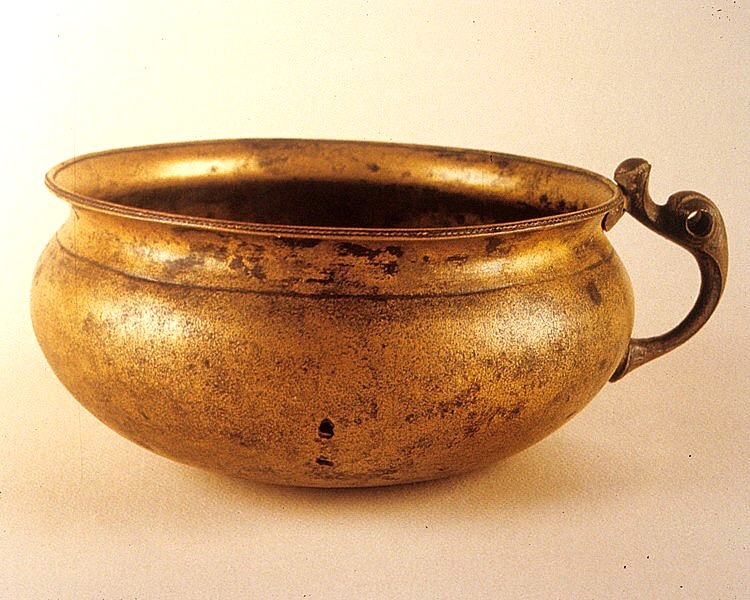
Of course one of the most beautiful pieces ever found in the County has to be the Keshcarrigan Bowl. 

  
The Facebook page goes on to say: 

“The Keshcarrigan Bowl …..discovered in Loch Marrave near Keshcarrigan village in 1854 during the original excavations of the Shannon/Erne Waterway . The vessel which may have been a ceremonial drinking bowl,is of fine golden bronze about 1mm thick and was formed by spinning. The handle which is cast ,is in the form of a bird . The eye sockets, now empty, probably held enamel settings . It is on display is in the National Museum”

The Bowl also appears on the wonderful Book and App entitled ‘History of Ireland in 100 Objects’ ,well worth a look http://www.100objects.ie

Leitrim is brimful of some great Archeaology both ancient and relatively modern from the 19th Century Lime Kiln at Farnaught to the portal tombs of Fenagh. Looking forward to future updates on this page.

A Sport in denial craving redemption – FIFA 2015

FIFA 2015

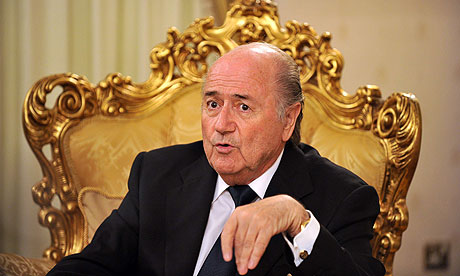
Joseph S. “Sepp” Blatter probably surprised a few people today by resigning from his position as President of the Fédération Internationale de Football Association (FIFA). The surprise comes from how bullish the man has been over the years. His resignation speech outlined the reason for going as being the fact that despite having the mandate of FIFA he feels he doesn’t have the support of everyone in Football. But if FIFA is the representative of World Football then surely this means that FIFA has little or no mandate at all. Yet in the rush to condemn FIFA we must be careful not to allow a vacuum be created that will be quickly filled by the rich and powerful in the game of which UEFA is in the vanguard.

Blatter has spent the last thirty-four years working at FIFA, initially as general secretary but since 1998 as president. He has been re-elected by the delegates from all over the world in 2002, 2007, 2011 and last week. What is unusual about his resignation is that it does not have immediate effect, but rather will only take effect when an extraordinary FIFA Congress is convened. This may take some time to convene. I sincerely hope there is no shredder in the office.

Sepp Blatter

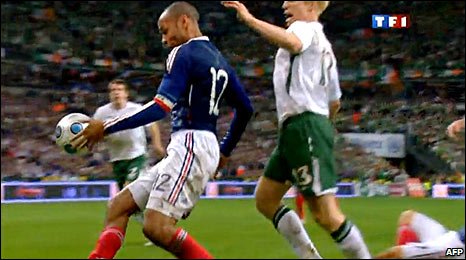
For a man who specialised in Public Relations for companies such as Longines, at times he has been a PR disaster. Blatter hasn’t been popular in Ireland, particularly since he made fun of Thierry Henry’s handball which enabled France score the crucial goal, ensuring that they, and not us, would be travelling to the 2010 World Cup in South Africa. The incident generated quite a bit of debate, mostly in European football, about fair play, introducing goal line technology and video refereeing but it all came to nought. It was well-known that Blatter was not a huge fan of such technology and in any event the World Cup might do without Ireland but it could not do without a potential 60 million TV viewers in France.

Thierry Henry

Henry admitted after the game that he had cheated. The incident was referred to the FIFA Disciplinary Committee for a ruling, but they held they had no power to sanction a player even though he had just admitted cheating in such an important game. FIFA reputation in Ireland fell even further when Blatter’s ‘off the cuff’ remarks about Ireland asking to be included as 33rd team for the tournament. Blatter laughed and joked about Ireland’s request which apparently had been alluded to in private discussions with the FAI and details of which should never have been aired in such a public manner. The FAI were scathing, their fans furious, at what was quite rightfully perceived as adding injury to insult.

But these are minor matters compared to what Blatter has presided over in FIFA with allegations of corruption ranging from whispers to outspoken claims of bribery involved in tournament selection. The award of the World Cup tournament to a country with no footballing tradition and  in the middle of an Arabian Summer was absurd and ludicrous. There will be a lot of eggs fried, for those lucky enough to have an egg, in Quatar in the summer of  2022.

Yet no one expected the end was so nigh for Herr Blatter. As Wodehouse wrote in Jeeves, “Unseen in the background, Fate was quietly slipping lead into the boxing-glove” It took the Americans to grab the bull by the horns and act once again as Global Policeman.  The arrest of seven FIFA officials was part hollywood, part judicial ambush but for all the showmanship there appears to be considerable substance behind the investigation conducted thusfar. 

In so many ways the Yanks have shown up Europe again as having no teeth or at the very least an unwillingness to force change no matter how compelling the allegations of wrongdoing. This is definitely one American led Regime Change which I will be wholeheartedly supporting.

………………………………………………………………………………

*It’s hard to believe it is 29 years ago this month that Diego Maradona broke English hearts with his famous ‘Hand of God’ goal at the Aztec Stadium. For whatever reason, I remember feeling okay about that particular goal. Yes it was cheating but it was Maradona and more importantly it was England. 

The little genius beat almost the entire English team a few minutes later to score one of the greatest World Cup goals ever and Argentina went on to win the Cup. The game had to be seen in the historical context of the Falklands War just four years previous and the Troubles on our own Island. Yet this was sport and this was cheating.

 I often wonder how I would have felt if it was Robbie Keane who had handled the ball at the other end in Paris in 2009, knocking it across to Doyler or Duffer to scramble it over the line. I’m quite sure if it had happened, I would  have come to terms with it, eventually, and by the time I was buying my vuvuzela outside the Soccer City Stadium the pangs of guilt would be well-forgotten. 

No Comment Needed

Sometimes words are not as compelling as a powerful image. So much like ‘Euronews’ I went for no commentary with this post. There really is no need and as the Latin saying goes ‘Res Ipsa Liqitor’, the thing speaks for itself. The images are from ‘People in Need’. 


Roscommon / South Leitrim: Bold Child or ‘Deliverance’ Country

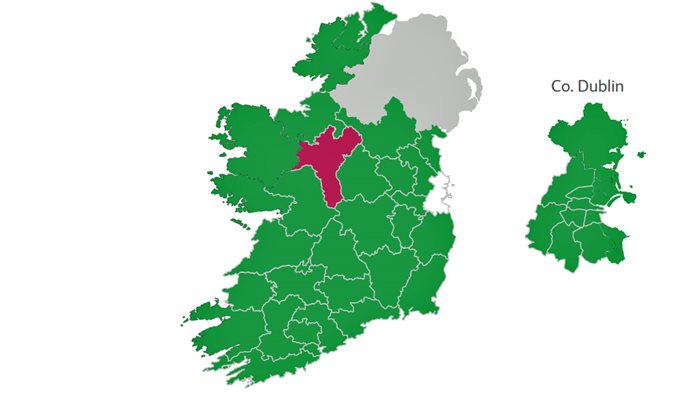
Referendum Map

Recently one of my children had a birthday party at our house. One of the adults asked them if they now felt older? The child appeared a little bemused before emphatically replying ‘No’. For the majority of people in this State the same applies to us today. Yesterday was a significant moment in our Nation’s history but it is hard for many to describe how this different new reality actually feels. Many of these same people voted magnanimously to extend the right of marrying the person they love to all citizens. Marriage is no longer the preserve of heterosexual couples and marriage will be simply defined as a union of two people based on the bond of love. Yet so much in our Country remains the same. The weather forecast for Ireland yesterday said that it would be sunny, with the rain spreading in from the West and patchy showers later in the afternoon. Strangely in a scene similar to that in the film ‘Grounghog Day’, the weather forecast for today also says that there would be sunny spells, followed by showers spreading from the West later. No change there then! But things have changed, dramatically, especially for the many supporters of what will become the 34th Amendment to our Constitution. Many will have woken up feeling that they are now living in a more tolerant, accepting society, a country that despite today’s weather forecast, will seem just a little bit warmer than it did yesterday.

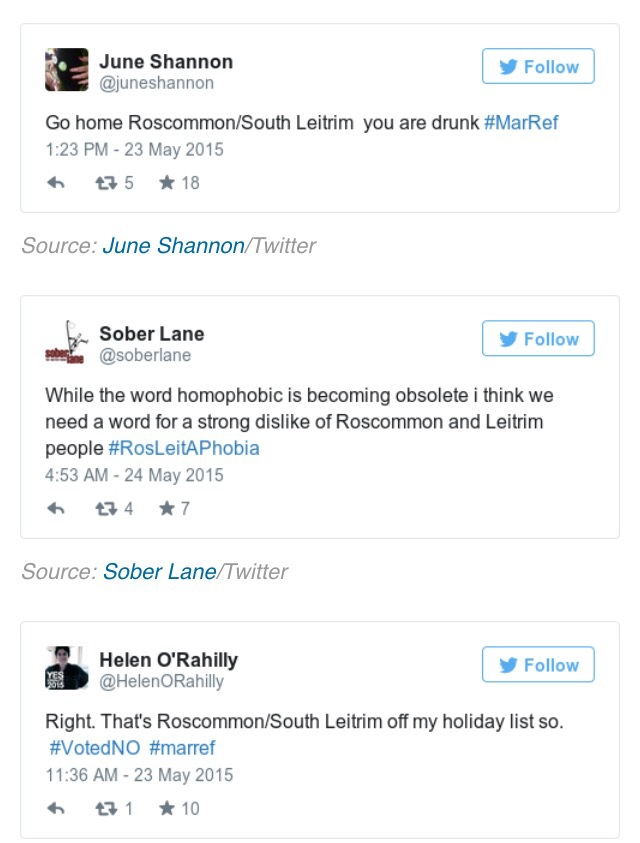
Except in Roscommon-South Leitrim that is, where many ‘Yes’ supporters are disappointed that their Constituency is the odd man / woman out by not voting yes to Marriage Equality. Outside the Constituency the response has been predictable enough. Twitterati and Facebookers are quick to point the accusing finger at those homophobic, medievalists that populate this area. Some of the comments are particularly uninformed and generic. One comment suggested people in the area were banjo-playing opportunistic rapists waiting for a ‘purdy mouth’ to come along. Comparing Roscommon-South Leitrim to ‘Deliverance’ country does not however cut as deep as to be ridiculed by one’s own. 

Many expats decried Roscommon and South Leitrim kinspeople for letting them down and spoiling the party. The comedienne, Katherine Lynch said that ‘Leitrim was dead to her’, but the Mohill native is known for being tongue in cheek, and I hope she is this time too. Others made quips about Roscommon seceding and joining Zimbabwe, more suggested that if the Referendum was about marrying cousins or farm animals, there would have been a better response. Most of the authors of such comments probably only did so for fun but the cumulative effect of this condemnation is to pillory and castigate a rural constituency where 48.52% of Voters actually supported the idea of Gay marriage. That is phenomenal figure yet many ‘Yes’ campaigners are quick to forget about those same people who made the effort to go out and vote for the same cause as them. Such an attitude seems bizarre and is surely the best recent example of throwing the proverbial baby out with the bathwater.

  In such a rush to chastise and cajole the Voters of Roscommon-South Leitrim it seems completely lost on the accusers of just how paradoxical their utterances are; especially in light of what they themselves were asking the people of Ireland to do last Friday. In doing so and in disregarding the right of a person to Vote in whatever way they wished, the accusers are themselves guilty of spreading intolerance, narrow-mindedness and prejudice. In many ways it spoiled some of the positivity that emanated from the result. Surely any accuser should wait and carry out a little analysis of why there was a higher percentage of No voters in this area than any other constituency.  Don’t  forget the referendum was carried by a slim margin of just 33 votes in Donegal North East and was in the low fifties in some other areas. Roscommon-South Leitrim is only unique because the bar is set at 50%, the simple majority rule , and it just fell short of that threshold. 

This is a predominantly rural community but its traditionalism and conservatism does not always stand up to scrutiny. Leitrim is home of one of the seven signatories of our Proclamation of Independence and a true social revolutionary, Sean MacDiarmada. It also is the birthplace of the socialist Jimmy Gralton, the only man to be deported from the country of his birth for his ‘radicalism’.  It is the home of John McGahern a paradigm of tolerance, respect and liberal values. Leitrim is also well known for its large Bohemian community of artists, writers and sculptors who have certainly made the area more diverse in both thought and outlook. So why is the area so out of kilter with the predominantly urban / sub-urban parts of the country. Firstly, I’d advise anyone who supports the lazy sterotyping of the constituents here as homophobic banjo players, to take a short tour through the Constituency and make a few notes on the following matters in particular;

  1. What do think of the vibrancy of the towns in the area? Are the high streets thriving?
  2. Did you meet many young people in the 18-35 age bracket?
  3. How did you travel by the way? Was it by public transport? Doubtful.
  4. How many flourishing businesses did you see?
  5. Make sure to bring bottled water (it’s a case of ‘water water everywhere but not a drop to drink’ in large areas here you cant even drink the tap water?
  6. Did it take you long to upload one of your barbed comments to your social media account? Seriously try it, the broadband here is terrible and satellite alternatives are expensive.

If you tried the above suggestions you’d invariably find many depressed market towns, some dead, some dying, others like Carrick-on-Shannon dependent on tourism and weekends of stag and hen parties. But when the stags and hens leave, and we clean up after them, nothing much has changed. There are very little employment opportunities in the area, most of the young people have left and one of the best barometers to confirm this is the local GAA clubs struggling to field teams. So what about those who are left? The majority are members of a demographic that the yes campaign had most difficulty connecting with throughout the country, nothing unique there. The difference is that a larger percentage of them reside here proportionally than in any other constituency. We have the oldest electorate, fact.

Not all ‘No’ voters in the area are part of this traditional, conservative group and the majority, I’m absolutely sure of this, are not homophobic. This is an area where the people are frustrated and disconnected from Government and Politics in general. Their communities are decimated by the loss of essential services; Rural post offices – Gone, Rural Garda Stations – Gone, Rural Scools and teaching posts – under threat,  Public Transport- almost non-existent with routes been cut by Bus Eireann annually. Oh and on your tour you will have noticed the motorway ended before Mullingar. The IDA rarely ever visits places like Leitrim, Longford and Roscommon and therefore he chances of major investment is slim. The largest employer in the north of the area, MBNA, is gone and despite all the assurances of Minister Bruton no replacement has been found. Those small and medium enterprises that do exist find they are hamstrung by poor infrastructure, especially the lack of adequate broadband. A mobile phone call usually involves leaving the house and finding a place of optimum coverage, maybe climb up on the roof or up a tree! Mental Health campaigners will confirm that the erosion of services has led the greater isolation amongst the elderly in the area, many of whom have had their home help hours cut back. The area also has had the highest rates of suicide in the country particularly amongst our young people. When people talk about Equality do they factor these issues in to the equation. 

Many will say these issues have nothing to do with the Marriage equality Referendum but such a view is foolish and naïve. The Voters in this area are completely disconnected from National Government and detached from the prevailing messages of the mainstream Dublin based media. They are chastised now as bold children who did not do what they were expected and urged to do. That is precisely the point, a community that has been neglected so much in terms of investment, both socially and economically will also be prone not to toe the establishment line. And let’s be absolutely clear, whatever about past prejudice and mores, supporting same sex marriage is the establishment view and was advocated by all the main political parties. 

It is in such an environment as exists in Roscommon and South Leitrim that induces the people to elect people such as Ming Flanagan and Michael Fitzmaurice, two men who many in polite society on this Island would consider square pegs in the neat round holes of Dail Eireann. Yes campaigners will also say that the vote in traditional working class areas was high but all this shows is that rural and urban deprivation are two different creatures altogether. This constituency and its people are rooted in the soil, its towns developed to serve the farming hinterland in a symbiotic model. Now both are in decline and nothing is been done to address it. The influence of the church is also a red herring. There are hardly any vocations now for the priesthood in this area no more than Dublin or Cork or any of the cities and mass attendances have dwindled. The voters here are as likely to react negatively to Mother Church telling them ‘Vote No’ as to the Taoiseach telling them to ‘Vote Yes’.

Despite all the foregoing almost half of the people who voted in Roscommon South Leitrim voted YES to change, Yes to a more inclusive society for members of the LGBT community. That is something the YES keyboard warriors should be celebrating and instead of pulling the plug and letting their own children flow out with the bathwater. Many people from the area who would be voting ‘Yes’ now live in other parts of the country and contributed to the Yes campaigns and votes in those areas. In the run up to the election many ‘Yes’ campaigners told us this Referendum was about promoting tolerance of difference and respect for minorities. Surely then if the accusers are genuine and honest, they should extend the same respect to the people of Roscommon South Leitrim who simply didn’t agree with them, something which it is their hard won, Constitutional right to do so. As Evelyn Beatrice Hall famously wrote ‘.   “I disapprove of what you say, but I will defend to the death your right to say it’. 

The only way of depicting the Roscommon South-Leitrim result as indefensible is to portray the constituents as backward, conservative zealots and such a strategy diminishes the core and heart of what was achieved by the ‘Yes’ campaign in this Referendum. So a huge sorry from us for not being above-average and being 13% behind the average test score nationally. Feel free to go ahead and bully us on the internet. At least Marian Keyes had the decency to apologise but insults are like toothpaste, once out its impossible to get it back into the tube.

SUPPING AND GLAMPING

Shannon-Blueway-TourismShannon_blueway_icon

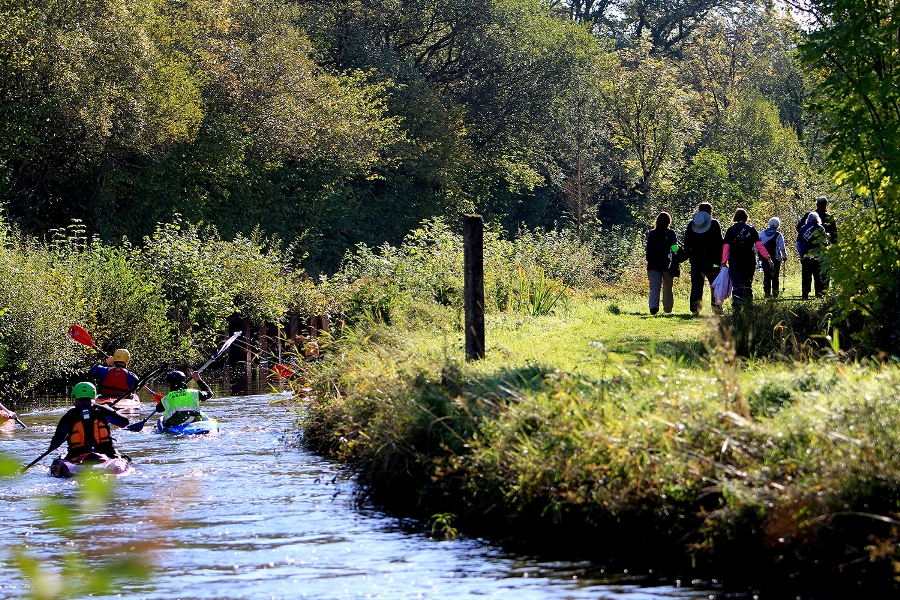
A few years ago many of us would not have known what terms like Glamping or Supping meant. The cousin, JP, thought Glamping was a nocturnal activity himself and Eddie Joe did at the weekends with a large spotlight attached to the bullbars of his jeep, scanning the bogs for Foxes.  So you can imagine my surprise when JP announced recently that he and ‘the woman’ were SUPping over in Drumshanbo at the weekend. Being old school I thought supping was something JP did whilst shouting at a TV screen in the local whilst elucidating on the performances of his ‘beloved’ Everton. For JP, until now that is, a good sup, usually consisted of 8-10 pints of Smithwicks. This time though JP wasn’t having me on, he had just spent a few leisurely hours paddling down a canal in what is now known as Leitrim’s Blueway.

The Shannon Blueway is in fact the first of its kind in Ireland, an inland series of  water and land based trails. It facilitates paddling from Drumshanbo to Carrick-on Shannon via Battlebridge and Leitrim Village. JP isn’t the only one raving about it, numerous Travel Writers and journalists are focussing in on places like Leitrim and initiatives like the Blueway. In the coming years we will likely see the development of a number of Greenways in the County. One of these planned Greenways will traverse North Leitrim from Dromahaire to Glenfarne on the route of the old Sligo-Leitrim and Northern Railway. Another Rail Trail is planned for South Leitrim running from Mohill to Belturbet in Cavan along the former route of the Cavan-Leitrim narrow gauge railway. All of these projects are wonderful and all hope to emulate the success of the Greenway in Mayo.

I decided to investigate at the weekend and although it was damp and cold I was well wrapped up by the time I got out of the Jeep at ‘Beirnes of Battlebridge’. Set on the banks of the River Shannon, there is a charming caravan and camping park her, set in natural sylvan surroundings. The Pub at Battlebridge has being in the Beirne family for generations. The place was one of Ireland’s best kept secrets until the charming rural retreat was the proud recipient of several awards, including: Black & White Pub award and Irish Pub of Distinction. In 2014 Beirnes was nominated by “The Irish Restaurants Association” for “The best gastro pub award”. The Caravan and Camping Park has standard pitches as well as the opportunity for some Glamping and has been listed as one of the “10 best Irish camp-sites” by the Irish Independent. You can even do a bit of paint ball shooting here.

Battlebridge has in fact two bridges, one crosses the Canal and the other the Shannon itself. The Canal was built as to assist navigation south of Drumshanbo and I head for a walk that starts between the Canal and the river. The walk is a loop walk to Drumhauver. It is a pleasant walk and like all canal-side trails is easy going due to the level ground. The sun is starting to dip in the west and I can see the Shannon to my left and its flat ‘calloughs’ fields and plenty of ‘pools among the rushes’ as Yeats wrote. The halfway point is a set of locks at Drumaleague. Here the frost laden crest of Sliabh an Iarainn comes into view, it’s white crown unseasonal but not unprecedented.  The turning point in my walk is Drumhauver Bridge and I take a break after walking for an hour at this stage.  I have met a score of people walking on the canal bank both visitors and locals I surmise. The lack of fitness begins to tell on the southern return leg. At Drumaleague I am like a marathon runner who has hit the infamous wall. I curse my over-confidence but struggle on, get a second wind, and in the fading light I reach Battlebridge again. I reward myself with the wonderful restorative properties of a pint of plain in Beirnes. Whilst I didn’t meet any SUPpers enroute I can appreciate that a paddle down the canal from Drumshanbo to Carrick-on-Shannon is on my to-do list for when the long evenings ahead. There are certainly many more activities such as trails and walks in Leitrim these days as we strive to attract those interested in activity based holidays. Great credit is due to the Leitrim Development Company, Leitrim Tourism and funds such as Leader and the Rural Development Programme (RDP) which have provided practical advice and financial resources to people interested in developing tourism focussed projects.

Recently, Pol O’Conghaile, the Travel Writer wrote a heart-warming article in  the Irish independent setting out Ten Great Reasons to visit Leitrim. Pol opened with “It’s small, off-radar and home to just 32,000 souls. But Leitrim packs a serious punch… and lots of surprises for the visitor” and went on to list the County’s Literary connections, its natural beauty spots, adventure breaks, award winning restaurants and describes the place as an ‘adventure Eden’ and ‘walkers paradise’. The article went mini-viral and was shared, mostly by Leitrim residents and ex-pats, although few in number, we Leitrim folk are very proud of our little corner of God’s creation. The article had the capacity to instil a pride in a person’s home place in the way that a parent feels  all gooey inside when their young daughter wins first prize at the local feis. I was no different, anybody who reads this blog will quickly realise that for me Leitrim is one of the loves of my life. Hopefully such articles will be read by more than just sentimental Leitrimites around the world. Come visit we’re open. 

http://www.independent.ie/life/travel/ireland/10-great-reasons-to-visit-leitrim-30739767.html

MATTHEW SADLIER – Leitrim’s ‘Titanic’ victim remembered

titanic_ship-1920x1080

April can be considered ‘Titanic Month’ for even though the famous liner sank to the sea floor 103 years ago, people’s fascination with the story shows no signs of diminishing. Titanic is the ultimate story that just keeps on giving: it is romance, and tragedy, there are heroes and villains, there is superstition and most of all the folly of man underestimating the power of nature.

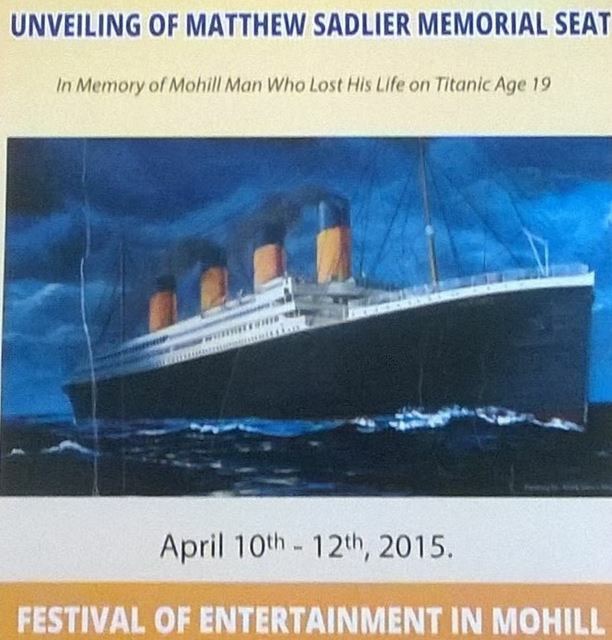
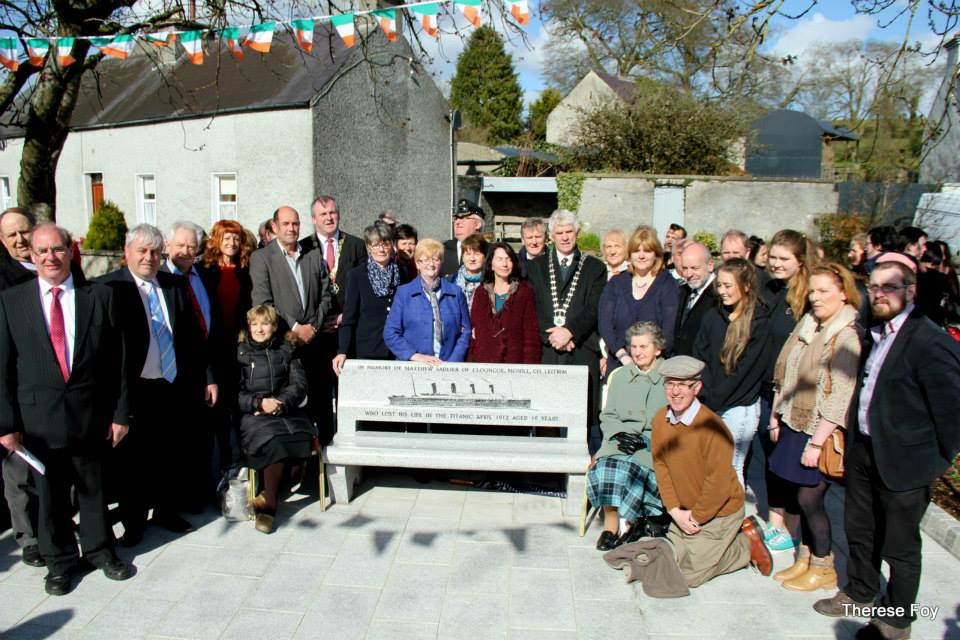
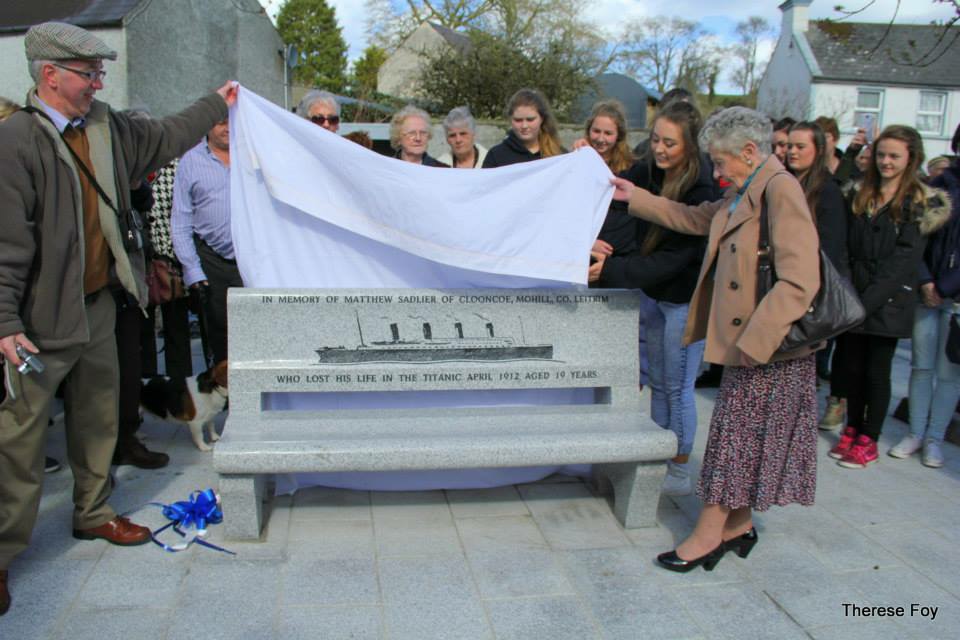
This month a small town in the North West of Ireland took centre stage as its own connection to the Titanic disaster was recalled and a commemorative seat unveiled to its own maritime victim. Mohill is the home of Matthew Sadlier a 19 year old lad who set out for New York to start a new life for himself. Over a year ago a Committee was set up in the town involving the local youth group, Foroige. They were joined by some more experienced hands and they got to work preparing a plan to commemorate the life of young Matt Sadlier. They decided upon a commemorative seat to be located in a prominent position in the town and also set out to contact any living relatives of Matthew. The Committees work came to fruition in a wonderful weekend of events associated with the Titanic, the highlight of which was the unveiling of the memorial in a newly renovated plaza.

IMG_1837

Who was Matthew Sadlier?

Matthew was born in 1892 to Matthew & Catherine Sadlier at their house at Clooncoe on the shores of beautiful Lough Rynn. The house was located on the famous Lough Rynn Estate, home of the Clements family, the Earls of Leitrim. The Sadliers were members of the Church of Ireland and Matthew was baptised at Farnaught Church on the 8th October, 1892. Matthews Civil Birth Record shows his birth was recorded just over two weeks later on the 26th October. The Civil Record gives his date of birth as the 8th October also, the same date as his baptism, something which seems extraordinary today. The informant is Dr Henry Pentland from Mohill who it says was present at the birth. This would suggest that Matthew may have been brought to the baptismal font on the same day as he came into this world. The fact that the Sadlier home is located so close to Farnaught Church means this would not have been a long journey but would have been, at the very least, be a great imposition on poor Catherine. Matthew Seniors occupation is recorded as an Agricultural Labourer. Catherine’s occupation is not given but as she was to bear Matthew Senior 9 children, 7 of whom would survive infancy, it is likely all Catherine’s time was taken up with child rearing and keeping house.

Matthew and Catherine did not always live at Lough Rynn. They married on the 25th February, 1881 at St. Marys Church of Ireland, Mohill. The church is reputedly built on the site of the original monastery, Maothail Manachain which was the precursor to the modern town of Mohill. The founder of the monastery was St. Manachan and his feast day is the 25th February, the same day that Catherine & Matthew Senior took their vows.

Matthew Senior and Catherine were both born in the same townland on small tenant farms just a mile west of the town of Mohill. Matthew Seniors father was Henry Sadlier, who was born circa 1810, but unfortunately the location is unknown. As well as farming his small holding Henry also for some time was a weaver. The fact that he was engaged in weaving might suggest that the family may have migrated to Leitrim from a more north eastern location where the linen trade was predominant. Henry Sadlier died on the 25th November, 1885 at the age of 75. He was buried in Mohill Church of Ireland Cemetery and we also know he died a widower, his wife having predeceased him. Present at his death was a Sarah McCombs.

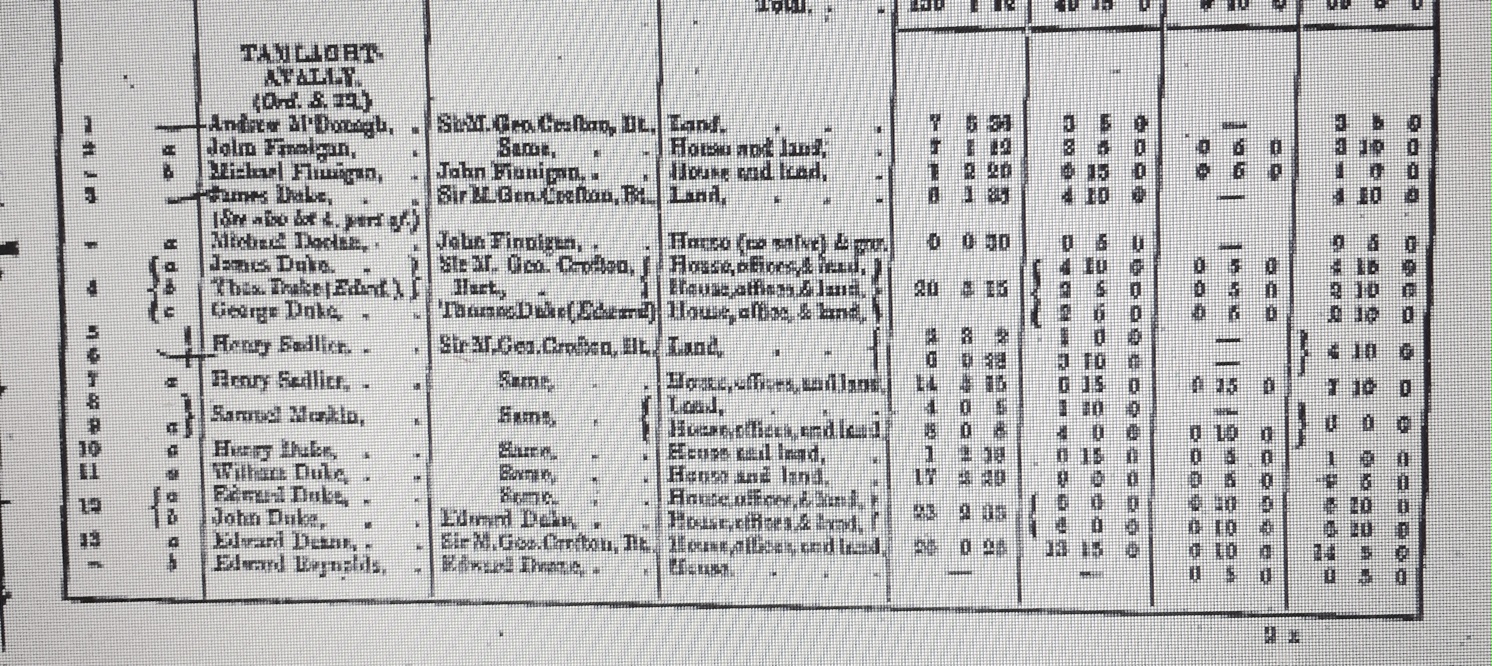
Griffiths Valuation (1857) shows Henry as holding a tenancy on the Crofton Estate in the townland of Tamlaghtavally. His holding is just shy of 15 acres in size which would have been well above the average holding in the area at that time.

 Tamlaghtavalley 1857 Griffiths

Sadlier Holding No’s 5,6 & 7 Tamlaghtvalley, Mohill, 1857.

 Catherine Sadlier, the mother of tragic Matthew, was born to Thomas and Anna Duke, also in Tamlaghtavally, Mohill in 1852. She was baptised in St.  Marys Church of Ireland on the 22nd December that year.

The 1901 Census will show Matthew Senior and Catherine Sadlier living in Clooncoe with their 7 surviving children Thomas (19), William (18), Jane A (16), Fanny (15), Henry (11), Kate (9) and young Matthew (8). 10 years later when the enumerators called again to the Sadlier household only Kate and Matthew remained at home. Catherine would go on to marry a William Boddy and live out her days in Mohill.

William the second eldest appears to have been the first of the Clooncoe family to cross the Atlantic circa 1904. The following year, the elder brother Thomas made the crossing, stating on the ship manifest that he was travelling to William at 49 Grove St., New York.

It is clear that young Matthew was intent on joining his siblings in America as soon as he possibly could. Matthew purchased a 3rd Class ticket (Ticket No. 367655 , £7 14s 7d) on the White Star Line to New York. It was a considerable sum of money at the time. Senan Maloney recounts some local lore about Matthews final days in Clooncoe;-

‘His parents didn’t wish him to leave , his mother being particularly attached to her youngest, having already see offspring William, Thomas and Fanny take the American boat. On the morning he was to leave, a cockerel came to the doorstep and crowed three times. His mother, seizing on superstition for her own ends, declared,‘That’s enough now!’ grabbing Matthews suitcase from his hand. It was unspoken knowledge that a cockcrow at the door meant sad news. Matthew patiently retrieved his case from his mother’s grasp, said farewells and went about his journey’[i]

Matthew made the long journey to Cork and then boarded the illustrious liner ‘Titanic’ embarking from Queenstown, Co. Cork on Thursday the 11th April, 1912.

Catherine Sadlier had already lost 2 children out of the 9 she brought into this world. Another local tale recalled by Maloney tells of a man called Easterbrook who was cycling home at night on the long sylvan Avenue leading to Lough Rynn House. This man claimed he met the ghost of Matthew Sadlier’s sister who had predeceased him. The ghost’s hair was dripping wet as if it were submerged in water. With fright he lost his balance and when he regained his nerve the ghost was nowhere to be seen. Apparently when this apparition occurred word had not yet made it to Leitrim that the ‘Titanic’ was lost.

In an interesting postscript, on the 25th September 1922 Matthew Sadlier Senior leaves Mohill and headed for New York on board the ‘Cedric’ of the same White Star Line that owned the ‘Titanic’. He purchased his ticket through Thomas J. Gannon Agent in Mohill and boarded at Liverpool. His next of kin is stated to be his daughter Mrs William Body of Tawlaghtavalley, Mohill and he was travelling to his son Thomas Sadlier of Fairfield, Connecticut. Matthew Senior arrived in New York 2nd October 1922.

For Matthew Junior there is no burial plot but the sea, his body if ever found has never been identified. Thanks to the Matthew Sadlier Committee there is however a place to remember him and to contemplate the incredible tragedy he was destined to become part of. The memorial is just a few feet from the final resting place of his dear sister Kate, to whom he was so close too. When you see the beautifully crafted seat commemorating Matt Sadlier you cannot but think of the words of Patrick Kavanagh.

“O commemorate me where there is water,

Canal water, preferably, so stilly

Greeny at the heart of summer. Brother

Commemorate me thus beautifully”[ii]

Committee IMG_1827

[i] Senan Molony ‘The Irish onboard the Titanic’ Mercier Press (October 24, 2012)

[ii] Lines Written on a Seat on the Grand Canal, Dublin -Patrick Kavanagh © Estate of Katherine Kavanagh

If destruction be our lot – the tragedy of Civil War


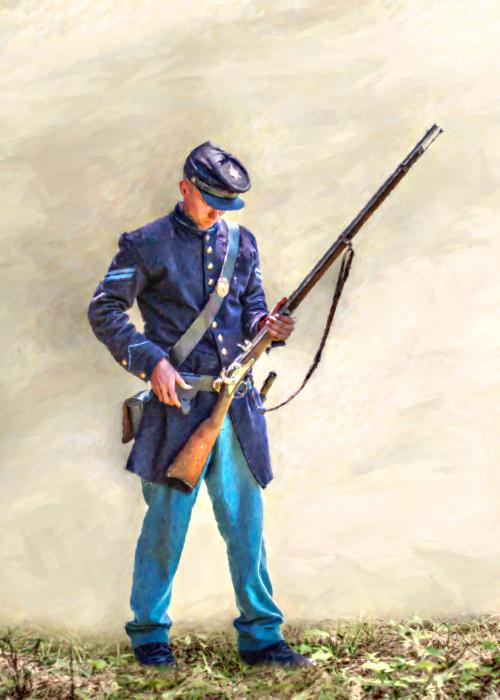
Union Soldier reloading by Randy Steele

Union Soldier reloading by Randy Steele

I have always had a great interest in the American Civil War. As a boy I read plenty of material about the conflict. Lincoln was almost as big a character as his outsized memorial in Washington, from his humble origins, to his powerful oratory at Gettysburg, and finally his dramatic and tragic death. More is known in Ireland about the American Civil War than our own similar bloodletting 90 years ago. Part of the reason for this is how the american conflict is perpetuated in popular culture. In the mid 80’s we watched the ‘Dukes of Hazzard’ with a Confederate flag emblazoned on the roof of the iconic 1969 Dodge Charger, better known of course as the ‘General Lee’. One of the big TV hits at the time was a mini-series called ‘North and South’ starring a young Patrick Swayze.  The saga tells the story of the enduring friendship between Orry Main born into a South Carolina planter – slaveowning family, and his friend George Hazard from a Pennsylvanian mill owning family. The pair had become best mates while attending West Point. Soon they find themselves and their families on opposite sides of the Civil War. One bi-product of watching the series was that I perfected my pronunciation of Charleston in a southern drawl, “Chawstunh”.

It was with great surprise that I later learned that my Grandfathers uncle had fought on the Union side. Recently arrived in the US he and his two sisters headed from New Orleans up the Mississippi to a riverside town in Illinois. It was an exciting time along the busiest river highway in the world. It was the world recreated in the fiction of Mark Twain, inhabited by characters like ‘Puddenhead Wilson’ and ‘Huckleberry Finn’. In the summer of 1862 my great granduncle voluntarily joined the 84th Illinois Infantry. Why a recently arrived immigrant would join a fight which really wasn’t his fight is a mystery but thousands of young men like him did the same. In a few months the new recruits were fighting their way through Kentucky and into Tennessee. There my uncle came a cropper in the fields around the town of Murfreesboro on New Years Day, 1863. Luckily he survived and after a few months was back with his regiment in the hell fire of Chickamauga and Chattanooga. Finally the Union broke into Georgia and split the Confederacy in half. My Great Granduncle wasn’t part of the infamous drive by Sherman to the sea. Instead his regiment headed back towards Tennessee via Huntsville, Alabama. There were some final battles but the end of the war and victory was in sight. My Great Granduncle returned to Illinois where he was to marry, raise a family and where he now lies resting in the cemetery at Keithsburg.

In reading about the American Civil Wat, I happened upon this sad tale recently. Civil War, as we well know in this country, can literally tear a family apart, pitting brother against brother or father against son as each rallies to the flag of the cause that captured his heart. As Lincoln said at the outset, “if destruction be our lot we must ourselves be its author and finisher”. There is no more dramatic evidence of this than the encounter that took place on the American Civil War battlefield at Malvern Hill July 1, 1862. Captain D. P. Conyngham was an officer in the Irish Brigade and described the incident shortly after the war:

“I had a Sergeant Driscoll, a brave man, and one of the best shots in the Brigade. When charging at Malvern Hill , a company was posted in a clump of trees, who kept up a fierce fire on us, and actually charged out on our advance. Their officer seemed to be a daring, reckless boy, and I said to Driscoll, ‘if that officer is not taken down, many of us will fall before we pass that clump.’

‘Leave that to me,’ said Driscoll; so he raised his rifle, and the moment the officer exposed himself again bang went Driscoll, and over went the officer, his company at once breaking away.

As we passed the place I said, ‘Driscoll, see if that officer is dead – he was a brave fellow.’

I stood looking on. Driscoll turned him over on his back. He opened his eyes for a moment, and faintly murmured ‘Father,’ and closed them forever.

I will forever recollect the frantic grief of Driscoll; it was harrowing to witness. He was his son, who had gone South before the war.

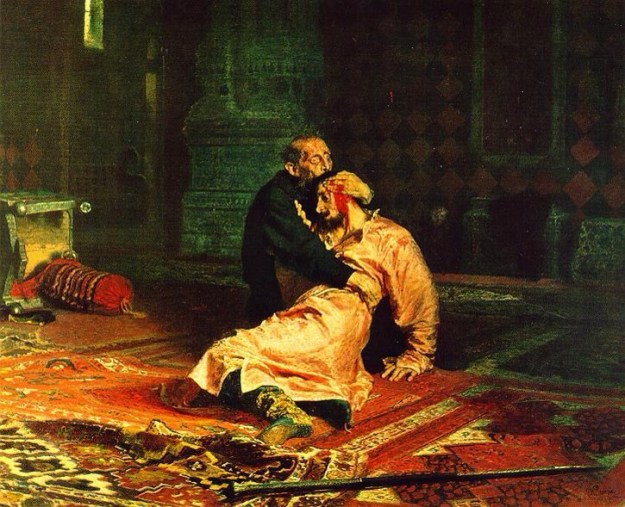
  Ivan Terrible after killing his son

And what became of Driscoll afterwards? Well, we were ordered to charge, and I left him there; but, as we were closing in on the enemy, he rushed up, with his coat off, and, clutching his musket, charged right up at the enemy, calling on the men to follow. He soon fell, but jumped up again. We knew he was wounded. On he dashed, but he soon rolled over like a top. When we came up he was dead, riddled with bullets.”

Bishop Edward O’Rourke and the Nazis of Danzig

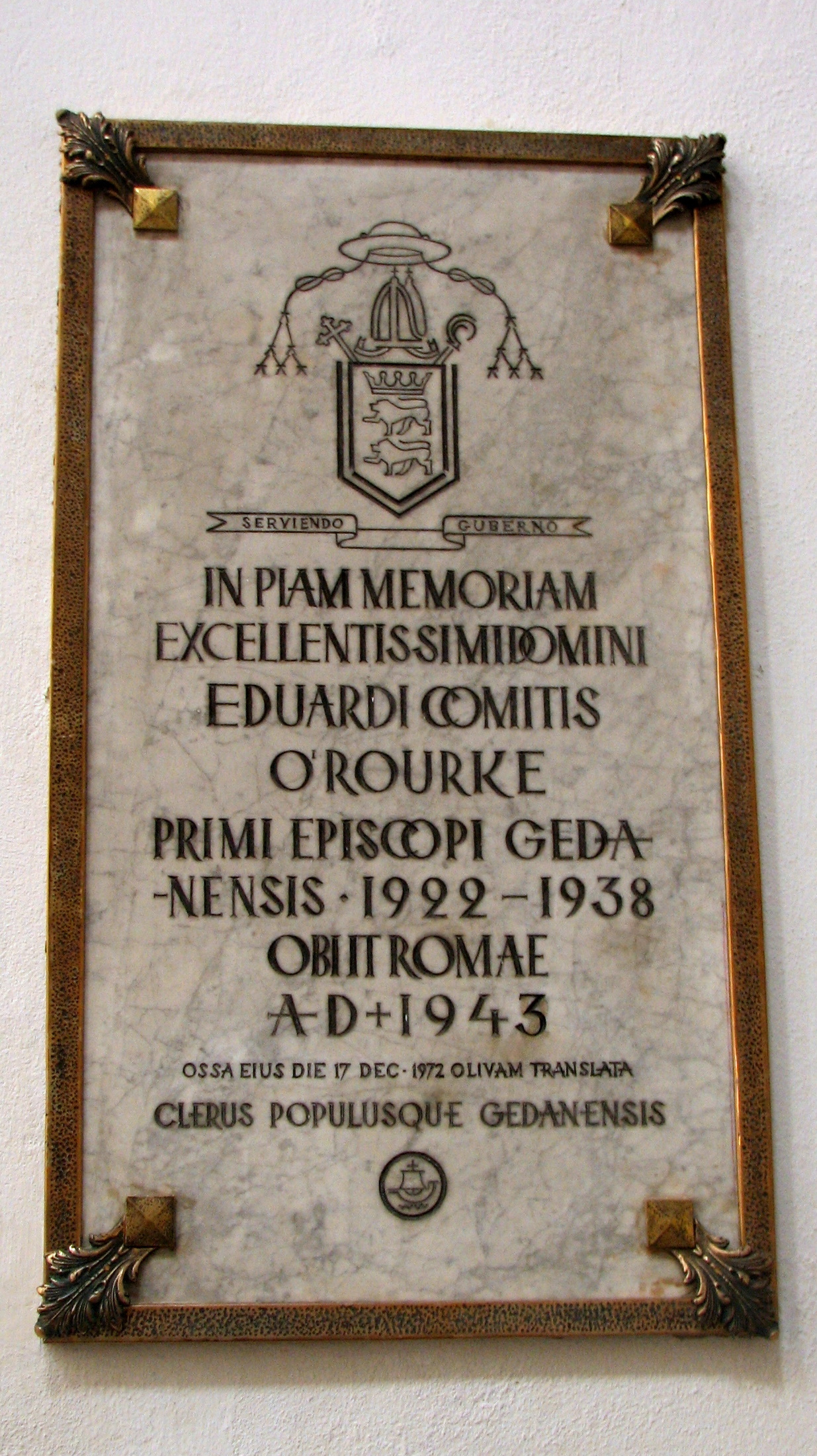
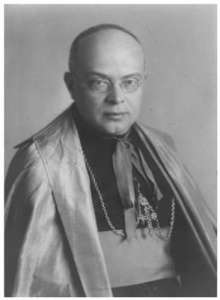
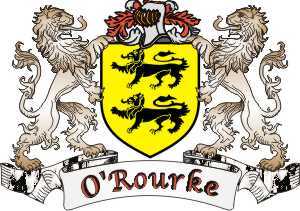
Bishop Edward O'Rourke 2O'Rourke_coat_of_arms_large

Count Eduard Alexander Ladislaus O’Rourke was born October 26, 1876 in Basin near the city of Minsk in modern day Belarus. At the time the area was part of the Russian Empire and the O’Rourke’s were an aristocratic family. They had large estates acquired no doubt on the basis of several generations of loyal and successful military service to the Czars. Edward’s father was Michael Graf O’Rourke and his mother a Angelika von Bochwitz who was of Baltic-German descent. The O’Rourkes had never forgotten their Irish and Leitrim Heritage and had petitioned the Czar to retain their Irish Titles

Leitrim Heritage

Eduard was a direct descendant of Ualgarg Mor Ui Ruairc of Breifne. Ualgarg’s descendants became known as the O’Rourkes of Clooncorrick and they were the major landowners in the modern Barony of Carrigallen in East Leitrim on the Cavan border. The O’Rourkes were greatly reduced in both wealth and influence from the end of the nine years war 1594-1603 but the O’Rourkes of Clooncorrick retained much of their lands until after the Cromwellian Conquest of Ireland in the early 1650’s. In the ensuing land confiscations many of the O’Rourkes fled to the continent with many of them achieving fame on the bloody battlefields of Europe.

Brothers Brian, John and Cornelius O’Rourke, were grandsons of Count Brian O’Rourke of Cloncorrick Castle. According to Anthony Kudryavitsky:-

‘John was born in 1728 in a village near the ancient castle of Woodford. At the age of twenty-five he left Ireland for London and entered the military service. He remained in the English capital for about five years, experiencing many disappointments, but ultimately fixed on the military profession as the best suited to his genius and disposition. In the First Tropps of Horse Guards he received the rudiments of arms; however, being a Roman Catholic, he was forced to resign.

John O’Rourke then went to France. Travelling to Versailles in 1758 he petitioned King Louis XV for a military commission, specifying his princely origin and praying for a regiment. The impressed King had O’Rourke installed as the Captain of the ‘Royal Scotch’ Brigade, much to the chagrin of the French officers. As a few instances of irregular promotions had been made in the brigade, the lieutenants were hurt at his appointment and resolved to contest the matter with him.

Challenged by a number of these enraged officers, John O’Rourke was forced to demonstrate his regal military deportment in a series of fencing duels, four in two days. He emerged victorious in all those duels and so gained a great reputation – not more by his gallantry in the field, than by his honourably confessing that he thought it an injury to the national regiment that he as a foreigner should be thrust upon them. He therefore gave up his commission, informing the French monarch that it was too dear a purchase to fight for it every day. After receiving a certificate of recommendation from the French King he was off to Russia and the court of Tsarina Elizabeth 1 in St. Petersburg.

In Russia John O’Rourke met up with his younger brother Cornelius, who like himself had emigrated from Ireland in search of a foreign military career. Cornelius was as regal minded as his brother and had allied himself dynastically in marrying the niece of Count de Lacy, descendant from the Norman Co. Meath family and a field marshal in the service of Austria. Both O’Rourkes became prominent Russian military leaders. They retained their titles of Irish Counts as they entered the Russian military service.

John O’Rourke finally demonstrated his military prowess during the siege of Berlin. In 1761 he was appointed First Major of Horse Cuirassiers in the regiment of Body Guards. During the course of the war he greatly distinguished himself, in particular, by storming the City of Berlin, which he laid under contribution. When the war with Prussia was over, word reached O’Rourke that the Prussian King, Frederic the Great, impressed with his gallantry, sought his counsel.

Advised by his fellow Russian officers not to go to this meeting with the enemy, O’Rourke remarked that “A man who was a brave enemy could not be a dangerous friend.” So he picked his way towards Berlin where he was graciously received by Frederick and presented with a diamond-studded sword. Frederick inquired how the Count could possibly have believed he could defeat Berlin, to which O’Rourke replied, “If ordered by my commanding officer to storm the heights of Heaven, I would have made the attempt.”

At the end of that war John O’Rourke returned to France with certificates of his gallant conduct from Peter the Third, Prince-General Volkonsky, and Prince-General Souvorov. He was appointed by King Slanislaus as one of his chamberlains in the year 1764. In 1770 he was appointed a Colonel of Horse by the French King and was enrolled among the nobility of France. He was also granted a pension from the French civil list and in 1774 was honoured with the order of St Louis.

John O’Rourke eventually returned to London and published his ‘Treatise on the Art of War’ and attempted to secure a position among the English military elite. The English however, were not as susceptible to O’Rourke’s charms and he was viewed with much suspicion despite being introduced to the King by Lord Stormont himself in 1779. The English doubted O’Rourke’s credentials forcing the Count to produce his now large collection of titles and certificates of regality. He, in turn, was disdainful of those he termed ‘the upstart families of England’; however, he was nevertheless made a Knight by them in 1782, four years before he died. Upon his death in 1786, a large obituary appeared in The London Times, highlighting his career. Before that, The Hibernian Magazine for March, 1782, published a picturesque description of some incidents in his life.

John’s brother Cornelius remained in Russia where he was made first a Captain, then a Colonel of Horse and finally a General Major. His son Joseph (Josif Kornelievich) O’Rourke was born in 1772 in Dorpat, Estonia. His portrait hangs in the Hermitage in St. Petersburg.
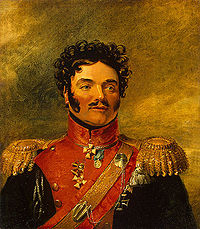
O'Rourke Joseph Cornelius

General Joseph Cornelius O’Rourke

According to Kudryavitsky:- “Being enlisted in his childhood into the elite Izmailov life-guards Regiment in the rank of sergeant, Joseph O’Rourke started his actual service as a Captain (Rotmistr) of cavalry in 1790.He took part in the Russian-Swedish war in Finland and later in the campaign against the Polish Confederation. At first he served in the Pskov Dragoon Regiment but in 1797 he was transferred to the famous Pavlograd Houssar Regiment. In 1798, he became a Major of same regiment.

During the Italian Campaign of General Souvorov he participated in the battles at Austerlitz and Praslau where he greatly distinguished himself and was soon made a Colonel. His service record was adorned with numerous awards. In 1805 he was decorated with St George Order (the 1st level), five years later he was awarded the St Anna Order. Between 1809 and 1812 Joseph O’Rourke took part in the war with Turkey and was appointed commander of a cavalry corps. In 1812 he was entrusted to command the vanguard of the Western Army. He led the cavalry in pursuit of the remains of ‘The Great Army’ from Biarezina to Kouna and Warsaw. For his part in the battle of Leipzig he was made General-Lieutenant and decorated with Order of Alexander Nevsky.

During the Congress in Vienna he was, in the suite of Tzar Alexander 1, amongst the most distinguished Russian generals. Soon he was helping to ensure Napoleon’s demise at Waterloo. In 1819 General O’Rourke retired and subsequently settled down in Navahradak region of Minsk province. He was quite a prominent landowner in Byelorussia and had in his possession about 20,000 acres of land including a small town called Usialub and five villages”.

The Population Census of 1858 stated that his family owned 236 serfs. In 1848 he petitioned Tsar Nicholas 1 for permission to retain the title of Irish Count. The Tsar granted the title to him and his descendants in November 1848. In December 1897, Tsar Nicholas II confirmed that the O’Rourke family of Byelorussia were entitled to be called Irish Counts. By the time Joseph O’Rourke’s died in 1849 all of his sons had thriving military careers. The volume “Titled Nobility of Europe” lists the officers Major Alexander P O’Rourke, Lieutenant Patrick A O’Rourke and Lieutenant Constanine M O’Rourke as serving in the Russian Imperial Army. Apparently, it was Lt. Patrick O’Rourke to whom John O’Donovan was referring when he wrote, “It is curious to see how this fallen Irish family has found its proud level in the present Prince O’Rourke of Russia.” Documents regarding the military service of this family can be found in the famed Hermitage Museum in St. Petersburg and also in military archives in Vienna.

Early Life & education

The young Edward would have grown up in a multi-lingual environment and it is likely that his first language would have been German. He attended the famous Jesuit College in Chyrów (then in Austria-Hungary, now modern Ukraine).. In 1903 he graduated from the Trade and Mechanics Faculty of the University of Riga In 1903 he moved to Freiburg, Switzerland where he continued his studies at the University’s faculty of law. The following year O’Rourke moved to the theological faculty at the University of Innsbruck in Austria-Hungaria.

On October 27, 1908 he was ordained a priest in Vilna (Vilnius, Lithuania) and became a professor of ecclesiastical history, German and French language at the seminary of the Roman Catholic Archdiocese of Minsk-Mohilev in Saint Petersburg Between 1912 and 1915, he became the priest of the multilingual congregation of St. Stanislaus in Petersburg.

 Religious Life

After the February Revolution in Russia, the church decided to re-establish the diocese of Minsk; O’Rourke was appointed as its administrator and the interim head of the Catholic Church in Russia. He met Achille Ratti for the first time, the Apostolic Visitor for the Baltic Countries and later, Pope Pius XI. Due to the proposed independence of Latvia, in 1918 the diocese of Riga was established. O’Rourke was appointed the bishop of Riga on recommendation of Ratti on 29 September 1918.

O’Rourke’s position in Riga was problematic as German forces occupied the city in early 1919.[1] By the end of World War I, the ecclesiastical organisation was largely destroyed, and only a few priests were active. O’Rourke did not speak Latvian but tried to encourage Latvian priests. He resigned after a new government in Latvia was appointed and there was a popular movement calling for an ethnic Latvian bishop. Released from Riga in April 1920, O’Rourke was appointed the titular bishop of Canea and Apostolic Delegate for the Baltic States. In November 1921 he was also appointed as the Pontifical Delegate for Russian refugees in Danzig and East Prussia, and in 1928 for Russians in Germany.

Danzig 1920-1939

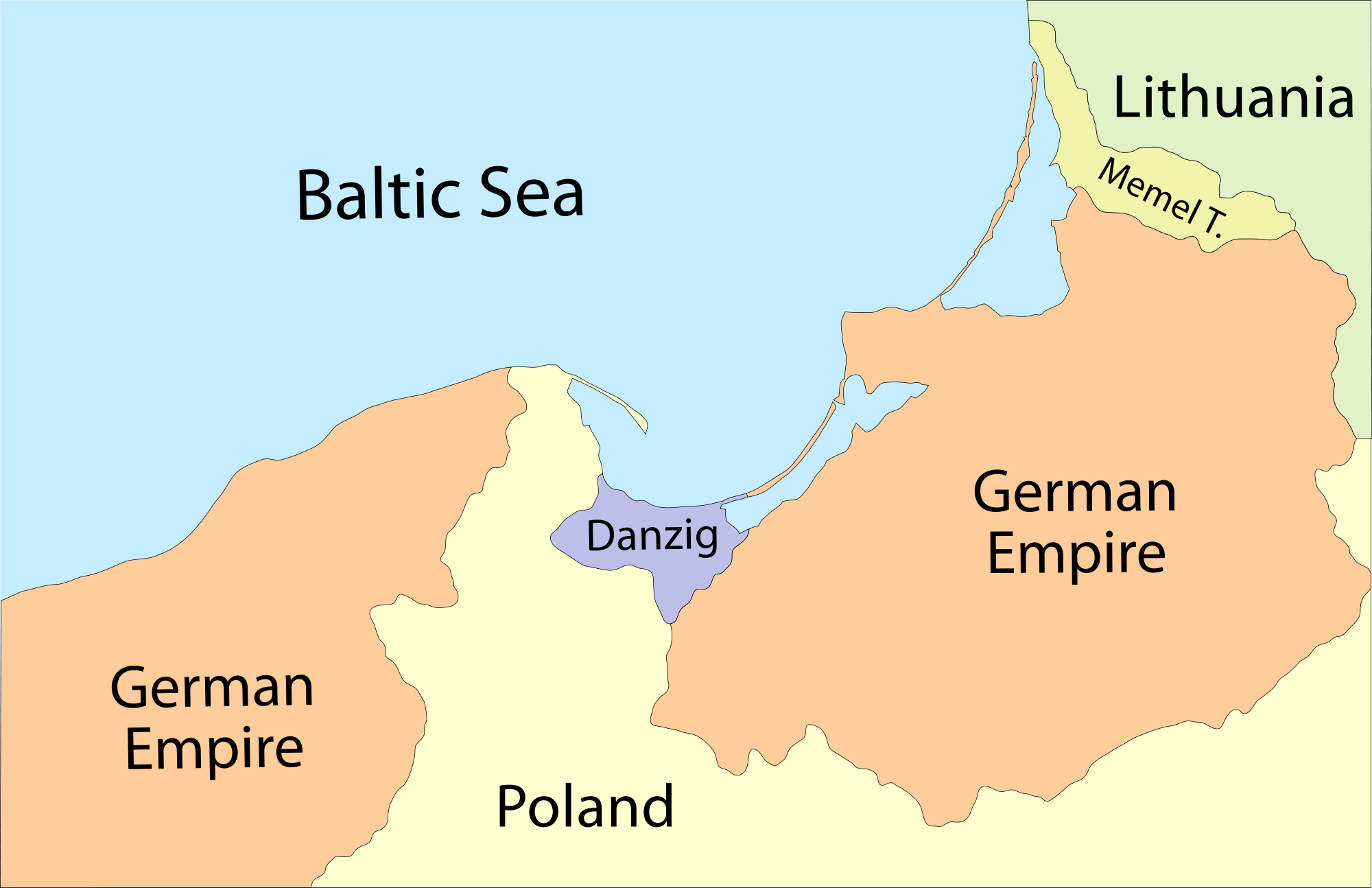
In the post war settlement the City of Danzig (modern day Gdansk) was problematic. The City was overwhelmingly a German city. Its population, history, culture and language were German. However, the River Vistula in all except the few miles which ran through Danzig was in Polish territory, and the natural part of Danzig was as a trading city to serve the basin of the Vistula; that is, to serve as the trading centre for Poland. Danzig was therefore a German city with a Polish trade.
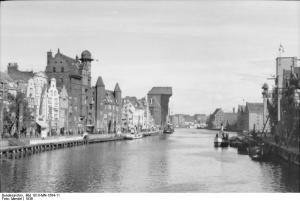
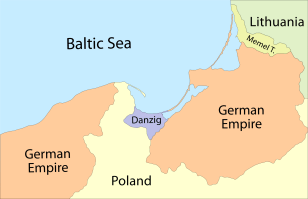
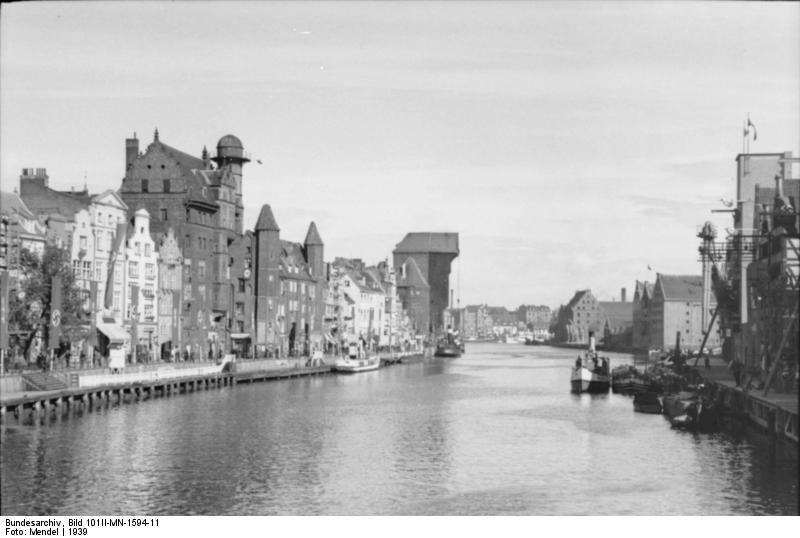
Danzig, Die Mottlau mit dem KrantorDanzig 1939

The Poles wished to have free and direct access to the Baltic Sea and so were given a corridor through the former German lands of Pommerania and Prussia. Danzig was too German and too large to be incorporated in the Polish State, so the Peace Conference in 1919 made it a Free City under a Commissioner appointed by the League of Nations—an office occupied by an Irishman, Sean Lester. The Free City experiment was not a success, the Poles set about reducing their reliance on what they still considered a German run Port and began constructing  a massive new port called Gydnia, just North of Gdansk. The Poles then starved Gdansk of Trade which had the effect of increasing the Danzig Germans hostility to the League of Nations, due the double in justice of been denied union with their mother land and denied trade by their polish neighbours. Danzig became a hotbed ripe for exploitation by the Nazis.

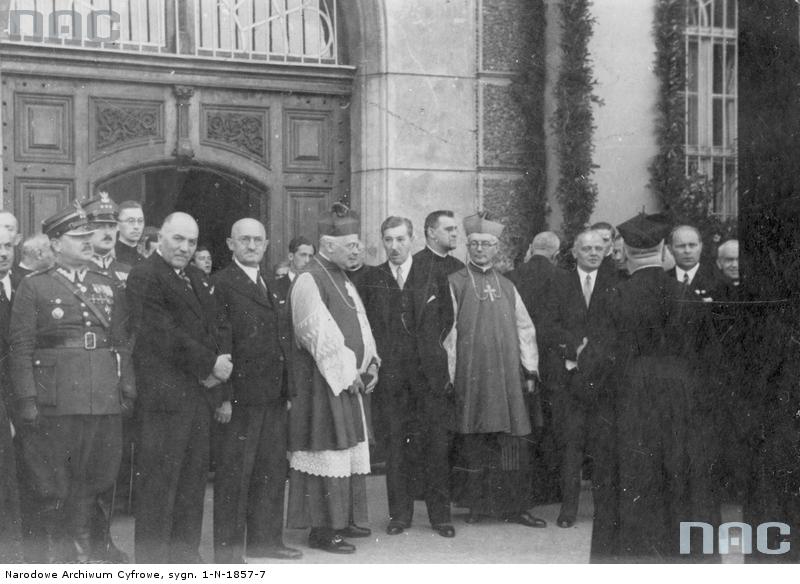
Edward O’Rourke was witness to all these tensions in the Free City as in 1923 he took up the post of ‘apostolic administrator’ (quasi-bishop) in the Free City of Danzig where he would remain for the next fifteen years. In 1925, as a separate political entity, the Free City was given its own diocese with its seat in Oliwa cathedral with O’Rourke becoming its first Roman Catholic bishop.

Such tensions also spilled over into the local Roman Catholic Church where the German-speaking majority resisted attempts by Danzig’s small Polish community to found their own Polish parish. During his first decade in the city O’Rourke sided with the German-speakers, even proposing in June 1931 to the Danzig Senate’s German nationalist president that there should be a ‘stepping up of anti-Polish propaganda in the Church.’
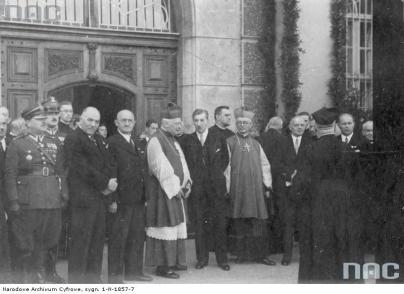
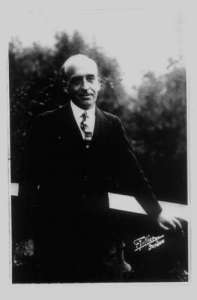
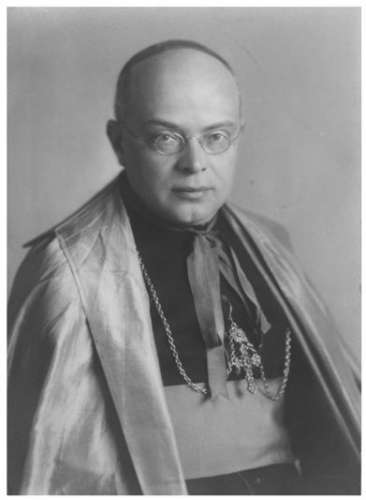
Bishop Edward O'RourkeSean Lester

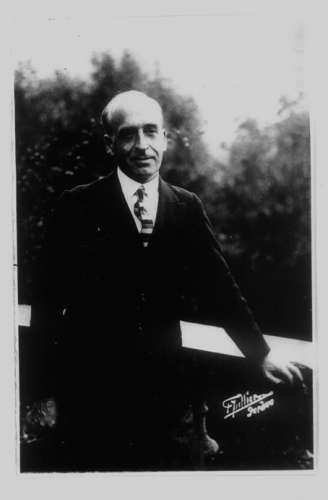
Bishop O’Rourke of Danzig                                                             Sean Lester

However, once the Danzig Nazi Party had taken control of the Senate in 1933, O’Rourke became one of the strongest allies of the Polish community in Danzig. With the Church now facing persecution by an external enemy, internal ethnic divisions in were set aside and the attitude of Bishop O’Rourke and part of the German-speaking clergy became more favourable towards the Polish community. Along with Irishman Sean Lester, the League of Nations’ High Commissioner in Danzig, O’Rourke was one of the very few independent voices prepared to publically criticize Nazi policies in the Free City. Of particular concern to O’Rourke were attempts by the Nazi Senate to absorb Catholic youth organizations and charities into Nazi structures and its pressure to completely ‘nationalize’ the Church in Danzig.

Despite the fact that Sean Lester was a Protestant and they initially had no common language except French, the two men became close friends and political allies. Both considered personae non grata by the Danzig Nazis, O’Rourke and Lester found a common affinity in their respect for human rights, their opposition to Nazism and their Irishness. Indeed, O’Rourke was intensely proud of his Irish ancestry, with Lester recalling in his diary how on their first meeting in 1934 the bishop came into the room ostentatiously carrying an Irish magazine and patriotically forcing himself to smoke ‘Irish’ cigarettes over his preferred Russian brand.

Once, however, Lester had been forced from his post in February 1937, O’Rourke’s became the last independent voice left in the so-called ‘Free’ City. With a section of the German-speaking Catholic clergy, along with the Nazis, openly opposing his support for the foundation of a Polish parish, O’Rourke finally resigned in October 1937, and moved to the Polish city of Poznan.

From then on, O’Rourke’s connections with Poland became stronger and stronger. Indeed, in 1939 he renounced his Danzig citizenship and became a Polish citizen.

When Germany invaded Poland in September, 1939 O’Rourke was forced to flee Poznan. In Brest-Litovsk he met the famous German General Heinz Guderian who gave him safe passage by car to Stettin from where he made his way to Berlin and then to Rome. He did try to return to Poznan during the war but the Germans would not grant him a visa. In a letter to a friend in Ireland from February 1940, O’Rourke outlines his escape from the war zone:-

 “I have been three months in Rome awaiting in vain for a German visum to go back to Posen. The most part of September I was in Poland; practically all the time of the warfare there. I was in Warsaw and in Siedlce during the bombardment of these cities, and came out of Poland with the help of a sympathetic German General, who sent me, with a motor car, to Eastern Prussia, and from there by sea I reached Stettin, and then Berlin and Rome.

The Germans were very kind to me, but they did not, and do not, wish me to go back to Posen. The rumours, spread in the papers, that I was killed by the Bolshevists, were probably caused by the fact that my cousin, Count Charles O’Rourke, was arrested by the Bolshevists, and it was said that he was killed. But he was only put in prison, and is till now detained, in horrible circumstances, in a cell with 30 other prisoners. He is 78 years of age, ill, and very weak. The President of Lithuania, Mr. Smetana, is trying to liberate him, but till now without success.

I was very amused by the cutting of the English paper. I am sorry I cannot confirm the good news it brought about me. But, fortunately, the bad news in the ‘Sunday Independent’ was not true. In Ireland there are many happy people and I hope Ireland will remain neutral and not take part in that terrible trouble the Continent is going through.”

Although O’Rourke died in Rome in 1943, in recognition of his defence of the Free City’s Polish community during the Nazi period, his bones were reinterred in Gdansk’s Oliwa Cathedral in 1972. Edward O’Rourke may the only member of his illustrious family to ever visit the birthplace of his ancestors. In the 1920’s he visited Leitrim and his enquiries led to him compiling “Documents and Materials for the History of the O’Rourke Family’ published in Danzig in 1925 (by Count Edward O’Rourke, Bishop of Pergame).
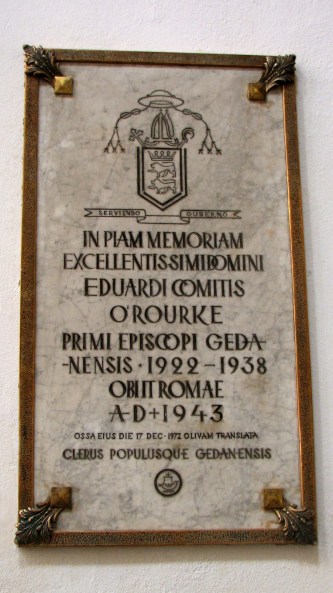

Plaque to bishop Edward O'Rourke in Oliwa Cathedral in Gdańsk