Category Archives: Rural Ireland

The Moustache is hiring

Bar in QueensAs he crossed Queens Boulevard and strolled up the wide sidewalk towards the Bar, Tommy McKillen checked his watch again, 8.45pm. His mate Jimmy had said he’d be there by 9.00pm. Tommy didn’t want to be late. He wondered had Jimmy changed much? He hadn’t seen him in five years now. They had grown up beside each other and were inseparable. Jimmy’s family had returned to the States when he was 14. Growing up in the North West there were several American born kids in school? There was the Harrington’s who were from New Jersey, who could ever forget Colleen Harrington playing basketball in the front courts at school. Tommy remembered how they had all gone to support the school team in the Connacht Finals but the truth was they had all gone to watch Colleen strut around the court. Tommy was shy back then and if she had spoken to him he knew he would have probably died there and then. Joe Burke and Jimmy were from Sunnyside, Brian O’Donnell was Chicago. Then there was that lad from Cashel who was from San Francisco, he was Moran, Tommy couldn’t recall his first name. He did remember him out at Annagh Lake one summer, at swimming lessons, bragging about little league baseball.  Jimmy later punched his lights out at the back of the school gym. God knows what had ignited the row but he recalled afterwards that Moran and Jimmy shared a cigarette; Moran’s hands were trembling so much he could barely hold the match to light his smoke.  Later he gave the entire pack to Jimmy, a sort of peace offering or reparations. We smoked some of the cigarettes under the Cryan’s Bridge until Tommy was dizzy and sick. Then we smoked some more that evening when Jimmy came with me to count the cattle over in Annagh. That’s when he told me they were going back.

Approaching the Bar the Elevated line roared overhead as the Number 7 braked for its stop at the 40th Street station. The old steel frames vibrated, the rails rattled all the way to Manhattan. The Citibank building in the distance stood there proud, alone defiant against the bigger skyline across the East River. Inside the bar was quiet. Tommy pulled in halfway down the bar and picked the middle of three vacant stools. Two older guys on his left were talking about a ball game. Slowly he got his bearings relishing the air-conditioning. There were two girls and a guy on his right who were shooting the breeze about some friend of theirs who had flunked in College. The girl looked nice, a lovely tan, blonde hair and white teeth. Frankie the barman nods as they make contact, Frankie the Greek/ Italian/ Irish barman. “Hey Tommy, What’s up?’ his right hand outstretched to shake mine as his left throws a fresh beermat on the counter. ‘I’m good Frankie’, a cold bottle of Bud is placed on the beermat. Jimmy threw down a few bills beside it. ‘Has Jimmy McHugh being in yet?’ ‘No haven’t seen Jimmy in months. He’s living up state now. Up around Tarrytown’. Tommy nodded and sipped the cold beer. He had telephoned Jimmy’s mother on Tuesday, or was it Wednesday. He wasn’t sure now but she told him shed she’d be speaking to Tommy. When he spoke to her again yesterday and she said Tommy would be here by 9.00pm. He sipped some more.
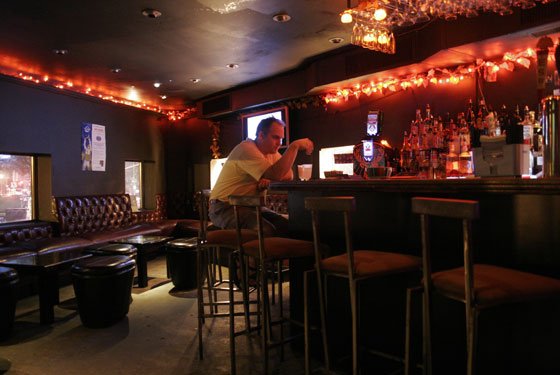
New york bar‘Jimmy’s a good guy. I like him. We went to the same High School’ utters Frankie as he passes by wiping the counter with a cloth, fastidious, clean cut Frankie. Tommy notes that there a baseball game on the television. He hates the isolation and sitting here listening to other people’s conversations, longing to join in. He checks his watch again, 9.10pm and wishes Jimmy would arrive and not leave him waiting like this.

Tommy’s contemplation is broken by one of the guys on his left, ‘give us two more here Frankie….. and two Irish Whiskies’ Tommy could see the moustachioed guy in the mirror behind the bar. ‘Here you go Roger, what type whiskey you want, I got Jameson, Tullamore Dew, Paddy?’ The Moustache thinks before replying ‘Two Jameson on the rocks and have one yourself my friend’. Tommy takes out his cigarettes and lights a Parliament before stopping to read the matchbox.

‘American Festival Café, Rockefeller Center, 600 5th Ave, New York, NY 10020’

He hates his job there, hates been out in the sun all day, hates the way he must play this phoney friendly waiter all day long. The match card has the famous statue as its centre piece. One of his colleagues Andy said he likes the statue at work, said he saw it in a movie, ‘You do know the Restaurant closes in winter and is turned into an ice rink’. Tommy nodded before telling Andy that the statue is of Prometheus. ‘Oh yeah’ shrugged Andy, ‘that’s cool’ before racing off to berate the two Bengali busboys again. A few days ago he argued with Tommy that the correct term was Bangladeshi when Tommy said you could also say Bengali. Tomato, Tomato, who cares, whatever, fini

Tullamore DewFrankie comes back with the whiskies. ‘Hey aren’t you having one yourself? C’mon Frankie I’m buying, have a drink with us even if those Mets suck, at least the Knicks are flying’ the Moustache is well on it, looks like he’s been here all evening, getting slowly pissed and gradually louder. Frankie takes a shot glass and grabs a bottle of Tullamore Dew, he pours himself a drink. Tommy sucks on his Parliament watching the proceedings out of the side of my eye and through the mirror. Where the fuck is Jimmy, 9.21pm. ‘Here’s to those Knicks, going to do it this season, you heard it here first, and don’t forget it’ Yeah that’s a very loud moustache, muses Tommy, his mate doesn’t even respond, the glasses raised, clink and down the hatch. Tommy watches Frankie; the whiskey doesn’t knock a stir out of him. He recalled one of the Barmen telling him that sometimes Bartenders have their own favourite shot. ‘So it goes like this’ he explained, ‘Couple of guys want a Jaeger, you fill them a Jaeger and then they start putting pressure on you to have one, so you have your own bottle, let’s say it’s a whiskey, so you take out your bottle of Tullamore Dew and fill your glass, you do the shot with them, and the next one and so on. They think you’re a great guy, part of their night out, but they are getting wasted, you’re not because your Tullamore Dew is filled with Iced Tea, all you have to do is clean up the fucking tips’. Frankie has a bottle of Tullamore Dew which he returns under the counter not on the shelf, he’s in on it notes Tommy, determined some night to play him at his own game just to let him know, that he knows. It won’t happen tonight because Tommy is skint. He is hoping Jimmy has some contacts, anything, a phone number, Tommy needs work.

So Roger is the name of Moustache. Now he’s telling his mate about his little girl and what a smart kid she is. Tommy notices the girl to his right again, lovely long tanned legs, hint that she’s been out on the beach, it reminds me to call out to visit his Grandmothers cousins in Breezy Point. She looks about 21. She lazily drapes her arm over the shoulder of one of the guys with her. He is in the middle of some story too, stories being told all around him but what story am I in?wonders Tommy. Then it kicks off to his left ‘Get the fuck out of here, you fucking asshole’. Tommy turns just in time to see Roger the Moustache jumping up and over his mate who is now stretched on the ground with a right hook, his stool is lying beside him, he is gingerly getting to his feet, raising a hand as if to protect himself from any more punishment. Tommy didn’t see the punch clearly but the blood now trickling from the guy’s mouth suggests that it was a sweet connection. Frankie has jumped the counter and is holding the Moustache, ‘Easy Roger, not here man, take your quarrel outside, not here’, ‘You dirty bastard’ the moustache roars trying to kick his former mate, ‘douchebag’. The wounded friend is now on his feet backing away to the door, then he is gone, his shadow passing by the window heading towards Woodside. Frankie still has a bear hold of the Moustache who stretched out is a big unit, 6’2 or 6’3 at least; they go over to a corner by the pool table. Tommy sips his beer again. Move on, nothing to see here, move along.
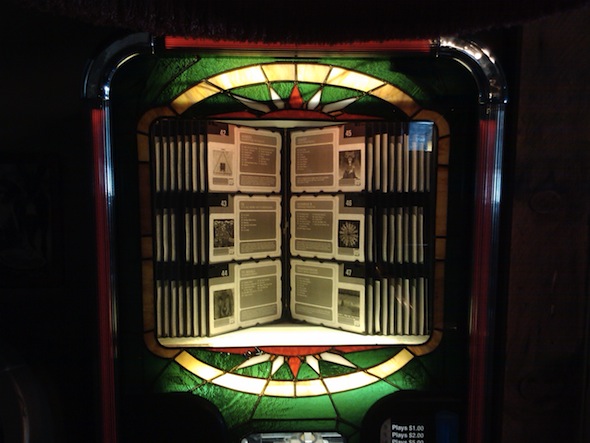
JukeboxThe girl next to Tommy asks ‘What is that all about?’ ‘I have absolutely no idea’ gesturing with open arms to reinforce his view. They all laugh and shrug shoulders, bemused. The girl gets up and goes to the juke-box, she starts flicking through the lists. ‘You’re Irish’ says one of the guys. ‘Yes I can’t hide it can I?’ ‘My family are Irish, from County Cork; my Gran never lost her brogue even though she is here since the early 50’s’. ‘I’d imagine that it’s hard to keep your accent in a place like this’ I reply for the sake of replying. Tommy remembers a girl who went to work in Bundoran for a summer, seven weeks later and it was all ‘Ock aye’ and ‘wee’ this and ‘wee’ that. Frankie comes back behind the Bar. ‘Sorry about that folks, excitement over. The guys had a bit of a disagreement, Roger there was right though so I’m letting him stay of that’s okay. He’s a good guy, he’s from the neighbourhood’. A few minutes later Roger the Moustache comes back from the restrooms, he has on a Polo shirt, cream shorts, white socks and sneakers. He takes up again on his stool, gathering his money, folding the bills before placing them again on the counter in a neat pile.

Tommy lights another Parliament, the jukebox kicks into life, Ace of Base. The trio on his right start chatting again, he is on his own again, and he is going to kill McHugh, 10.04pm. ‘I saw the sign and it opened up my eyes, I saw the sign…’ Frankie comes back with some bowls of pretzels, placing one in front of the Moustache and one in front of me. ‘Cheers man’ says the moustache ‘I’m sorry Frankie you know I’m not like that but fucking hell what an asshole’Frankie is working his way along the bar only half listening, so the Moustache starts talking to Tommy. ‘You just never know do you?’ he says. ‘Know what?’‘This guy, I was drinking with him for like two hours, seemed like a decent guy, he was Navy so was my Dad, ya’know, just having a beer. I was telling him how my father was chosen to be Neptune when they crossed the Equator, you know the tradition right, meant so much to my old man’ He stopped for a moment and threw his whiskey on his head and slammed the glass on the counter. ‘Son of a bitch! So I was telling him about my daughter and showed her photo like this’ he takes his wallet out and shows Tommy a photo of this young oriental looking girl, his daughter. Must have got a mail order wife assumes Tommy, Thai, Filipino somewhere like that. ‘So he says nice kid and asks me do I want to see his, I say yeah sure, I thought you weren’t married blah! Blah! and he takes out his wallet and shows me some pictures of young kids nude, disgusting man, young kids, fucking paedo, sick bastard!’Christ I think, he was right to box him so, ‘I’m sorry kid but this guy really got me, if Frankie wasn’t here I would have done some real harm, Frankie give is two beers and I’m gone’ Frankie places two fresh beers on the counter, ‘There on me’ The moustache is off again, ‘I was just telling your friend here about that creep, fucking hell’ Frankie winks at me without the Moustache seeing and heads back up along the bar. ‘I’m sorry I didn’t get your name kid, I’m Roger by the way, Roger Wallstein’ his hand is out so I shake hands, ‘How are ya, I’m Tommy’‘Irish huh, this neighbourhood was all Irish once upon a time, when I was growing up it was all Irish, all the businesses too. I’m Catholic, German, family, Bavarian, yeah a good Catholic boy. So what’s your story Tommy?’ 

Tommy takes a drag out of his cigarette before answering, ‘Well I was supposed to meet a mate of mine but he’s stood me up. Irish guy I grew up with, well he was born here but family came back to Ireland and then back over here again. Frankie knows him. I’m looking for work to be honest, only been here six weeks. Have a job in a bar in midtown but the hours aren’t great’ ‘Midtown not great for tips either save Thursday and Friday afternoons’ says Roger. ‘There’s some temporary positions going in our place, easy work, money is okay’. This sounds good thinks Tommy, ‘Where bout’s that? Doing what?’ ‘It’s an apartment block on the Upper East Side, concierge, you know, Doorman, elevator cars that sort of thing. You might get a few months’ work, who knows’. ‘That would be great, really need something soon’. ‘Frankie give me a pen’ When the pen arrives Roger starts writing an address and number,

Empire House, 180 East 72nd St 3rd & Lex., Shaun Richards

‘You give them a call or call in and speak to Richards. Who knows he might give you a break’. The Moustache looks at his watch ‘Oh my god, I’m out of here!  Nice talking to you ….’ ‘it’s Tommy’ ‘yeah Tommy’ he throws his bottle on his head, picks up his Bills and throws a twenty back on the counter, ‘Thank you Frankie, I’m sorry about earlier buddy’. With that Roger the Moustache is gone. Tommy looks at the napkin, Upper East Side he thinks and places the napkin in his wallet. Frankie is over and picks up his tip and wipes the counter down, ‘Roger was in good form tonight eh Tommy?’ ‘Yeah, certainly was a bit of drama alright, I never met him before’. Frankie continues wiping the counter ‘I suppose he told you all about the wife leaving him, he really misses his daughter. He met this girl Chinese or something through some agency in the church, she comes over, they marry, have a kid, lovely little girl, then she ups stick and are now living in Manhattan with some other Chinese guy. Roger thinks he was set up, maybe he was but he certainly got her a green card and she’s here to stay but he’s left paying the bills. He’s drinking a good bit these days. I worry about him’. Frankie reaches into the under-counter fridge and pulls out another Bud for me ‘That guy surely ruffled his feathers earlier’ Frankie goes through the whole story about the  porn pics in the wallet and the man claiming they were his kids. ‘Dirty bastard’ Tommy shakes his head and then asks ‘What does Roger do for a crust? ‘He works in some building in the city, security or something. Not sure Tommy’
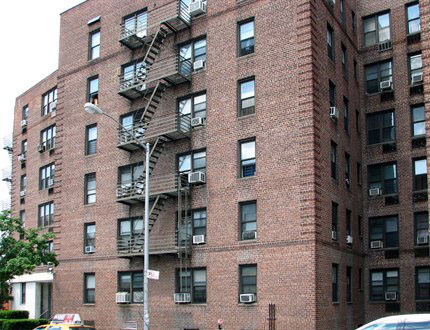
apartmentBack in the Apartment Tommy tip toes by their Ecuadoran room-mate. There is no sign of Andy in the bedroom, out on the town again. With the stifling heat, Tommy can’t wait to turn on the fan for some relief. There is no air conditioning in the apartment and they struggle to sleep. The noise of the city wakes him up and he looks at his watch; it’s just after 7.30am and he is covered in a lather of sweat. The pillow is soaked through and the sheets also. He even kicked off his boxer shorts during the night. Not able to sleep any more he takes a shower, relief, relief god that water is good he thinks but then he can’t dry himself with the towel, as he starts sweating again. He hates this heat, he hates this apartment, but most of all he hates being broke in this city. In a few minutes he is gone down the stairs out into the bright, blinding white of day. He wants to go home but he can’t. In the Diner he has some breakfast Canadian bacon, eggs and coffee. He can feel a slight thud in his forehead. Jimmy never showed. He takes several refills of coffee and read the The Post.

Two hours later and he comes up out of the subway station. He takes a few seconds to orientate when he does he continues over East 72nd Street and into a shady atrium. Tommy walks to the front door and is met by a man in a smart uniform and white gloves. ‘Can I help sir?’ he asks, stretching his arms across to ensure Tommy doesn’t consider entering the building. ‘Can you show where the reception is?’ ‘Reception’ he looks curiously ‘this is an apartment building not a hotel. This is the main entrance and is for tenants only sir; you’re going to have to move on sir’. Tommy turns to walk away but then shouts after the Doorman, ‘I’m looking for the manager Mr. Richards, Shaun Richards?’  ‘Go back to the service entrance on the corner of 71st and 3rd, you better go now’.

The building is huge, Tommy looks up at the sky and it seems to cover an entire city block, a central tower with two substantial wings with probably several hundred apartments in total. He walks around the block and thinks about abandoning his mission. He stands at the entrance for a few seconds. This is not near as glamorous as the entrance on the other side of the building where he’s just been. A couple of men point me towards the office and he enters the bowels of the building, down a ramp and into furnace like heat and the deafening noise of a rubbish compactor. Men in overalls push overflowing garbage bins up the ramp to waiting trucks. At the bottom of the ramp a corridor leads on and he sees a sign for the office. There is a glass window and he can see a number of men inside deep in conversation. There is a time clock on the wall and a large board with dozens of employee’s time cards in neat rows. Tommy pauses before knocking on the door but when nobody answers he just opens it. A man is sitting at a desk; he is on the phone but momentarily puts the mouthpiece to his chest and says ‘What you want?’ ‘I’m looking for Mr. Shaun Richards’. He points towards another door, returns to his call and I go on further, knock on the door,

‘Come in’ is the reply so Tommy opens the door, ‘C’mon, c’mon I don’t fucking bite, what can I do for you?’ says a Burt Lancasteresque figure in a sharp suit. ‘I’m here to meet Mr. Richards’ ‘Oh yeah well I’m Richards, Shaun Richards, who are you?’  he roars, why is he roaring? ‘Tommy McKillen, here about the job, Roger sent me’ He gleams with big white teeth showing and a powerful stare. ‘Roger?  Roger who?’ ‘Roger Wallstein’ I reply. ‘I have no idea what the fuck you are talking about son, Saunders! Saunders get in here!’ the man on the phone rushes in., ‘Saunders are we hiring? Summer relief? You know anything?’ ‘Well yes sir we do need some cover yep’, ‘Listen this kid looks the part, and he’s got balls to walk in on me like this’ says Richards as he reverts his gaze back on Tommy‘ look son we have a few weeks work that’s all but there may be something more permanent come out of it. Be on time, always be on fucking time and be polite to the tenants, if you’re not, you’ll have me to deal with, now get the fuck out of here’.

Saunders leads Tommy out of the office and down the corridor where he takes out a bunch of keys and opens the door. When the lights flicker on Tommy can see rack upon rack of uniforms, some still in dry-cleaning covers. ‘What size waist?’ asks Saunders ‘34”’ ‘Here try these’ the trousers don’t fit so Tommy tries another. With trial and error he gets fully kitted out and is then given a locker in the changing rooms to keep his stuff in. ‘Get a lock, get 3 or 4 white shirts, always come in clean and tidy. No bad breath or BO, you start tonight at 11.00pm, you be here by 10.30pm and relieve the man at Elevator 6 at 10.45. You give good relief you get a good relief. In the morning your replacement will try and be in for 6.45am. Where are you living?’ ‘Oh Elmhurst, just off Broadway’ replies Tommy. ‘Okay, if you haven’t shirts there is a Sears out at the Queens Center, it’s just another couple stops on your train, get some’

At 10.44pm that night Tommy takes the service elevator up to the lobby. It is a beautiful hall of mirrors with a water feature behind the main entrance where he had initially been this afternoon. Two door men look towards him and he can sense they are checking him out. Tommy has a piece of paper with instructions about polishing brass and cleaning mirrors, on the other side is his Roster for the next 3 weeks. He walks towards where I’ve been told Elevator 6 is. A uniformed man with a moustache stands outside the car, looking in the mirror, fixing his collar, ‘Hi Roger I got the job’ Tommy announces excitedly, ‘Hey kid, thanks for the relief’ he looks peculiarly at Tommy, ‘We met in the Blackthorn last night, remember?’ but Roger just frowns, ‘The Blackthorn?’ he looks at Tommy vacantly.  ‘Yes remember the old guy with the kid’s photos?’ Roger opens the door to the service elevator, grabs his bag and says ‘I’m sorry kid I think you must be mixing me up with someone else, have a good one’
Dithane and Doodlebugs

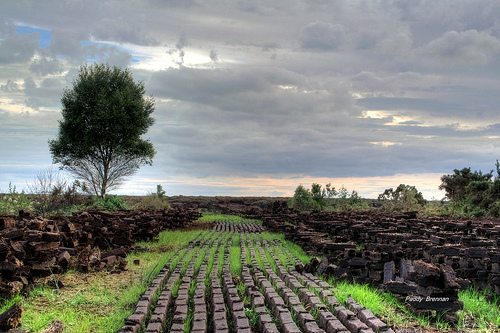
'Turf Rearing' P Brennan ‘Turf Rearing’ P Brennan

My Granduncle lived a very regimental and ordered life, practically all of it in the industrial heart of England. It was a country where my young mind believed the trains always ran on time and drivers never exceeded the speed limit. The Granduncle was in London first but then moved to Coventry where he had secured a job in the Standard Motor Company factory. A company that was standard, what more could a standard Irish migrant want.  

The factory later became the even larger Massey Ferguson plant, ‘Twenty Thousand people walked through those gates every day’ he’d boast. The uncle always simply called it Massey ‘Oh aye’ which suggested he hadn’t much time for the Ferguson half of the operation.

He came home every summer without fail, using up all his annual holidays. He brought us a bag of Humbug mints each – which none of us liked. He smoked Players cigarettes, tip less and toxic and his long thin fingers were like stained amber with years of nicotine layers. The first cigarettes myself and my brother ever smoked were pilfered from his box. We would smoke them in the hay-shed; it seemed to us a logical place to smoke back then. Unfortunately this logic put paid to a career in the local Fire Service, something about ‘deficit in risk assessment and prevention’.

During his holidays my father would bring the Uncle to town every Saturday night and occasional visits to our many relatives houses. My father would often be working on the farm until nine or ten o’clock at night and the Uncle couldn’t understand why Irish people only went to town at half past Ten, “some of them don’t even come in until after eleven’ he moaned.  In the UK, he often reminded us, people would be going home at that time, they had to he said, ‘last bus goes at half ten’. Somehow I don’t think he ever missed that last bus of a Saturday night in Coventry.

I was always interested in history. After much prising, the Uncle might be encouraged to give up some titbits about life in London, particularly about the Blitz which he had lived through. He pronounced the word Bomb as Bum so we of course mischievously kept asking him about the Blitz just to hear him say Bum over and over; ‘Oh they pounded London with bums, all bloody night, those bums raining down, fires everywhere’. I never heard him say he was afraid but he must have been, a 20 year old lad thrust from a small farm in the North West of Ireland into this cauldron of fire and death.

My Grandmother and another brother were with him at the time. My grandmother also spent time in Manchester but came back to Ireland and soon after met my grandfather and married. It was 1942.

The Uncle stayed on. He got work down near the South Coast ‘where they were sent’. I couldn’t understand that part of it, who sent them? Of course it was a well-kept secret what was happening but the Uncle told us he knew well they were getting ready to cross the Channel and invade France. No flies on him, he knew all about D-Day months before everyone else.

Back in London he recalled the V2 rockets landing; ‘if you heard it coming you were fine, it meant it had already passed you by’. I explained to him this was because the rocket was travelling faster than the speed of sound so it arrived at its target before you heard it. I told him that the speed of sound was 768 miles per hour; he informed me this couldn’t be as he had once seen a V2 flying in the sky and it wasn’t going that fast!

I, like many young boys my age idolised the great Liverpool team of the 70’s and 80’s. The Uncle had no time for them; he said that they scored a goal and then just kept the ball, passing it over and back to each other. I fancied that this was quite a clever way for a team to fill the Club’s trophy cabinet but he was having none of it.

He liked his home town club, the Sky Blues, Coventry City, who at the time were a mid-table team in the First Division who occasionally survived tense relegation dogfights.

I began to memorize the players babes from Panini sticker books. I asked the Uncle if he ever went to games in Highfield Road; ‘Oh aye’. He told me later that the the last time he was at a game there were over 60,000 there. I couldn’t fathom this as at the time Coventry was averaging about 20,000 attendances per game. I remember checking the record books and discovered that there was over 50,000 at a match in 1967 when they beat Wolves to gain promotion. Was this the last game the Granduncle was at?

My father visited him in 1985. My mother and he were over visiting our maternal Uncle who was gravely ill in London. My father got the train up to Coventry and the Uncle met him at the station.

He asked my dad if he was hungry and the pair went in search of a renowned Cafe which the Uncle proclaimed served the best roast dinner in town. They walked around for nearly an hour, passing dozens of Asian and Chinese restaurants, before the Uncle gave up aghast; ‘it used to be around here somewhere’. It may have been there in 1967 when he last ate there, perhaps on the way to the big game.

The Granduncle lived in a small neat bedsit in a large building with dozens of other Irishmen of similar age. I remember my father was moved by it, surprised even, maybe he had expected that he had a nice mock-Tudor semi-d in the suburbs.

When he came home the Granduncle liked the open fields, the cattle, making the hay and silage pits but most of all he loved the turf bog. He would be on the bog by eight o’clock in the morning. He couldn’t understand how we young fellas only went down at ten. When we got there we often broke the tedium by having mud fights – throwing buts of wet turf at each other. Sometimes we would abandon our posts and head off over to the high bank, jumping drains and bog holes, catching frogs, chatting with other people on the bog.

But the Uncle would stick at it, back bent, a steady pace, slowly but relentlessly making his way down the plot of turf. He often chastised our father for not having control of us but my father only told us what was being said about us. The day after these tell tales we would give the Granduncle the silent treatment.

My father liked to foot the turf once, making small footings but the uncle insisted on lifting them, turning them, this was only stage one of a laborious process. It became our summer penance. When this was done he went back to the beginning and made small footings of six to eight clods and then when that was done he would wait a few days before starting all over again and making them into bigger clamps.

He would look with disdain at a neighbour whose turf were cut weeks and lain untouched, green grass growing high around and sometimes through them. The neighbour would then come down nonchalantly and make a start, work for fifteen minutes, chat, smoke and then head home. The Uncle couldn’t understand it. Yet I often remarked that the neighbour usually got his turf home as soon as we did.

The summers of 1985 and ’86 were terrible in the bogs and in the meadows. The farm felt like a Gulag. The turf was the new sausage machine variety and they were impossible to work with. They just broke and crumbled in our hands and we all cursed them but none more so than the Uncle who lamented the old ways of slan and barrow.

In 1987 he retired from Massey (I don’t think he ever developed any fondness of Mr. Ferguson because he was again not mentioned). He got a Gold watch from the company, just like thousands before him. I don’t know who instigated it but he packed his bags there and then and came home. Maybe he had always planned to come home. He had been away forty eight years but he still only had one home.

The house he had grown up in was still standing and home to his older brother and his wife. They had married late in life, well past child bearing years. The house was pretty much as it had been in the 1930’s when the rest of the family took the Mail-boat to Holyhead.

The Uncle adopted a superior tone when speaking about his elder brother who had never left home, but it seemed lost on him that this man never had to leave home, and it wasn’t as if his own decision was one of choice, the reality being that it was one of economic necessity. So when he came home he moved in with my Grandparents who lived up the lane from us.

After leaving a life that was ordered and routine it must have been difficult for him to adjust. It showed in little things like when he smoked he seldom finished his cigarette. He usually butted it out halfway down. The habit was obviously borne out of the short ciggy breaks in the East Midlands factory where he had been incarcerated.

The rigidity and regimental nature of his working life was completely out of sync with the more laid back life in the rural west of Ireland. It wasn’t that people didn’t work hard, they often worked harder, it was just that they were not slaves to the clock. They didn’t clock in but they never clocked out. No 5 o’clock finish in the evenings, they would work to midnight if they had to or if felt like it. The only things exercising any control of their time were the seasons. To me it seemed a more natural way to live life.

The homecoming year of 1987 was also a monumental year for Coventry FC. They won the FA Cup beating a highly fancied Spurs team at Wembley. The Uncle didn’t even watch the match and seemed indifferent when I told him the news. He did have interest in GAA and could recall cycling to games including a Junior All-Ireland Semi-Final in Breffni Park in the early 40’s.  Leitrim were going well against Meath until the great Red Moran from Aughavas broke his leg. He also extolled the skill and strength of the larger than life, Jack Bohan, centre half back on the Leitrim team in 1927.

When we were younger we thought the Uncle had built every Massey Ferguson tractor that had ever ploughed a field. We had an old Ferguson Twenty and a 1968 MF 165. Surely he had built some part of these tractors. One Saturday morning my father asked the Uncle to hop up on the 165 to tow the Twenty (the last time there was a battery in the Twenty was when it left the Massey plant in the early 50’s). So the Uncle got up and let the clutch up too quickly and the engine conked out. He began fidgeting and it quickly became apparent that he didn’t know how to start a tractor. How could this be? How could a man that worked in a factory for over forty years, the place where hundreds of thousands of tractors were built, including the one he was now sitting on, not know how to drive one? My father wasn’t that surprised and he soon let us know that he had heard that the Uncle had worked all those years in the stores.


If there was one other job that animated the Granduncle it was spraying the spuds. The name itself was weighted with danger, you’d never call a child or a family pet Dithane! The anti-fungal powder had replaced bluestone as the number one agent in fighting the dreaded potato blight.

My father would drop down a couple of barrels of water to the bog garden where we grew the spuds. The spraying paraphernalia was quite simple. A plastic knapsack, with a handle on one side and nozzled hose on the other, a plank of timber, a thick branch or brush handle, a jug and a pair of Granny’s old tights. The Uncle or my Granny would throw the tin of Dithane into the barrel of water and mix it with the branch. When the Uncle did it he invariably stood downwind for some reason? The contents of the barrel were now what Patrick Kavanagh called ‘the copper-poisoned ocean’.  The plank of wood was placed across the barrel and then the knapsack on top. The lid was screwed off and the tights placed across the opening of the tank which was filled using an old plastic jug.

When full I would reverse like a donkey into a cart, be strapped in and away I’d go down between the potato ridges, pumping the lever whilst arching the nozzle left and right spraying the stalks with this chemical mist, him thinking of the floury spuds on the table next year, me about the life cycle of ‘Phytophthora infestans’ that we were studying in Biology at school.

The Uncle didn’t trust me by this stage and he would watch my every move making sure I didn’t miss any stalks. He insisted I got in under the leaves as well as covering the top side. The trust was gone, too many times I had been found out by him, the stolen cigarettes, the little lies. One time my parents were away and we never checked the cattle. There were 45 cattle in one holding, 15 weanlings in one field and 30 cows and calves in another. ‘Did you check the cattle down in Lily’s?’ he asked ‘I did’ I said without flinching, ‘How many were there?’ ’15’ ‘Oh is that right well there was 30 cows and calves there this morning’. Other indiscretions such as skipping church on Sunday and then been asked who had said eleven o’clock Mass, ‘Fr. Corcoran’ says I, ‘Oh that’s strange because he also did Half ten in Gorvagh’. I was never going to amount to much in his eyes, only a passing interest in cattle or farming, just dossing, or staying in the house like a woman, reading books.

It had already been established that the Uncle, for a man who had spent his entire career in the auto-motive industry was not very mechanically minded. He was always breaking things, wrenches, spanners, vice-grips, vices, hacksaw blades, shovel handles, axe-handles, measuring tapes and my father’s patience. He could however fix a puncture on the High Nelly bike he had commandeered from my Grandmother.

He was suited to manual labour and would toil all day at the same task unmarred by monotony. At silage time he would spend two days trimming the sides of the pit until you could almost hear the big clamp of freshly cut grass cry, ‘enough! enough!’ He would bend into a yard-scraper pushing slurry ahead of him until he got to the chute leading to the slurry tank, then back again repeating the process again and again. If there was a quick, easy, mechanical way of doing a task he would favour the slow, grinding, back breaking method. He did this well into his eighties but slowly and surely he had to relent, but, he wasn’t done fully, he became the obstinate overseer, watching everything that was done on the farm and passing judgement.

Nobody was immune from his scrutiny. He commented on the time you got up in the morning to the time the light went off in your room at night. He had an indomitable spirit and great work ethic but his life did not have to be so hard, so dreary, and so weary. When he ended up in hospital after taking a fall off his bike the nurse gave him painkillers to take. He couldn’t swallow them, he didn’t know how. He had never taken a tablet in his life, he was Eighty two. He knocked in another few boundaries after that before he got bowled out.

  Spraying the Potatoes 

(an extract)

The barrels of blue potato-spray

Stood on a headland in July

Beside an orchard wall where roses

Were young girls hanging from the sky.

The flocks of green potato stalks

Were blossom spread for sudden flight,

The Kerr’s Pinks in frivelled blue,

The Arran Banners wearing white.

And over that potato-field

A lazy veil of woven sun,

Dandelions growing on headlands, showing

Their unloved hearts to everyone.

And I was there with a knapsack sprayer

On the barrel’s edge poised. A wasp was floating

Dead on a sunken briar leaf

Over a copper-poisoned ocean.

The axle-roll of a rut-locked cart

Broke the burnt stick of noon in two.

An old man came through a cornfield

Remembering his youth and some Ruth he knew.

He turned my way. ‘God further the work’.

He echoed an ancient farming prayer.

I thanked him. He eyed the potato drills.

He said: ‘You are bound to have good ones there’.

By Patrick Kavanagh

© estate Patrick Kavanagh

The Month’s Mind

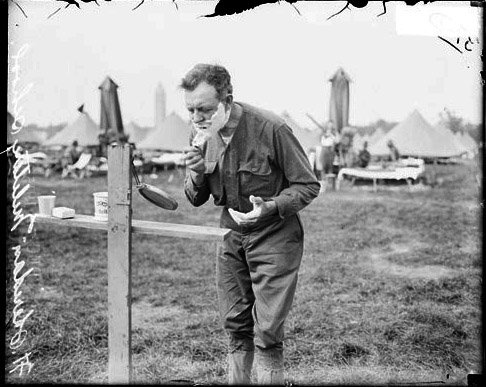
I have reworked a previous blog post about shaving into a short story. The title refers to  requiem mass celebrated about one month after a person’s death, in memory of the deceased. The tradition is of great antiquity and some believe the word is derived from the Norse word ‘Minne’  describing a ceremonial drinking to the dead. The tradition survives in Ireland where the family and close friends attend. The story is reworked into a rites of passage narrative. 


shaving brush


I walk down the lane to the neat little farmhouse half consciously counting the cars parked in the farm yard and driveway. It is four weeks since he died and since then the dahlias in the front garden have come out rejoicing I n full bloom. My granduncle is standing sentry-like at the back door, smoking his cigarette and fumbling in an effort to put his matches back into the inside pocket of his well-worn suit. My Aunt says she swears it is the same suit he wore twenty seven years previous to my parents wedding. ‘It’s hard to believe, it sure is, hmm’ he mutters cigarette smoke bellowing from his mouth and nostrils like an old train, ‘imagine hah….. Where does the time go to?’ I’m sure he can barely make my shape out through his glossy, brandy dulled eyes.

The second I open the door I am almost overcome with the unnatural heat and noise coming from inside the house. ‘It’s nice that they laid him out in the home place’ said Mrs Noone to my mother, ‘even of the house is showing its age and all that, it’s what he would have wanted.’ Mrs. Heeran interjects ‘I’m not gone on these funeral homes at all; they’re pure pagan so they are’ to which Mrs Noone replies ‘It’s hard to beat a good wake at home amongst your own and then the chapel’. I am stranded here between them like a net on a tennis court when my aunt rescues me, ‘There he is, won’t be long before he’s off to University, isn’t that right Liam, now come up here to your Grandmother for  a minute, Grainne will you get Mrs Noone a fresh brew?’

In a few short minutes I find myself sitting in the room where he once sat, in the chair that he would have sat in. I settle down and look around the room at the people gathered for his Months Mind. Trays of sandwiches are passed around followed by plates laden with slices of fruit flan and apple tart, the latter flavoured with cloves of course, my Grandmother’s way. My Aunts and Cousins fly about with pots of steaming tea topping up delicate china cups, in a room where an epic turf fire blazes. On a shelf above the radio, a small statue of St. Martin de Porres acts as a paperweight for numerous Mass Cards, the little figurine itself surrounded by various miraculous medals and bottles of holy water from Knock, Fatima and Lourdes. There too are his reading glasses, the ones he detested and fumed about constantly. On the inside sits a shiny box red and black containing his electric razor.

Shaving had never seemed routine to me as a boy. I believe that shaving is something ceremonial, almost ritual and more than mere necessity; it can be a performance, the theatre of the everyday, the essence of life, a mark of manhood and flash of vigour. I remembered my father used a wooden handled foam brush to mix the cool shaving cream that he then daubed over his prickly face to soften the stubble. He then began by slowly dragging the sharp Wilkinson blade across his jaw, like mowing a meadow in straight swathes, before cleaning the blade under the cold tap after every second or third stroke, repeating the motion, cleansing, shearing and renewing. He would finish with the more difficult movements around the mouth and lips, which he pinched, in deep concentration, before finally washing the residual foam away with a wet cloth. A quick dab of cold water marked the end of the ceremony; all the time unaware that I was standing there watching, learning, in awe.

No doubt he too would have looked at his father, my Grandfather, shaving, or perhaps his uncles when they came home from England in the summer. Once I had tried to mimic the act of shaving with my father’s razor, a foolish act borne out of my impatience to become a man, and testified by the cross-like scar on my upper lip. The scar is hidden now by my own stubble only to appear anew when I shave. My Grandfather had berated me for my stupidity, a silly boy trying to be a man.   ‘Have you the bags packed Liam? You won’t find it now. He would have been so proud of you’  It is my cousin Aileen smiling, her words breaking my trance-like reminiscing and I become aware of her heady perfume. ‘Yes just two weeks away, won’t find it’ I reply, ‘Have you digs organised?’ she asks, ‘yes, I was lucky to get a room in a house on Quay Road. Only got word yesterday so I’m taking it blind but it should be fine’ She puts her hand on my knee and squeezes it ‘It’ll be the making of you young man, the world is your oyster, he’d be so proud, he’ll be with you Liam, he’ll be by your side’.

It was I who used hang at my Grandfather’s side watching him, learning from him, like in McKee’s Bar on the nights of the big sales in the local Mart, the pub full of jobbers, tanglers, dealers, Northern buyers, tobacco smoke and thick ash plants for beating cattle up trailer ramps. I would sit on a high stool beside him, aping his gestures and movements, my legs dangling, swinging in time to the beat and blare of the mixed accents of men from Cavan, Longford, Roscommon and Fermanagh. The air was thick with the sounds of laughter, merriment, rows, insults and the vigorous shaking of hands, the entire drama that went on such nights as I pretended my frothy Cavan Cola was a glass of Guinness.

Later I would link my Grandfather home from town, standing well in on the grassy verge when car lights approached, until finally we came as far as our lane.  On the way home he would denounce what ‘They’ had done to men like Blessed Oliver Plunkett; He would tell me how Parnell was let down badly but had let himself down too. He would get most animated when he spoke of about his own Great-Grandfather, ‘don’t ever forget’ he said that ‘we were burnt out of  our house, put to the road and they after hanging him from the shafts of a cart.’ Unbeknownst I was being passed on invisible torches, whether I wanted to hold them or not. Then as we approached the house he would straighten up, puff out his chest, fortified for meeting my Grandmother. ‘Liam you’ll have this’ it was my Uncle Martin, ’put hairs on your chest’. In his hands are two small glasses with two large pours of whiskey, one of which he is pointing towards me. I don’t usually drink whiskey yet instinctively I take one. I lift the glass to my nose and savour its woody pungency before slowly sipping the burning malt.

In summer time my Grandfather had often shaved outside on the back street of the house. A red basin with warm water set on a chair brought out from the kitchen, a fresh towel laid across the high back, a small mirror propped up on the wall with a red brick. I am back there again; the brown faced Collie lying stretched out, but watching him, panting in the heat of the mid-morning sun. I am sitting there watching him too. With his braces now hanging down by his sides, he looks like a character from a Western; standing there he could’ve been out on the high plains. We are both engrossed in his labour. When finished he bends down scooping up the water in his cupped hands, washing away the last of the foam from his now shiny skin. He then pats his face dry with the towel, which is then thrown over his shoulder, before he picks up the basin with a flourish, flinging its contents down the yard, scattering cats and hens in all directions. He is gone then into the house, his ablutions over. When he emerges he is wearing his bright sports coat and a gaudy wide tie, the latter clearly from another decade, another continent even. He pinches my cheek first and then pats the dog and mutters something about looking like a ‘broken down gentleman’ then he is gone away for the day to some meeting.

Martin has now come back with the bottle of Jameson and topped up my glass again. I feel my cheeks aglow and the whiskey now tastes far sweeter than that initial sip just minutes before. ‘SsH! SSh! began to pass through the house and as the various conversations subside the reprise of the Rosary can be heard from the living room. The people sitting next to me begin the reply ‘Holy Mary, Mother of God, pray for us sinners, now and at the hour of our death.’ Our neighbour Patrick Joseph gets down tentatively on his knees and manoeuvres himself so that he is facing into the armchair he’d just been sitting on. I couldn’t help but notice the well-worn shiny seat of his pants. For all his piety he is more accustomed to sitting than kneeling. I thought of the line from the reading I had read at the funeral mass, ‘To everything there is a season, A time for every purpose under heaven’. The whiskey was making me dreamy as was the murmuring uniformity of the prayers. ‘A time to be born, a time to die, A time to plant, and a time to pluck up what is planted’. Ecclesiastes, egg cheesy elastic, heck cheesy plastic. ‘Holy Mary, Mother of God, pray for us sinners, now and at the hour of our death.’

My grandfather had become a frail man, his body shaking with uncontrollable tremors that mocked him and broke his spirit. His daughters took turns in shaving him. His shaking hand would only have done himself harm. Instead of a sharp razor blade they preferred to use the Remington electric Razor. It was a present they had bought for him one recent Christmas. It was very sleek and modern with a tilting head to match the contours of his rugged, well lined country face. I remember thinking that one day I would like to own a smart looking Remington too. ‘Hail, holy Queen, Mother of Mercy, To thee do we cry, poor banished children of Erin’. An hour later as we are all leaving I ask my Grandmother if I can have his razor. ‘Of course’ she says, ‘of course, why wouldn’t you, …… sure we’ve no use for it now’. I reach up to the shelf for the box and say my good nights. As I approach the  door my Aunt walks into the back kitchen, she sees the box in my hand and I can see her eyes well up. She takes a tissue and wipes her eyes ‘Good night Liam’ her hand touches my shoulder as I leave.

I awake with a dry mouth. I lie there for several minutes until the the thirst is too much. In the bathroom I greedily drink a gulps of cold water straight from the tap. Looking in the mirror I rub my chin and cheeks. My stubble feels rough and bristly. Need to look presentable the first day. I open the cabinet door and take down the box. Inside are various brushes, the razor and the power lead.  I plug the razor into the two pronged socket. The shaver buzzes loudly until I place against my skin so that it hums softly. I trace a path across my face down the the jawbone and then faxk il again. The razor starts to struggle and choke.  Flipping open the lid I see it us full and I tap it firmly against the side of the wash hand basin tipping the contents out. The slow running water from the cold tap gathers up the discarded stubble. The colour of the water, turns first grey, then dark and mottled, making ever increasing concentric circles. Suddenly I am startled by sight of my own fresh stubble now mixed with the last my grandfather ever grew. I remembered now, I remembered the women below in the corpse room preparing his body for the wake, and our cousin coming up the hall with the Remington box in her hand. She placed the box on the shelf.  I gaze in the mirror at my half shaven face looking deep at and through my now glossy eyes, overcome with the significance of the stubble, slowly emptying down the plughole of eternity.

Francis McGann – Leitrim Mathematician, Surveyor, Patriot (1786-1815)

Growing up in South Leitrim I had often heard of the brilliant but tragic Francis McGann. McGann was a native of Eslin and a noted scholar who died at the early age of 29. McGann was simply known to his peers as “the Bright Boy” and his early demise was sadly lamented for generations of people who saw in his passing the loss of one who had the potential to be a great leader of the people.

Francis McGann was born in 1786 in Drumlara, a townland in the parish of Mohill and on the northwestern shore of Lough McHugh. His father’s name was Peter McGann and his mother was a Mulvey from Aughacashel.

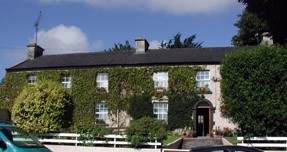
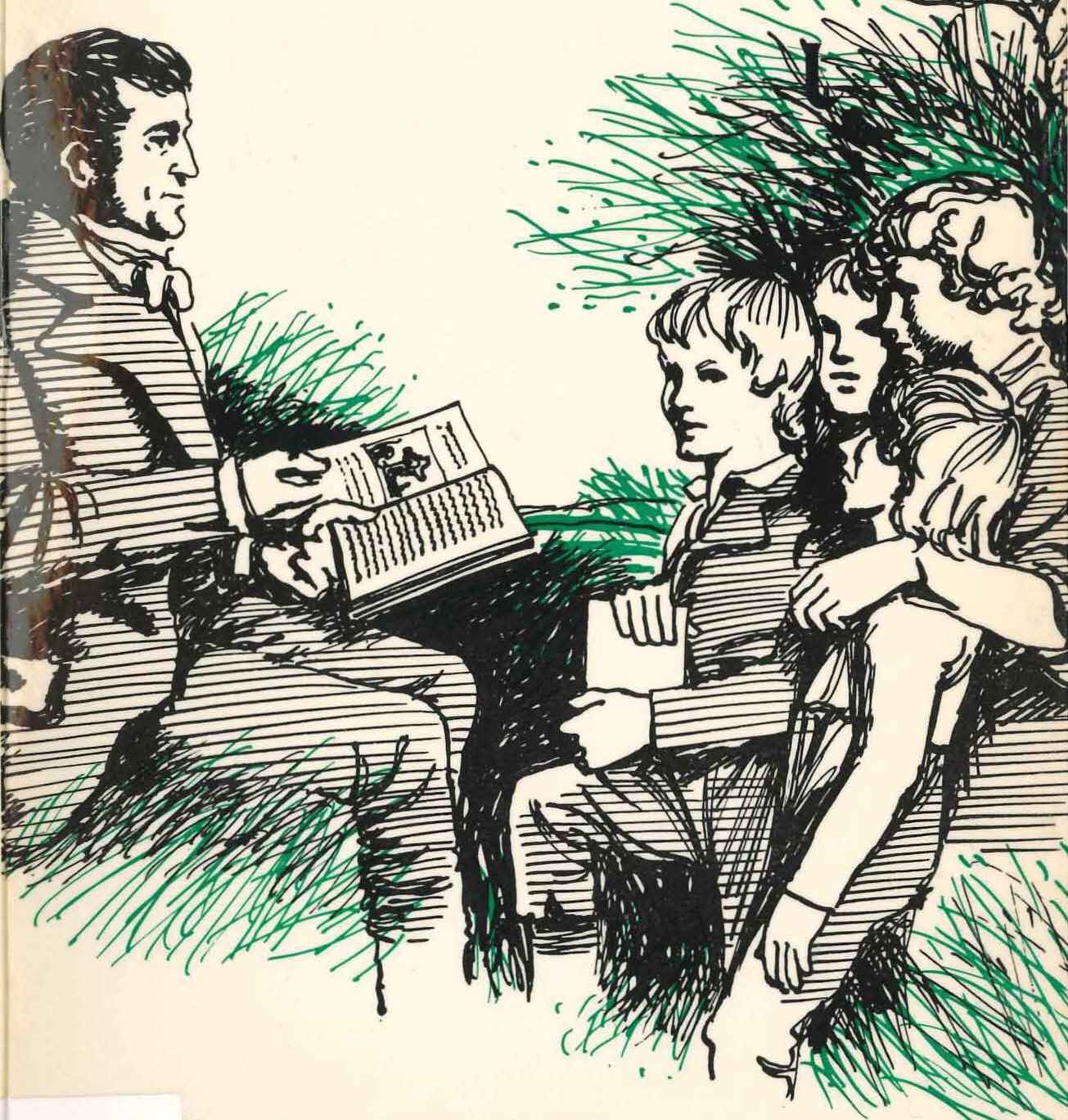
Francis was born into a country where the penal laws restricted the life and prospects of most Catholics. He initially attended a local Hedge School run by a Hugh McDonald where his genius soon became apparent. Soon he was enrolled in a highly regarded private school run by an Owen Reynolds at Glebe St., Mohill. The building where Reynolds school was located still stands and is now converted into two private residences. The Reynolds School was highly regarded in the teaching of Mathematics and McGann excelled in this discipline.

Owen Reynolds School. Mohill

    Owen Reynolds School. Mohill


Hedge school

Hedge school

McGann later moved on to a classical school in Drumsna run by a Parson Kane where he became proficient in Greek and Latin. By this stage McGann’s own reputation as a gifted scholar was widely known. In order to further his education in Mathematics, McGann travelled to Ballingarry, Co. Limerick, where he was enrolled in a school conducted by a Mr. James Baggot, himself a famous Mathematician of the day. In 1805 Baggott was advertising that he had acquired a supply of “curious mathematical and astronomical instruments,” in which he hopes his pupils will find “both pleasure and profit in the prosecution of their studies.”

Baggott was also noted for the fact that he was a friend and correspondent of Pierre Simon Marquis Laplace, the great French scientist and tutor to Napoleon. It is recorded that when Laplace was once in conversation with a Colonel O’Dell, a Limerick MP, he enquired if O’Dell knew of  “the great Irish mathematician. The Great O’Baggott”.

The Baggott School was an environment where the young McGann from Leitrim thrived but it wasn’t only Mathematics he was now learning. Baggott was also a member of the United Irishmen and his house in Ballingarry was where Lord Edward Fitzgerald stayed when he toured the country stoking up rebellion in 1798. Baggott is also said to have devised a plan for the capture of the city of Limerick. The plan was however discovered and the plotters all arrested. It is not known if McGann was amongst those interrogated but it is clear that Baggott had a huge influence on him and helped formulate in McGann’s mind the revolutionary ideals which were to become more apparent later in his life.

The Government in Dublin Castle were kept fully informed by a spy who signed himself “J.D.” of all Baggott’s movements, and a General Payne wrote advised Dublin Castle: “That rascal Baggott can neither be frightened nor bribed, and when Mr. O’Del returns I think we had better take him up.” The Government were right to be worried about Baggott and his school, particularly in light of his known correspondence with well figures in Parisian Society. Baggott died at Charleville on 31st August 1805 at the age of thirty five. He was widely mourned as can be noted from the following contemporary verse penned in his honour.

O Science, mourn! thy favourite is no more,

Alas! he’s numbered with the silent dead;

 Hibernia’s genius will his loss deplore

Whom he to fame’s exalted temple led.

By nature blessed with an exploring thought,

His brows were decked from the Newtonian tow’r

The deep arcana of fair Science sought,

And gleaned her fields of ev’ry golden flow’r

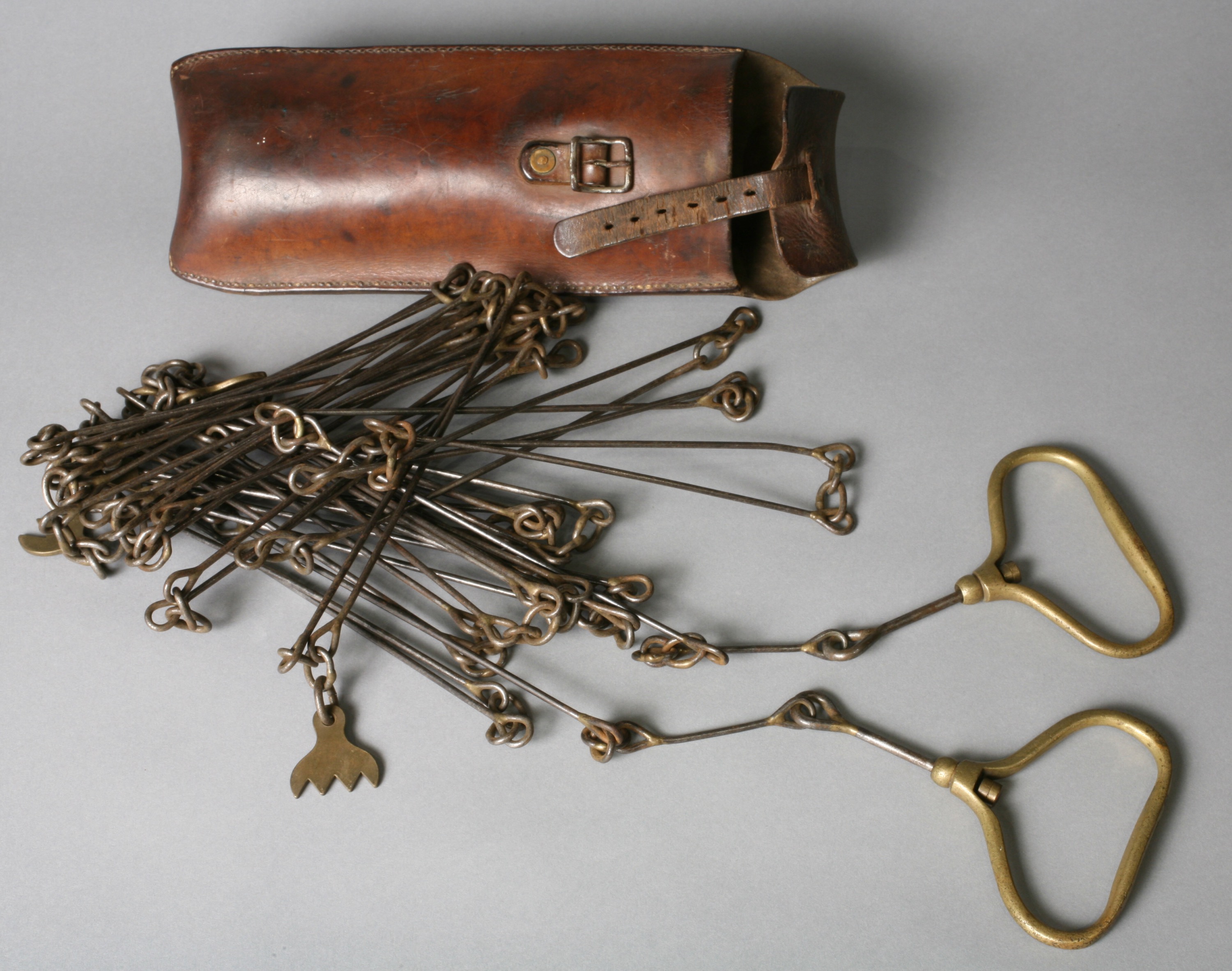
It can be surmised that the end of Baggott also signalled the end of Francis McGann’s education. Returning to Drumlara, McGann began working as a mapper / surveyor and a pioneer in the art of preparing accurate large-scale maps which were developed later by the Ordnance Survey. His attention to detail was widely known and it was said locally that he would even take care to “rub the breath off the chain” he used for surveying so that it would not distort his measurements.

 
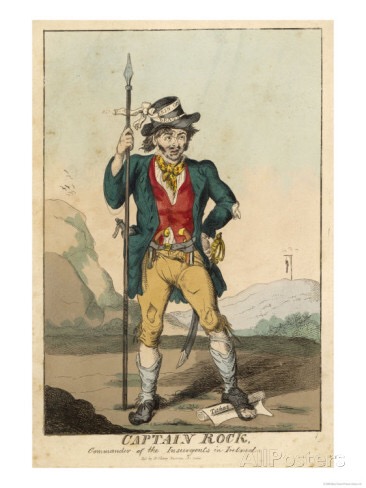
He drew a map of the district of Bunnybeg, Attymanus and Annaghhasna on a dried and pressed sheepskin for the landed Lawder family. He also mapped the townland of Killamaun and the length of the Eslin river. It is said that he was offered a position with the East India Company as chief surveyor but he declined. The Leitrim that McGann  returned to was the subject of considerable military activity in the decade following the failed insurrection of 1798. Although the United Irishmen were broken McGann became leader of a secret society known as “the Rock” “White Rock” or “Rockites”. It is little surprise that McGann was prominent and he may even have helped found such a militant agrarian society. The area where he had lived whilst in Baggott’s school was also a major centre of “Rockite” activity. A John Hickey of Doneraile, was suspected by the English authorities of the time of being ‘Captain Rock’. The Rockites tended to use United Irishman rhetoric and regularly mentioned that “assistance was to be given from France” to any Irish insurgents. One of the main Rockite aims was the placing “Catholics upon a level with Protestants”.


In late 1815 there were major civil disturbances in the Keshcarrigan and Gorvagh areas. In the aftermath several houses and farms were burned to the ground. A local landlord by the name of Minor Peyton had also retaliated by cutting the road into the townland of Laheen Peyton thus preventing the Catholic Tenants from getting to Mass. McGann organised a large meeting to be held at Keshcarrigan Fair on December 20th, 1815. His speech to the massive crowd there is recorded in oral tradition. He told the assembled crowd that he was there;

“to meet the intelligence, the genius and the mind of Kiltubrid and to denounce Minor Peyton, a tyrannical brute and a disgrace to humanity, who not being content with burning Drumcollop, he now tears up the pathway which lead to the ‘House of God’. But the Sun of his glory is set and today he is like the remnant of a melancholy wreck having nothing but tradition to point to his former grandeur and greatness”

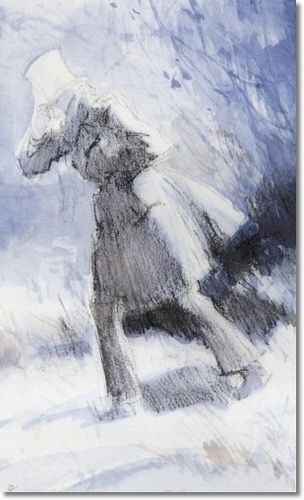
When returning from the mass meeting at Keshcarrigan Fair, McGann in the company of two men called Billy the Joiner and James Ward took shelter in a Sheebeen near Kilnagross. It had begun snowing quite heavily. The country had been enduring a severe cold snap and snow had lain on the ground for over six weeks. The people it was said had to boil snow to get a drink for their cattle. After a few hours McGann left the Sheebeen “for want of drink and fire” . It is believed he intended to visit the home of a young McKeon lady nearby with whom he was on friendly terms. Sadly McGann never reached his destination. The following day his body was found frozen to death in a snow drift, only short distance from McKeon’s house. Sadly ‘The Bright Boy” was no more and a few days later he was buried in Mohill. According to local tradition the place where McGann died was marked for many years by an evergreen tree which had become known as ‘The Monument’.
McGann’s passing was a huge blow to the people in the area.  His intellectual ability was noted from an early age. In many ways his life mirrored that of his mentor Baggott.

When McGann returned from Limerick he had matured and was clearly someone unafraid to take on the establishment both privately and publicly. Such men were in short supply in places like rural Leitrim.

The ballad, “The Fate of Francis McGann,” was penned by John Cox, the poet of Clooncarne in the parish of Bornacoola and in its folksy way it records the life and tragic death of this brilliant young man.

“He was versed in the language of all foreign parts,
And master of several bright liberal arts,
The art of surveying he had a command,
Mathematics and logic he did understand.
He could measure the air, the sea or the land,
John Cox gives his praises to Francis McGann.”


Many Swallows make a Summer

swallow

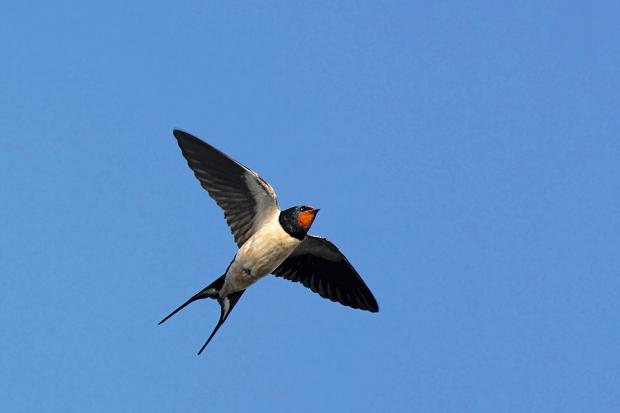
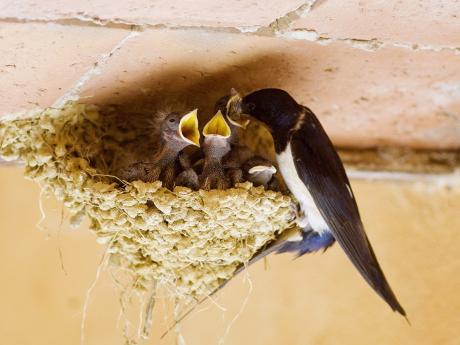
The annual arrival of the Swallow is one of the surest signs that Summer is on its way. We have had them since the beginning of April. The first weeks are spent securing their nests, building new ones and repairing old ones. You can find them anywhere but they seem to like farmyards and their byres, haysheds and barns. We have two permanent nests on our dwelling house, the oldest of which is here at least ten years now. I have managed to affix some plain corrie board from an old  poster directly underneath the nests to catch the droppings. The swallows might be cute but they have little respect for a freshly painted or whitewashed wall. One of our nests is high up under the eave on the Western Gable of the house whilst the other is squeezed in between an eave and a drainpipe. I’m reminded of the  The Wind in the Willows, where the swallows discuss with relish their impending return to “the house of the perfect eaves”. Not only are these tiny birds amazing flyers but they are great architects and precision builders too.

By now the birds are paired off, well settled in, with eggs laid and soon to hatch. The swallow practices love in a cold climate. The male and female will build the nest together. The long evenings are now spent darting and diving in the acrobatic pursuit of insects. It was the swallow after all who first invented the concept of in-flight dining. They say that the swallow is so adept that they can even swoop low along a watercourse and drink water without stopping. The skill and athleticism of these little birds are a sight to behold in the dying hours of the day. They are also very brave little birds and will swoop low like an F16 fighter pilot on any man or beast getting too close to the nest. I have vivid memories of the swallows teasing an old sheepdog we had at home, dive bombing him and turning him around in circles in the farm yard, in what for them must have been a source of endless amusement and mischief. The rest of their summer will now be spent rearing the insatiable chicks.

swallow 2

I always find it amazing to think that these little birds will next year return to this same place, the place of their birth and in some ways I feel honoured..

Billy Flynn, an ecologist for the Irish Wildlife Trust said , “Swallows travel in families, with the younger birds following their parents when they migrate for the cold months. What is incredible about them, Flynn explained, is that young swallows are still able to make the journey themselves, even if their parents have died or got lost before they had a chance to show them.

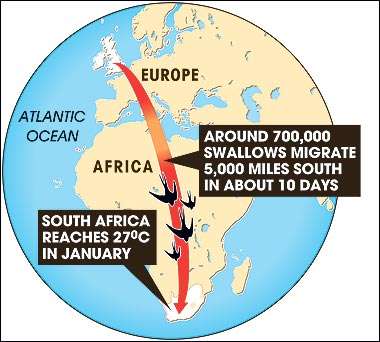
No one is exactly sure how they manage this but it is thought instinct plays a big part, as well as magnetism. Most animals have the mineral magnetite in their skulls and this gives birds a kind of internal compass. It’s an amazing journey, they pass over deserts, seas, they fly through all sorts of weather and when you see the tiny size of them, you can fit two in the palm of your hand.[i]

Migration map

Migration map

The swallow doesn’t seem to do retirement and is constantly on the move, He simply cannot sit still, a consummate workaholic. As if inventing in flight dining wasn’t enough he also promoted the classic long distance commute. As much as I look forward to them coming I hate to see them going; their departure signals the end of the summer. If they are gone before the Hurling final you can watch out for a bleak winter, if they linger on until October then it mightn’t be too bad. In the months following this I will curse again the price of oil, whilst Comrade Swallow has retired five thousand miles to the south, to his dacha in sub-Saharan Africa. Observers say the numbers of swallows are depleting and I sincerely hope that this can be reversed. It will be a very sad day if ever the swallow does not return.

The Swallow Song

Come wander quietly and listen to the wind
Come here and listen to the sky
Come walking high above the rolling of the sea
And watch the swallows as they fly

There is no sorrow like the murmur of their wings
There is no choir like their song
There is no power like the freedom of their flight
While the swallows roam alone[ii]

[i] http://www.thejournal.ie/swallows-summer-2067147-Apr2015/

[ii] Richard farina – Chapell music

“The savage loves his native shore”

Packy McGarty

I’ve had the pleasure of meeting Packy McGarty on a few occasions and one thing that always strikes me is how he remains, even at 82, quick in mind and light on foot. In an era of high performance coaching, increasing demands on players and the onset of the ‘elite’ County player, programmed to play numerous systems and tactical set-ups, McGarty remains a beacon of light, a reminder of what makes the GAA great and unique. Surprisingly, to some at least, its not about a dresser full of medals.

I enjoyed this piece by David Kelly in today’s ‘Independent’.

http://www.independent.ie/sport/gaelic-games/gaelic-football/we-never-won-anything-but-we-competed-and-i-made-great-friends-in-every-county-31330735.html

“He Wishes for the Cloths of Heaven”

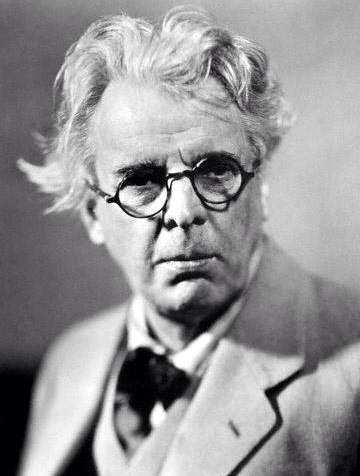
 William Butler Years was born on this day in 1865. Although born into the Anglo-Irish ascendancy Yeats could arguably be said to have done more to reshape the modern Irish identity than any if his contemporaries. Yeats drew his inspiration from ancient Irish myths and folklore and as an ardent cultural nationalist, valued the classical past as an inspiration for a modern pluralist society. He has so many great poems and this is one of my favourites that simply has to be read aloud.

He Wishes for the Cloths of Heaven”

Had I the heavens’ embroidered cloths,
Enwrought with golden and silver light,
The blue and the dim and the dark cloths
Of night and light and the half-light,
I would spread the cloths under your feet:
But I, being poor, have only my dreams;
I have spread my dreams under your feet;

Tread softly because you tread on my dreams.

A Loop in the River

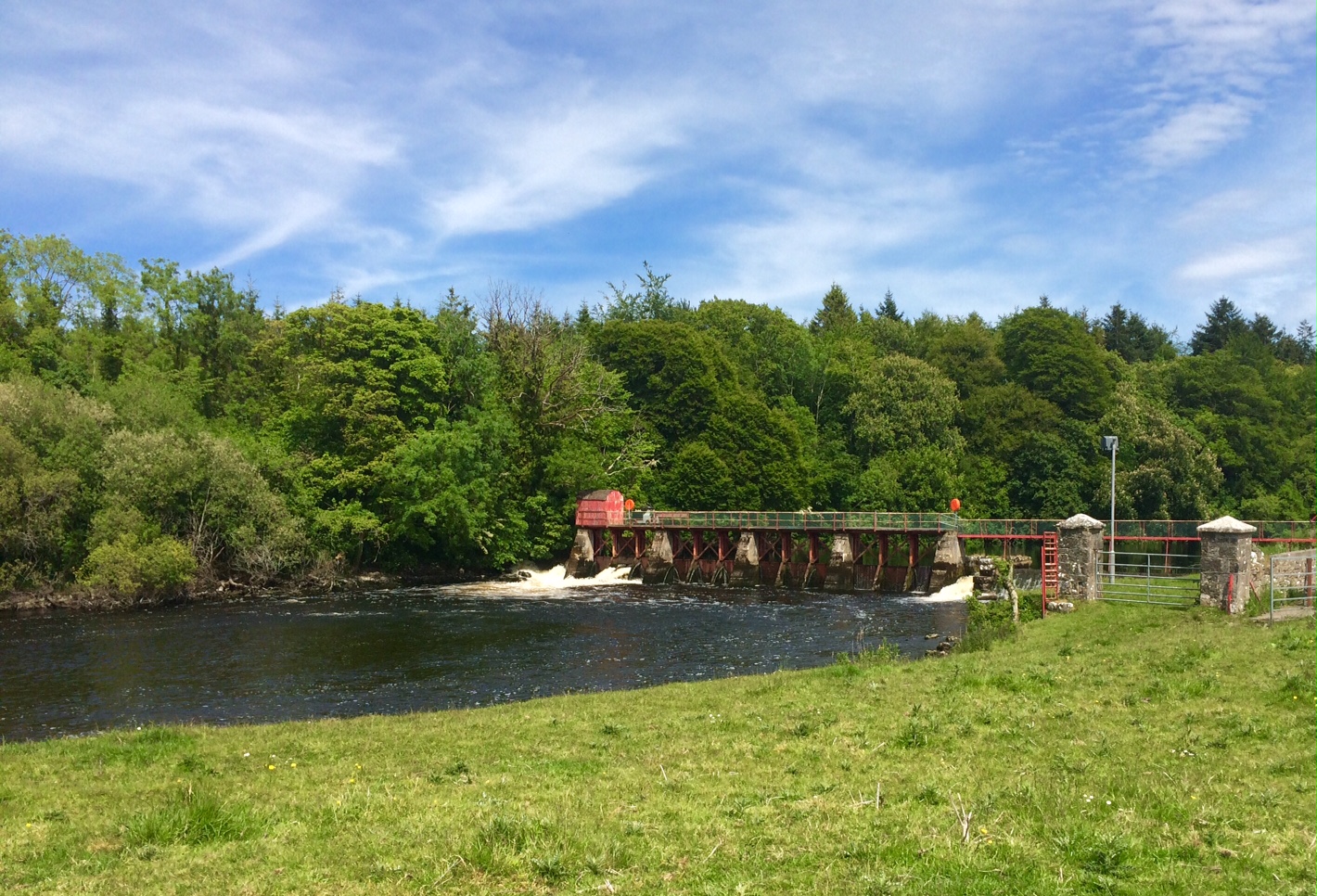
The Weir at Jamestown

The Weir

This Blog’s title owes itself to the River Shannon. The river meanders its way through the countryside and provides us with some beautiful backdrops. Today the sun was shining brightly which can be rarity hereabouts, at least of late. I was smiling to myself after a friend told me a little anecdote about Rick Santorum the US Republican Senator. Apparently Santorum had said that Pope Francis ought to leave climate change to the scientists! Poor Rick however was apparently unaware that the Pope, prior to taking orders was a trained chemical lab technician. Little matters like Ricks oversight can make you feel happy sometimes. As I was passing through Jamestown the river came into view.  I just had to stop the car to admire the beautiful Weir and the sound of the cascading waters. I was reminded of those beautifully crafted lines of Kavanagh:-

“Where by a lock Niagariously roars

The falls for those who sit in the tremendous silence

Of mid-July. No one will speak in prose

Who finds his way to these Parnassian islands.”

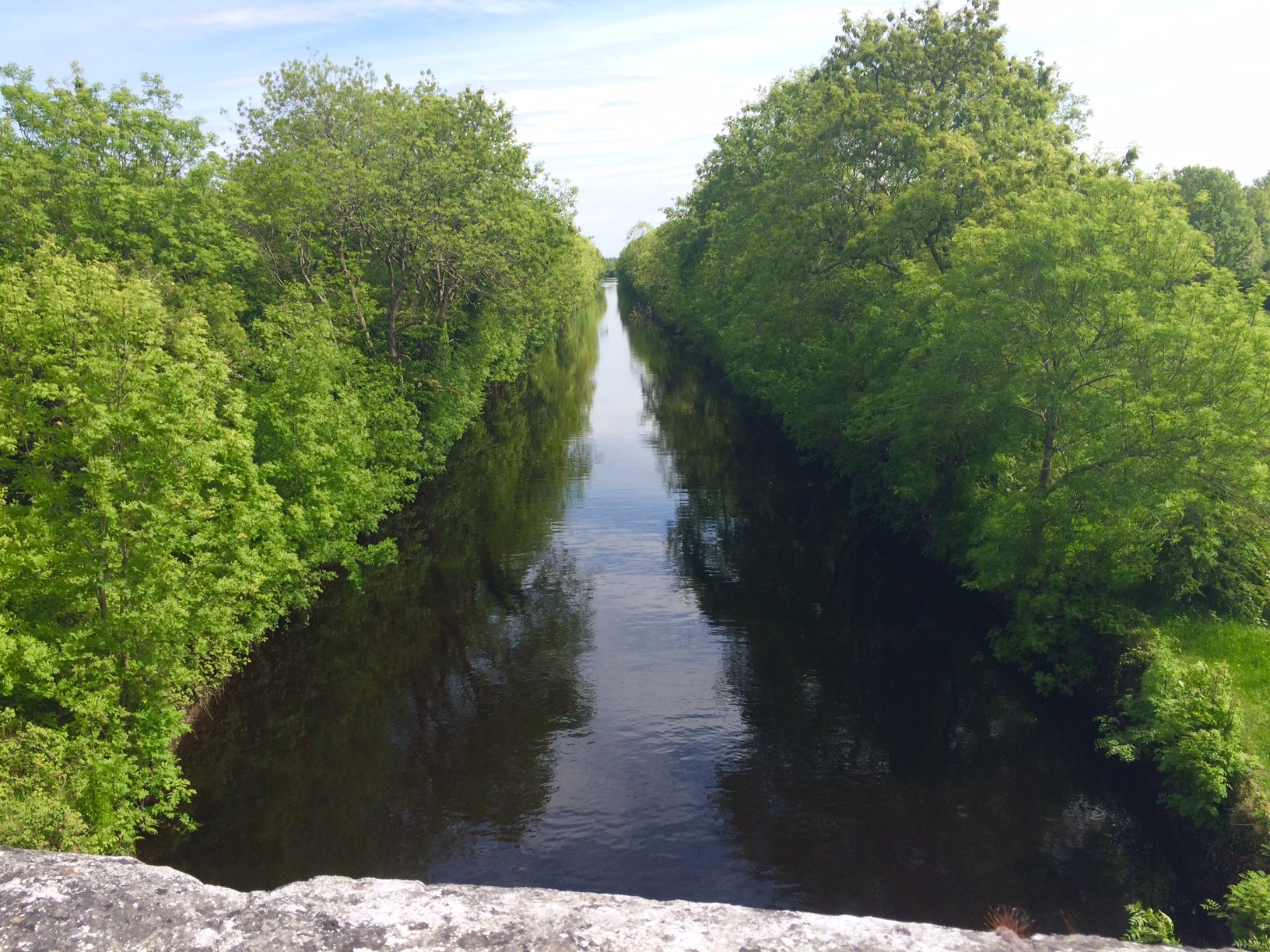
A few minutes later I stopped at one of the bridges that traverse the Albert Lock and Canal. This stretch of water is likely to be very familiar to the boating fraternity on the Upper Shannon.  It is also an area rich in history ancient and modern. The canal is also known as the ‘Jamestown Cut’ and it bypasses an un-navigable part of the river in the loop between the neat villages of Jamestown and Drumsna.

The Albert Canal

The Albert Canal

Jamestown itself was founded in 1622 as a walled plantation town and remarkably, as a recognised borough, it returned two MP’s up until the Act of Union in 1801 . The town itself never really flourished in the manner envisaged by its founders. Its prominence peaked in the mid seventeenth century when it was fought over during the 1641 Rebellion. In 1650 a famous Synod of the Bishops was held here but from then on the town declined although it retained a modest river trade and was still a significant fording point over the Shannon. The importance of the crossing point has long been recognised. The area marked the traditional fording area and point of demarcation between the ancient provinces of Connacht and Ulster. The ‘Doon’ of Drumsna stretched for over 1.6 km between the villages of Drumsna and Jamestown.The Doon consisted of a large earthenwork rampart up to six metres high on its northern side. The ramparts also had a fortified gate or entrance and was effectively an ancient ‘Checkpoint Charlie’. It is believed that the Doon was in use in the period 500BC to 400AD.

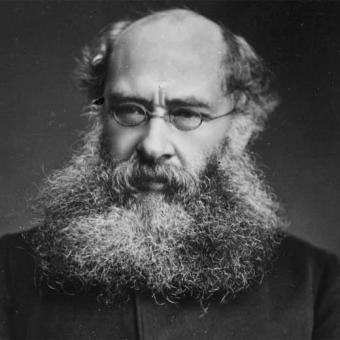
Drumsna is also a picturesque riverside village. Up until the mid Nineteenth Century it was of huge significance as the main postal town of the southern part of the County of Leitrim. The Novelist Anthony Trollope lived for a time in the Village and penned one of his earliest novels ‘The Macdermotts of Ballycloran’ here.

Trollope

Trollope

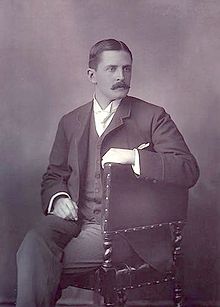
Another famous person associated with the area is the famous Surgeon and Explorer Thomas Heazle Parke who was born in nearby Clogher House. Parke made a name for himself in the relief of Gordon at Khartoum in 1885. He also worked with Henry Morton Stanley in the Emin Pash Relief Expedition. Whilst in Central Africa Parke is said to have purchased a pygmy girl, a strange act in modern terms but one which saved his life. When he contracted malaria the girl nursed him back from death. Unfortunately he could not bring her with him as her eyes could not adjust to the sunlight after coming out of the dark of the forest.

Thomas Heazle Parke

Thomas Parke

The Canal was first mooted in the 1600’s as part of an overall scheme to make the Shannon navigable. A canal was not constructed however until 1769. The original canal was much smaller and narrower than what we see today and its depth averaged only 1.2 metres. The Shannon Commissioners approved new works in 1844 and much of the construction work was carried out by Poor Relief Committees during the famine. On average 300 men worked on the Canal daily at this time. The new Lock was named after the Prince Consort and husband of Queen Victoria. The canal served the area well commercially until the late 1950’s by which time increased use of road haulage made the river barges obsolete. From a highway of commerce the river has now become a leisure route . I hope today’s  canal users take just a moment to think of the local labourers whose backbreaking toil, with hand tools, built this fine canal, all for the measly sum of six pence a day.

All the toil of man is for his mouth, yet his appetite is not satisfied

Ecclesiastes 6:7

Archaeology of Leitrim

I see a new Facebook page dedicated to the extensive Archaeology of County Leitrim. This is the link:- https://www.facebook.com/pages/The-Archaeology-of-Co-Leitrim/937361499659406

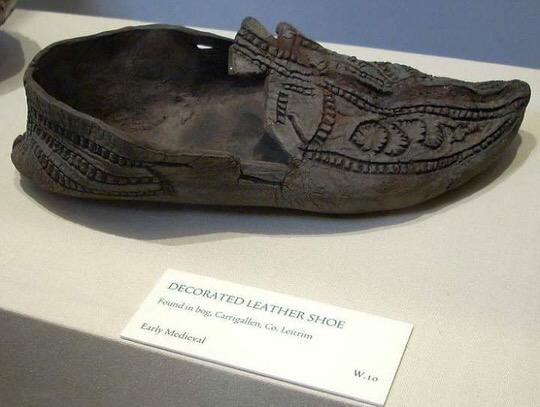
This is my favourite picture; some fancy footwear from medieval Carrigallen, found near the Ringfort in Kilahurk apparently.

  
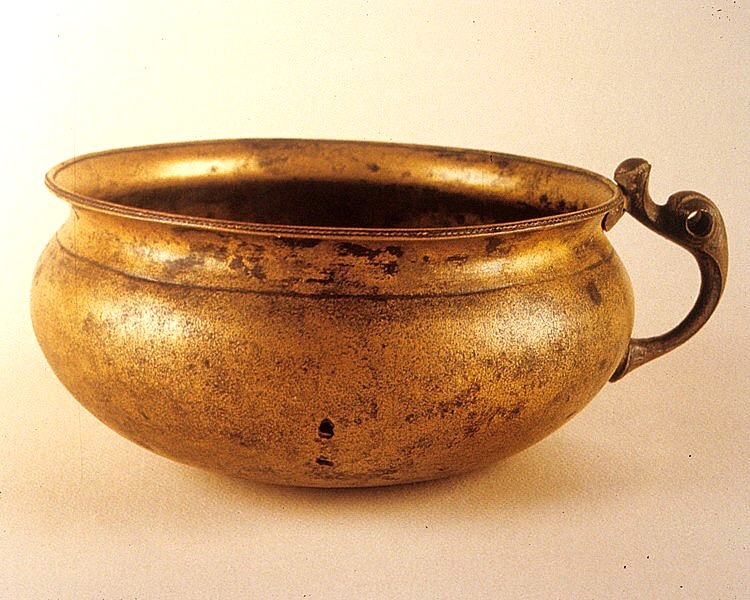
Of course one of the most beautiful pieces ever found in the County has to be the Keshcarrigan Bowl. 

  
The Facebook page goes on to say: 

“The Keshcarrigan Bowl …..discovered in Loch Marrave near Keshcarrigan village in 1854 during the original excavations of the Shannon/Erne Waterway . The vessel which may have been a ceremonial drinking bowl,is of fine golden bronze about 1mm thick and was formed by spinning. The handle which is cast ,is in the form of a bird . The eye sockets, now empty, probably held enamel settings . It is on display is in the National Museum”

The Bowl also appears on the wonderful Book and App entitled ‘History of Ireland in 100 Objects’ ,well worth a look http://www.100objects.ie

Leitrim is brimful of some great Archeaology both ancient and relatively modern from the 19th Century Lime Kiln at Farnaught to the portal tombs of Fenagh. Looking forward to future updates on this page.

Roscommon / South Leitrim: Bold Child or ‘Deliverance’ Country

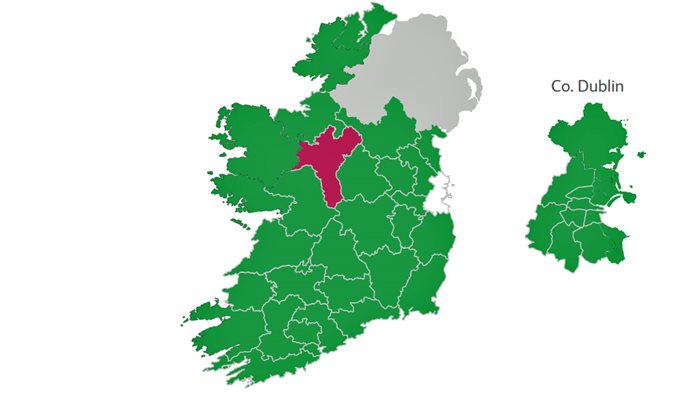
Referendum Map

Recently one of my children had a birthday party at our house. One of the adults asked them if they now felt older? The child appeared a little bemused before emphatically replying ‘No’. For the majority of people in this State the same applies to us today. Yesterday was a significant moment in our Nation’s history but it is hard for many to describe how this different new reality actually feels. Many of these same people voted magnanimously to extend the right of marrying the person they love to all citizens. Marriage is no longer the preserve of heterosexual couples and marriage will be simply defined as a union of two people based on the bond of love. Yet so much in our Country remains the same. The weather forecast for Ireland yesterday said that it would be sunny, with the rain spreading in from the West and patchy showers later in the afternoon. Strangely in a scene similar to that in the film ‘Grounghog Day’, the weather forecast for today also says that there would be sunny spells, followed by showers spreading from the West later. No change there then! But things have changed, dramatically, especially for the many supporters of what will become the 34th Amendment to our Constitution. Many will have woken up feeling that they are now living in a more tolerant, accepting society, a country that despite today’s weather forecast, will seem just a little bit warmer than it did yesterday.

Except in Roscommon-South Leitrim that is, where many ‘Yes’ supporters are disappointed that their Constituency is the odd man / woman out by not voting yes to Marriage Equality. Outside the Constituency the response has been predictable enough. Twitterati and Facebookers are quick to point the accusing finger at those homophobic, medievalists that populate this area. Some of the comments are particularly uninformed and generic. One comment suggested people in the area were banjo-playing opportunistic rapists waiting for a ‘purdy mouth’ to come along. Comparing Roscommon-South Leitrim to ‘Deliverance’ country does not however cut as deep as to be ridiculed by one’s own. 

Many expats decried Roscommon and South Leitrim kinspeople for letting them down and spoiling the party. The comedienne, Katherine Lynch said that ‘Leitrim was dead to her’, but the Mohill native is known for being tongue in cheek, and I hope she is this time too. Others made quips about Roscommon seceding and joining Zimbabwe, more suggested that if the Referendum was about marrying cousins or farm animals, there would have been a better response. Most of the authors of such comments probably only did so for fun but the cumulative effect of this condemnation is to pillory and castigate a rural constituency where 48.52% of Voters actually supported the idea of Gay marriage. That is phenomenal figure yet many ‘Yes’ campaigners are quick to forget about those same people who made the effort to go out and vote for the same cause as them. Such an attitude seems bizarre and is surely the best recent example of throwing the proverbial baby out with the bathwater.

  In such a rush to chastise and cajole the Voters of Roscommon-South Leitrim it seems completely lost on the accusers of just how paradoxical their utterances are; especially in light of what they themselves were asking the people of Ireland to do last Friday. In doing so and in disregarding the right of a person to Vote in whatever way they wished, the accusers are themselves guilty of spreading intolerance, narrow-mindedness and prejudice. In many ways it spoiled some of the positivity that emanated from the result. Surely any accuser should wait and carry out a little analysis of why there was a higher percentage of No voters in this area than any other constituency.  Don’t  forget the referendum was carried by a slim margin of just 33 votes in Donegal North East and was in the low fifties in some other areas. Roscommon-South Leitrim is only unique because the bar is set at 50%, the simple majority rule , and it just fell short of that threshold. 

This is a predominantly rural community but its traditionalism and conservatism does not always stand up to scrutiny. Leitrim is home of one of the seven signatories of our Proclamation of Independence and a true social revolutionary, Sean MacDiarmada. It also is the birthplace of the socialist Jimmy Gralton, the only man to be deported from the country of his birth for his ‘radicalism’.  It is the home of John McGahern a paradigm of tolerance, respect and liberal values. Leitrim is also well known for its large Bohemian community of artists, writers and sculptors who have certainly made the area more diverse in both thought and outlook. So why is the area so out of kilter with the predominantly urban / sub-urban parts of the country. Firstly, I’d advise anyone who supports the lazy sterotyping of the constituents here as homophobic banjo players, to take a short tour through the Constituency and make a few notes on the following matters in particular;

  1. What do think of the vibrancy of the towns in the area? Are the high streets thriving?
  2. Did you meet many young people in the 18-35 age bracket?
  3. How did you travel by the way? Was it by public transport? Doubtful.
  4. How many flourishing businesses did you see?
  5. Make sure to bring bottled water (it’s a case of ‘water water everywhere but not a drop to drink’ in large areas here you cant even drink the tap water?
  6. Did it take you long to upload one of your barbed comments to your social media account? Seriously try it, the broadband here is terrible and satellite alternatives are expensive.

If you tried the above suggestions you’d invariably find many depressed market towns, some dead, some dying, others like Carrick-on-Shannon dependent on tourism and weekends of stag and hen parties. But when the stags and hens leave, and we clean up after them, nothing much has changed. There are very little employment opportunities in the area, most of the young people have left and one of the best barometers to confirm this is the local GAA clubs struggling to field teams. So what about those who are left? The majority are members of a demographic that the yes campaign had most difficulty connecting with throughout the country, nothing unique there. The difference is that a larger percentage of them reside here proportionally than in any other constituency. We have the oldest electorate, fact.

Not all ‘No’ voters in the area are part of this traditional, conservative group and the majority, I’m absolutely sure of this, are not homophobic. This is an area where the people are frustrated and disconnected from Government and Politics in general. Their communities are decimated by the loss of essential services; Rural post offices – Gone, Rural Garda Stations – Gone, Rural Scools and teaching posts – under threat,  Public Transport- almost non-existent with routes been cut by Bus Eireann annually. Oh and on your tour you will have noticed the motorway ended before Mullingar. The IDA rarely ever visits places like Leitrim, Longford and Roscommon and therefore he chances of major investment is slim. The largest employer in the north of the area, MBNA, is gone and despite all the assurances of Minister Bruton no replacement has been found. Those small and medium enterprises that do exist find they are hamstrung by poor infrastructure, especially the lack of adequate broadband. A mobile phone call usually involves leaving the house and finding a place of optimum coverage, maybe climb up on the roof or up a tree! Mental Health campaigners will confirm that the erosion of services has led the greater isolation amongst the elderly in the area, many of whom have had their home help hours cut back. The area also has had the highest rates of suicide in the country particularly amongst our young people. When people talk about Equality do they factor these issues in to the equation. 

Many will say these issues have nothing to do with the Marriage equality Referendum but such a view is foolish and naïve. The Voters in this area are completely disconnected from National Government and detached from the prevailing messages of the mainstream Dublin based media. They are chastised now as bold children who did not do what they were expected and urged to do. That is precisely the point, a community that has been neglected so much in terms of investment, both socially and economically will also be prone not to toe the establishment line. And let’s be absolutely clear, whatever about past prejudice and mores, supporting same sex marriage is the establishment view and was advocated by all the main political parties. 

It is in such an environment as exists in Roscommon and South Leitrim that induces the people to elect people such as Ming Flanagan and Michael Fitzmaurice, two men who many in polite society on this Island would consider square pegs in the neat round holes of Dail Eireann. Yes campaigners will also say that the vote in traditional working class areas was high but all this shows is that rural and urban deprivation are two different creatures altogether. This constituency and its people are rooted in the soil, its towns developed to serve the farming hinterland in a symbiotic model. Now both are in decline and nothing is been done to address it. The influence of the church is also a red herring. There are hardly any vocations now for the priesthood in this area no more than Dublin or Cork or any of the cities and mass attendances have dwindled. The voters here are as likely to react negatively to Mother Church telling them ‘Vote No’ as to the Taoiseach telling them to ‘Vote Yes’.

Despite all the foregoing almost half of the people who voted in Roscommon South Leitrim voted YES to change, Yes to a more inclusive society for members of the LGBT community. That is something the YES keyboard warriors should be celebrating and instead of pulling the plug and letting their own children flow out with the bathwater. Many people from the area who would be voting ‘Yes’ now live in other parts of the country and contributed to the Yes campaigns and votes in those areas. In the run up to the election many ‘Yes’ campaigners told us this Referendum was about promoting tolerance of difference and respect for minorities. Surely then if the accusers are genuine and honest, they should extend the same respect to the people of Roscommon South Leitrim who simply didn’t agree with them, something which it is their hard won, Constitutional right to do so. As Evelyn Beatrice Hall famously wrote ‘.   “I disapprove of what you say, but I will defend to the death your right to say it’. 

The only way of depicting the Roscommon South-Leitrim result as indefensible is to portray the constituents as backward, conservative zealots and such a strategy diminishes the core and heart of what was achieved by the ‘Yes’ campaign in this Referendum. So a huge sorry from us for not being above-average and being 13% behind the average test score nationally. Feel free to go ahead and bully us on the internet. At least Marian Keyes had the decency to apologise but insults are like toothpaste, once out its impossible to get it back into the tube.