Category Archives: Rural Ireland

SUPPING AND GLAMPING

Shannon-Blueway-TourismShannon_blueway_icon

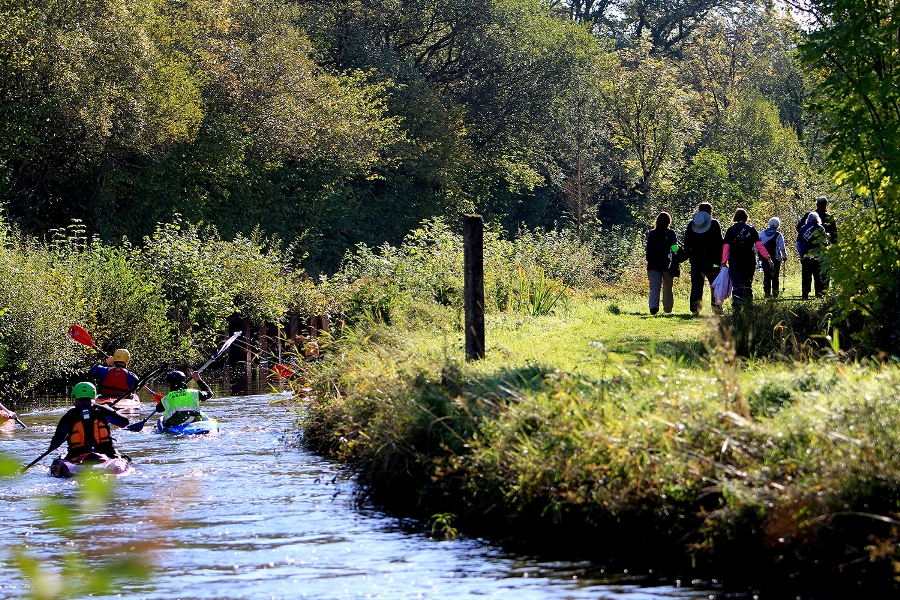
A few years ago many of us would not have known what terms like Glamping or Supping meant. The cousin, JP, thought Glamping was a nocturnal activity himself and Eddie Joe did at the weekends with a large spotlight attached to the bullbars of his jeep, scanning the bogs for Foxes.  So you can imagine my surprise when JP announced recently that he and ‘the woman’ were SUPping over in Drumshanbo at the weekend. Being old school I thought supping was something JP did whilst shouting at a TV screen in the local whilst elucidating on the performances of his ‘beloved’ Everton. For JP, until now that is, a good sup, usually consisted of 8-10 pints of Smithwicks. This time though JP wasn’t having me on, he had just spent a few leisurely hours paddling down a canal in what is now known as Leitrim’s Blueway.

The Shannon Blueway is in fact the first of its kind in Ireland, an inland series of  water and land based trails. It facilitates paddling from Drumshanbo to Carrick-on Shannon via Battlebridge and Leitrim Village. JP isn’t the only one raving about it, numerous Travel Writers and journalists are focussing in on places like Leitrim and initiatives like the Blueway. In the coming years we will likely see the development of a number of Greenways in the County. One of these planned Greenways will traverse North Leitrim from Dromahaire to Glenfarne on the route of the old Sligo-Leitrim and Northern Railway. Another Rail Trail is planned for South Leitrim running from Mohill to Belturbet in Cavan along the former route of the Cavan-Leitrim narrow gauge railway. All of these projects are wonderful and all hope to emulate the success of the Greenway in Mayo.

I decided to investigate at the weekend and although it was damp and cold I was well wrapped up by the time I got out of the Jeep at ‘Beirnes of Battlebridge’. Set on the banks of the River Shannon, there is a charming caravan and camping park her, set in natural sylvan surroundings. The Pub at Battlebridge has being in the Beirne family for generations. The place was one of Ireland’s best kept secrets until the charming rural retreat was the proud recipient of several awards, including: Black & White Pub award and Irish Pub of Distinction. In 2014 Beirnes was nominated by “The Irish Restaurants Association” for “The best gastro pub award”. The Caravan and Camping Park has standard pitches as well as the opportunity for some Glamping and has been listed as one of the “10 best Irish camp-sites” by the Irish Independent. You can even do a bit of paint ball shooting here.

Battlebridge has in fact two bridges, one crosses the Canal and the other the Shannon itself. The Canal was built as to assist navigation south of Drumshanbo and I head for a walk that starts between the Canal and the river. The walk is a loop walk to Drumhauver. It is a pleasant walk and like all canal-side trails is easy going due to the level ground. The sun is starting to dip in the west and I can see the Shannon to my left and its flat ‘calloughs’ fields and plenty of ‘pools among the rushes’ as Yeats wrote. The halfway point is a set of locks at Drumaleague. Here the frost laden crest of Sliabh an Iarainn comes into view, it’s white crown unseasonal but not unprecedented.  The turning point in my walk is Drumhauver Bridge and I take a break after walking for an hour at this stage.  I have met a score of people walking on the canal bank both visitors and locals I surmise. The lack of fitness begins to tell on the southern return leg. At Drumaleague I am like a marathon runner who has hit the infamous wall. I curse my over-confidence but struggle on, get a second wind, and in the fading light I reach Battlebridge again. I reward myself with the wonderful restorative properties of a pint of plain in Beirnes. Whilst I didn’t meet any SUPpers enroute I can appreciate that a paddle down the canal from Drumshanbo to Carrick-on-Shannon is on my to-do list for when the long evenings ahead. There are certainly many more activities such as trails and walks in Leitrim these days as we strive to attract those interested in activity based holidays. Great credit is due to the Leitrim Development Company, Leitrim Tourism and funds such as Leader and the Rural Development Programme (RDP) which have provided practical advice and financial resources to people interested in developing tourism focussed projects.

Recently, Pol O’Conghaile, the Travel Writer wrote a heart-warming article in  the Irish independent setting out Ten Great Reasons to visit Leitrim. Pol opened with “It’s small, off-radar and home to just 32,000 souls. But Leitrim packs a serious punch… and lots of surprises for the visitor” and went on to list the County’s Literary connections, its natural beauty spots, adventure breaks, award winning restaurants and describes the place as an ‘adventure Eden’ and ‘walkers paradise’. The article went mini-viral and was shared, mostly by Leitrim residents and ex-pats, although few in number, we Leitrim folk are very proud of our little corner of God’s creation. The article had the capacity to instil a pride in a person’s home place in the way that a parent feels  all gooey inside when their young daughter wins first prize at the local feis. I was no different, anybody who reads this blog will quickly realise that for me Leitrim is one of the loves of my life. Hopefully such articles will be read by more than just sentimental Leitrimites around the world. Come visit we’re open. 

http://www.independent.ie/life/travel/ireland/10-great-reasons-to-visit-leitrim-30739767.html

MATTHEW SADLIER – Leitrim’s ‘Titanic’ victim remembered

titanic_ship-1920x1080

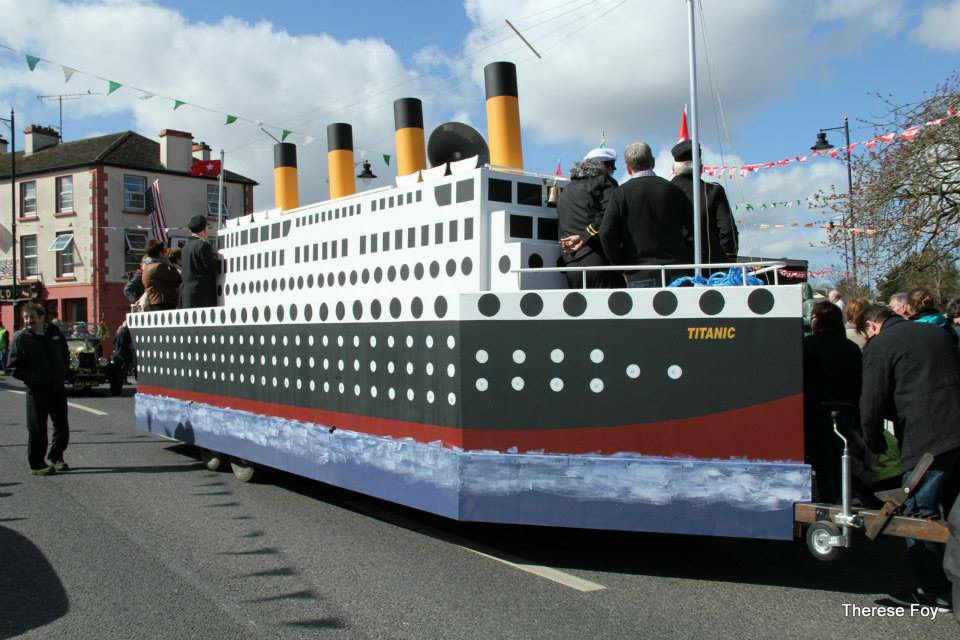
April can be considered ‘Titanic Month’ for even though the famous liner sank to the sea floor 103 years ago, people’s fascination with the story shows no signs of diminishing. Titanic is the ultimate story that just keeps on giving: it is romance, and tragedy, there are heroes and villains, there is superstition and most of all the folly of man underestimating the power of nature.

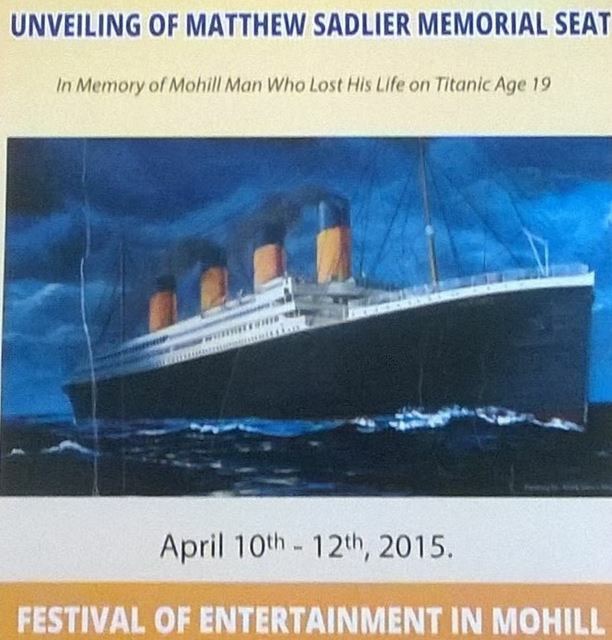
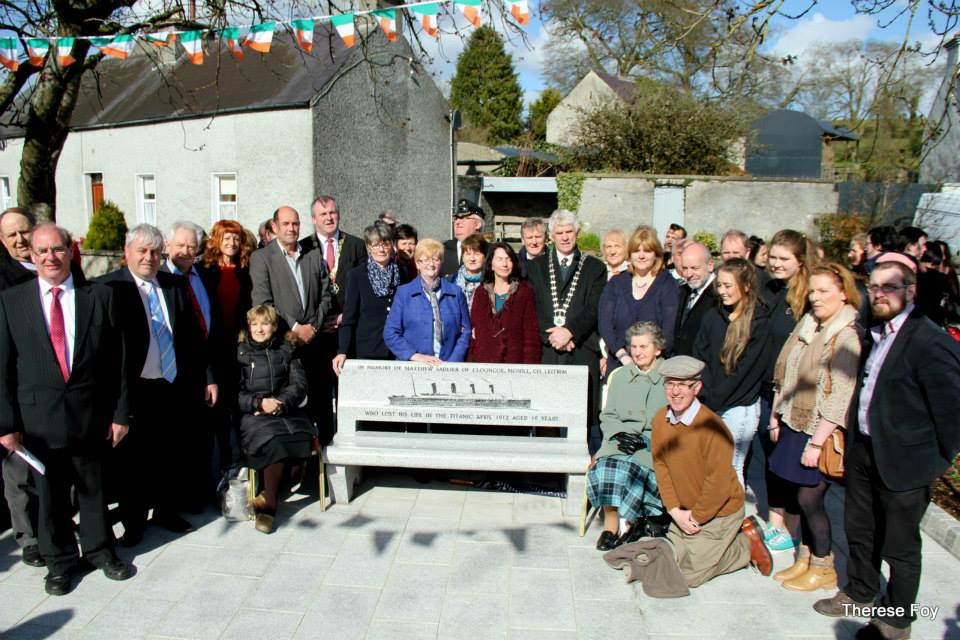
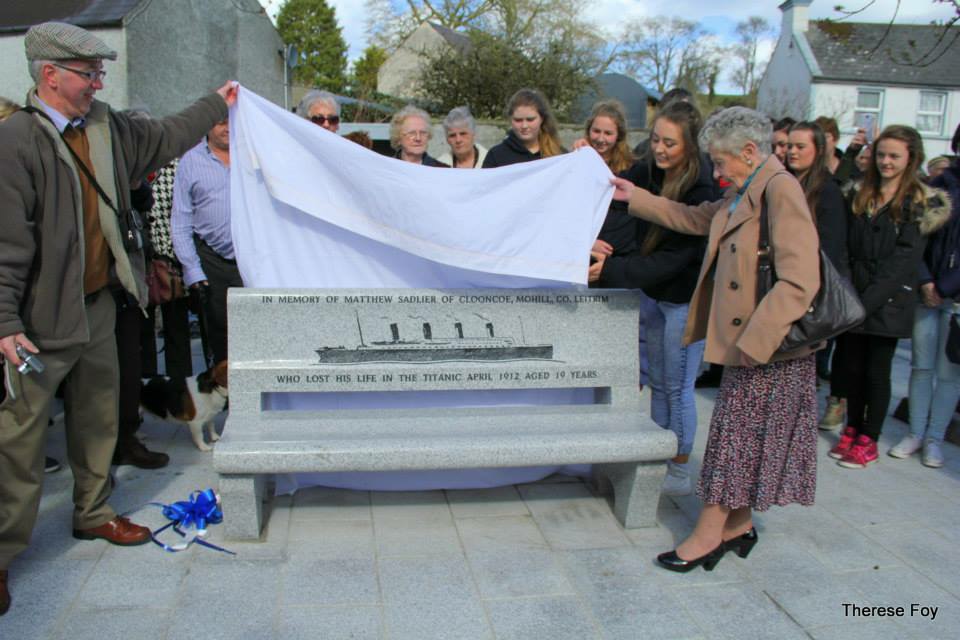
This month a small town in the North West of Ireland took centre stage as its own connection to the Titanic disaster was recalled and a commemorative seat unveiled to its own maritime victim. Mohill is the home of Matthew Sadlier a 19 year old lad who set out for New York to start a new life for himself. Over a year ago a Committee was set up in the town involving the local youth group, Foroige. They were joined by some more experienced hands and they got to work preparing a plan to commemorate the life of young Matt Sadlier. They decided upon a commemorative seat to be located in a prominent position in the town and also set out to contact any living relatives of Matthew. The Committees work came to fruition in a wonderful weekend of events associated with the Titanic, the highlight of which was the unveiling of the memorial in a newly renovated plaza.

IMG_1837

Who was Matthew Sadlier?

Matthew was born in 1892 to Matthew & Catherine Sadlier at their house at Clooncoe on the shores of beautiful Lough Rynn. The house was located on the famous Lough Rynn Estate, home of the Clements family, the Earls of Leitrim. The Sadliers were members of the Church of Ireland and Matthew was baptised at Farnaught Church on the 8th October, 1892. Matthews Civil Birth Record shows his birth was recorded just over two weeks later on the 26th October. The Civil Record gives his date of birth as the 8th October also, the same date as his baptism, something which seems extraordinary today. The informant is Dr Henry Pentland from Mohill who it says was present at the birth. This would suggest that Matthew may have been brought to the baptismal font on the same day as he came into this world. The fact that the Sadlier home is located so close to Farnaught Church means this would not have been a long journey but would have been, at the very least, be a great imposition on poor Catherine. Matthew Seniors occupation is recorded as an Agricultural Labourer. Catherine’s occupation is not given but as she was to bear Matthew Senior 9 children, 7 of whom would survive infancy, it is likely all Catherine’s time was taken up with child rearing and keeping house.

Matthew and Catherine did not always live at Lough Rynn. They married on the 25th February, 1881 at St. Marys Church of Ireland, Mohill. The church is reputedly built on the site of the original monastery, Maothail Manachain which was the precursor to the modern town of Mohill. The founder of the monastery was St. Manachan and his feast day is the 25th February, the same day that Catherine & Matthew Senior took their vows.

Matthew Senior and Catherine were both born in the same townland on small tenant farms just a mile west of the town of Mohill. Matthew Seniors father was Henry Sadlier, who was born circa 1810, but unfortunately the location is unknown. As well as farming his small holding Henry also for some time was a weaver. The fact that he was engaged in weaving might suggest that the family may have migrated to Leitrim from a more north eastern location where the linen trade was predominant. Henry Sadlier died on the 25th November, 1885 at the age of 75. He was buried in Mohill Church of Ireland Cemetery and we also know he died a widower, his wife having predeceased him. Present at his death was a Sarah McCombs.

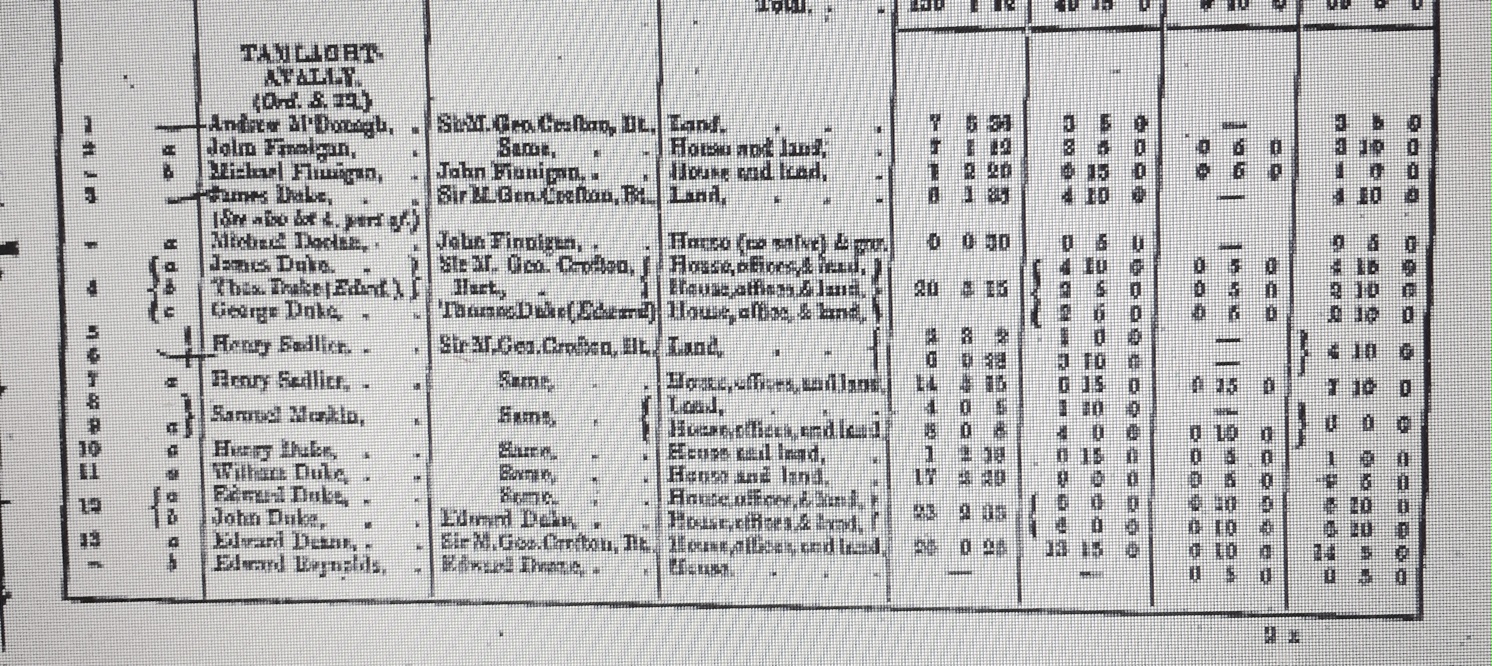
Griffiths Valuation (1857) shows Henry as holding a tenancy on the Crofton Estate in the townland of Tamlaghtavally. His holding is just shy of 15 acres in size which would have been well above the average holding in the area at that time.

 Tamlaghtavalley 1857 Griffiths

Sadlier Holding No’s 5,6 & 7 Tamlaghtvalley, Mohill, 1857.

 Catherine Sadlier, the mother of tragic Matthew, was born to Thomas and Anna Duke, also in Tamlaghtavally, Mohill in 1852. She was baptised in St.  Marys Church of Ireland on the 22nd December that year.

The 1901 Census will show Matthew Senior and Catherine Sadlier living in Clooncoe with their 7 surviving children Thomas (19), William (18), Jane A (16), Fanny (15), Henry (11), Kate (9) and young Matthew (8). 10 years later when the enumerators called again to the Sadlier household only Kate and Matthew remained at home. Catherine would go on to marry a William Boddy and live out her days in Mohill.

William the second eldest appears to have been the first of the Clooncoe family to cross the Atlantic circa 1904. The following year, the elder brother Thomas made the crossing, stating on the ship manifest that he was travelling to William at 49 Grove St., New York.

It is clear that young Matthew was intent on joining his siblings in America as soon as he possibly could. Matthew purchased a 3rd Class ticket (Ticket No. 367655 , £7 14s 7d) on the White Star Line to New York. It was a considerable sum of money at the time. Senan Maloney recounts some local lore about Matthews final days in Clooncoe;-

‘His parents didn’t wish him to leave , his mother being particularly attached to her youngest, having already see offspring William, Thomas and Fanny take the American boat. On the morning he was to leave, a cockerel came to the doorstep and crowed three times. His mother, seizing on superstition for her own ends, declared,‘That’s enough now!’ grabbing Matthews suitcase from his hand. It was unspoken knowledge that a cockcrow at the door meant sad news. Matthew patiently retrieved his case from his mother’s grasp, said farewells and went about his journey’[i]

Matthew made the long journey to Cork and then boarded the illustrious liner ‘Titanic’ embarking from Queenstown, Co. Cork on Thursday the 11th April, 1912.

Catherine Sadlier had already lost 2 children out of the 9 she brought into this world. Another local tale recalled by Maloney tells of a man called Easterbrook who was cycling home at night on the long sylvan Avenue leading to Lough Rynn House. This man claimed he met the ghost of Matthew Sadlier’s sister who had predeceased him. The ghost’s hair was dripping wet as if it were submerged in water. With fright he lost his balance and when he regained his nerve the ghost was nowhere to be seen. Apparently when this apparition occurred word had not yet made it to Leitrim that the ‘Titanic’ was lost.

In an interesting postscript, on the 25th September 1922 Matthew Sadlier Senior leaves Mohill and headed for New York on board the ‘Cedric’ of the same White Star Line that owned the ‘Titanic’. He purchased his ticket through Thomas J. Gannon Agent in Mohill and boarded at Liverpool. His next of kin is stated to be his daughter Mrs William Body of Tawlaghtavalley, Mohill and he was travelling to his son Thomas Sadlier of Fairfield, Connecticut. Matthew Senior arrived in New York 2nd October 1922.

For Matthew Junior there is no burial plot but the sea, his body if ever found has never been identified. Thanks to the Matthew Sadlier Committee there is however a place to remember him and to contemplate the incredible tragedy he was destined to become part of. The memorial is just a few feet from the final resting place of his dear sister Kate, to whom he was so close too. When you see the beautifully crafted seat commemorating Matt Sadlier you cannot but think of the words of Patrick Kavanagh.

“O commemorate me where there is water,

Canal water, preferably, so stilly

Greeny at the heart of summer. Brother

Commemorate me thus beautifully”[ii]

Committee IMG_1827

[i] Senan Molony ‘The Irish onboard the Titanic’ Mercier Press (October 24, 2012)

[ii] Lines Written on a Seat on the Grand Canal, Dublin -Patrick Kavanagh © Estate of Katherine Kavanagh

‘JAZZING EVERY NIGHT OF THE WEEK’

8o years ago #Leitrim was not a hotbed of #Jazz. It still isn’t but for Jazz musicians it is now considered relatively safe to travel through the County.

Tighearnan's avatar'A River runs through it'

Canon Donohoe Hall, Mohill, Co. LeitrimJitterbug_dancers_NYWTS

The Anti-Jazz Campaign

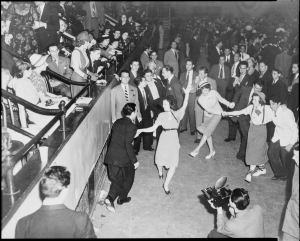
Mohill and Cloone became the national centre of the infamous Anti – Jazz campaign of the early 1930’s. The leader of the campaign was the parish priest of Cloone, Fr. Peter Conefrey.  Conefrey was an ardent cultural nationalist and was heavily involved in the promotion of Irish music, dancing and the Irish language.  He devoted his life to making parishioners wear home – spun clothes and become self – sufficient in food.

Many people who look at the anti-jazz campaign often do so in isolation of the cultural context and background in which these events played out. The new Irish State faced enormous economic and social problems including high unemployment rates and falling living standards. The hierarchy of the Catholic Church had grown considerably in power and influence after independence and began to pre-occupy itself with perceived threats to the virtue of it flock. In the Lenten…

View original post 1,298 more words

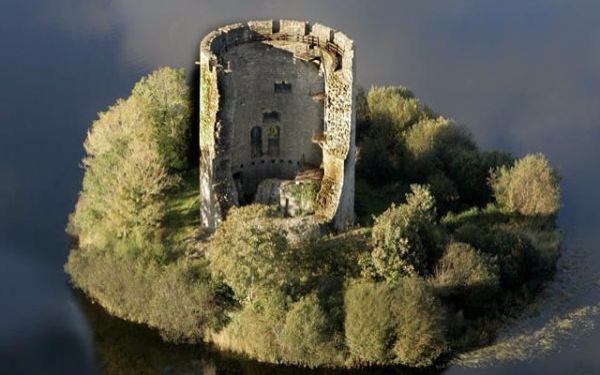
Cloughoughter Castle, County Cavan

Tucked away in a remote corner of the Erne River system, on a tiny island in Lough Oughter, stands the ruined circular tower of Cloughoughter – a modest-sized castle with a surprisingly prominent history. It was probably begun by William Gorm de Lacy between 1200 and 1224, possibly on the site of a crannog, after the Normans seized parts of the O’Rourke kingdom of Breifne. The lower two storeys can be ascribed to this phase; it had loops but no entrance on the ground floor, three doorways and at least two windows at first-floor level and possibly a curtain wall on the west side.

From 1233 until the end of the seventeenth century, the territory of East Breifne, roughly today’s County Cavan, fell under the control of the O’Reilly clan, who built up the castle to its present height. It played an important role in the dynastic power struggles of the O’Reillys and in conflicts with their former overlords, the O’Rourkes of West Breifne, and during this time also served as a grim prison, where some unfortunates were incarcerated for years. When Philip O’Reilly was held here in the 1360s he had “no allowance save a sheaf of oats for day and night and a cup of water, so that he was compelled to drink his own urine”.

After the Flight of the Earls in 1607, the castle was captured by Sir Richard Wingfield and granted to Captain Hugh Culme, who built himself a residence on the south shore of the lake. In the 1641 Rebellion the castle was captured by the O’Reillys and used again as a prison; here the old Bishop of Kilmore, William Bedell, together with his two sons, his son-in-law and Arthur Culme, were kept in irons in a “cold, wet and windy room almost at the top of the tower”. It was the last stronghold to fall in the Cromwellian wars and immediately afterwards, in March 1653, was rendered useless by a massive explosion of gunpowder. During the eighteenth and nineteenth centuries the picturesque ivy-clad ruin was depicted by a number of artists, including William Ashford, whose fine painting of the castle c. 1790 hung at Fota until recently. Excavation was carried out to facilitate conservation works on the walls in 1987, most of the finds were of seventeenth century date, including four human skeletons, three male and one female, all evidently casualties of the final fatal siege of 1653.

Located on an island in Lough Oughter
3 miles SE of Killeshandra and S of Killykeen Forest Park.
NGR: H 863554.
National Monument.
Open access.

The Ballad of JP

  photo - Copy

There was the first chill of the oncoming winter in the house tonight. I pulled the heavy door shut, turning the key in the stiff lock, another little job to add to the ever growing list for the weekend. I’m sure there is a can of WD40 somewhere in the shed. The turf fire in the old range will have the place nice and toasty by the time I get back tonight. An involuntary shiver overcomes me as I walk through the exhaust fumes towards the car, parked facing west, down the long grass centred lane.  “It’s the darkness that gets me” she had said. I could never understand what she meant, I never missed the lights, there was always the moonlight or the starlight, but then for someone born and reared in a city it might be different. I had to allow her that. “You’ll get used to it”, I had said, seeking to comfort and reinforce the idea that one day this could be home for us. I turned left down onto the main road past the solid stone piers my grandfather had built, or maybe it was his grandfather, who knows. I remembered turning on the headlights that night “There is that any better for you?” and laughing “You will, you’ll get used to it” but now I know that the eyes adjust but the rest might not follow, that was just ten months ago.

As we approached town we had met a couple of oncoming tractors, pulling cattle trailers, on the way home from the livestock mart. One driver drove a vintage Massey Ferguson. There was no cab to shelter him, the only adornment being a roll bar on the back. He was well wrapped up and a pipe dangled precariously from his mouth, his bare hands gripping the steering wheel. “God will you look at that bloke” she said, “he must be freezing, he’ll get his death”. “He might be happier than you or me!” I replied. “He’s probably after selling a couple of weanlings and had his fill in Duignans or Reynolds. It might be cold outside but he could be warm enough inside”. I looked at the temperature gauge which displayed Four degrees. He will be cold by the time he gets home alright, but I was unwilling to betray my thoughts, especially after  leaping to exalt the lone driver just seconds before. Must be a Leitrim trait I thought, to defend ones place, defend one’s own, zealously, even when the attack is slight, veiled or maybe only imagined. “Will he have far to go now?” she asked, and my mind immediately remembered the jobbers and dealers that congregated in my Uncles Pub back in the 70’s, “He could be from as far away as Corlough or Glangevlin” I replied, “Is that far?”, I thought of Big Tom McGovern with hands the size of shovels handing me a bottle of Cavan Cola with a straw. I can’t have been more than 8 or 9 years old then. “Oh it’s a good spin alright, but he’ll have half a bottle of Jemmy in him to keep him warm, and he might have one or two more stops on the way”.

I pulled up outside the Bar on the empty street. I could make out the smoky silhouettes of a few heads inside. Opening the creaking door a blast of furnace-like heat meets me, and as I scan the place my eyes are drawn to a coal fire crackling away in the corner. Three men sit at the the counter, two manning a corner each, and one in the middle, my Uncle tending to them. He has failed since I last saw him that evening four months ago. We nod at each other. ‘Good man Dan, pull up a stool there’ says Tommy Gucks, ‘and fit and well you’re looking. It’s always an honour and a privilege to meet an educated man like yourself’. ‘How’ya young Dan’ comes from down the counter, the voice of a little snipe-like creature shirking beneath a well-worn tweed cap, Hugh Dunleavy. ‘Good man Hugh, you’re keeping well’, the reply was instant ‘not too bad Dan, not too bad, considering the state the country is in. Your grandfather and father would turn in their graves if they saw the messing that’s going on’. There is a pause as if the patrons must take up new positions and their conversation must adjust because of my intrusion. The pub hasn’t changed much since I was a boy and yet it still remains a place of wonderment, a place where these characters act out their roles and my Uncle like a good stage-director, steers the conversation in whatever direction he thinks appropriate. The Uncle places a creamy pint in front of me, ‘and sure get the lads one there as well’.

‘Any sign of JP?’ I ask the Uncle as he gives me back my change. No, you mightn’t see him in tonight, he was in last night and had a tightener. ‘He sure had’ said Tommy, ‘he sure had, when you see the little dog coming over to our place of an evening you know he’s looking to see if there’s any grub to spare’. ‘Thank you Dano’ says Hugh acknowledging the drink, ‘Good health to you Dan’ says Gucks lifting his glass and tipping his head in a well-choreographed  manoeuver.

The clock above the till is at 9.30 but it’s surely after 10 by now. I realise the fading discoloured clock has actually stopped. The clock is a souvenir of the Leitrim team from 1994. ‘I think you need a battery for that yoke’ I say to the uncle, pointing towards the idle timepiece. ‘I must do that tomorrow’ he replies, Tommy nudges me, ‘Ah sure it’s  a bit like the Leitrim team today, they are at a standstill, do you know someone remarked last week that it’s harder to get off the team than on it, now isn’t that something’. The uncle looks wounded, ‘That’s a bit rich from a man that never kicked a ball out of his way, aren’t they flying the flag anyway, fair play to them’. Hugh broke into a laugh which became a cough and a series of splutters the culmination of six decades of tipless cigarettes. We all wait a few minutes for Hugh to get his breath back and to put away the dirty cloth handkerchief that has never been washed since it came into his possession. Tommy wasn’t going to take my uncles slight lying down, ‘Sure I had no time for football and me busy teaching young Colm O’Rourke how to play, didn’t I teach him everything he knew before they all headed for Meath. Sean Boylan thanked me personally for helping them win the All-Ireland’. Hugh was composed again and quipped,’ Well where ever he got the football it had little to do with you Gucks. An awful pity though he didn’t come back to us, We could’ve done with him.’ My uncle now has his back to us, fumbling with some paperwork on the shelf, his glasses hanging off the end of his nose, like Harold Lloyd hanging from a Manhattan skyscraper. ‘Didn’t you play with the brothers Phil?’ ‘Whose brothers?’ replies the Uncle placing a Players Please GAA ornament of two men in the Galway and Kerry colours I’m presuming.  ‘The O’Rourkes of course!’ Turning now and placing his huge bare forearms either side of him leaning on the shiny counter, the Uncle gathers himself, before saying slowly, ‘Indeed I did, and great lads they were too, Fergus was a giant, a gentle giant most of the time, ah but we had great teams back then, Mayo had the flying Doctor but we had the flying dentist, Leo Heslin, what a gent’ as he looked wistfully towards the fire. The moment is broken by the creaking door and in comes Jack ‘the Lad’ Shanley whistling to himself, ‘Good night to ye all, could be freezing and if it’s not its damn well near it’.

‘Is JP still kicking ball?’ I ask. ‘Apt’ says Hugh, trying to is all he’s at, sure he hardly trained the year, with hamstrings and groin strains.  ‘It’s the G-strings that is causing him more harm mind’ spurts Jack the Lad, and they chuckle in unison at some joke that will remain untold but will be left hanging, part released, in a ‘to be continued’ mode. ‘On his day he is good, I’ll grant him that’ says Gucks ‘but Jaysus he loves been told it, he does, ah he does. Do you mind the time he was in here on the Monday they bet Drumreilly and he had scored, was it 1-5 or something, any way he starts bladdering on about how he scored 1-5 yesterday and 0-9 the week before, and how he had, wait, was it 5-35 scored in the championship so far, and he was bladdering on and on”. “Now you were doing little in the way of discouraging him Gucks’ said the Uncle. ‘Well I gave him plenty of rein before I hit him the deadly, and if you don’t mind me asking JP, how much did you score on that young McDermott lad in the final last year? well it stuck him to the floor”. “F%4k you is all he said and off to the juke box, sure ya see he never got a sniff of it that day and they took him off at half-time. Well he stayed up that end for a while and then came back and sidled up to me and he says, you know well Tommy what happened me that day!’, ‘I don’t says I. What happened you at all?”. Tommy leaned into me imitating JP ‘You know fucking well I got the sh*ts after that kebab I had above in Longford the night before’. They all laughed again like it was the first time they had heard this tale, “Sure maybe he did” said I and Gucks took a sip out of his pint before giving me a half disproving look. “He’s had more good games than bad now! Or at least that’s what I hear,’ conscious that I hadn’t seen JP play since he was a minor.

Ah JP is some flower alright’ said the Uncle, he was telling us one night about his uncle Tom Pat ‘sure doesn’t he take after him’ muttered Eddy Joe Gray, a big bear of a man just in the door and in the process of hanging his heavy coat over the back of a chair near the now blazing fire. ‘Do you know that one Eddie Joe?’ enquires the Uncle.  ‘Which one, there are so many?’. ‘The one about the bull calf. Go on you know it, start it off there and I’ll boil the kettle’.

Eddie Joe sat in on a stool, then rubbing both his hands repeatedly on the knees of his trousers he began with a disclaimer, ‘Well gentlemen, If its lies I’m going to tell ye, then its lies that I was told, and this is what I was told, whether it be truth or lies. Tom Pat went out one morning and was doing his foddering and bits and pieces. He had this fine yearling bull calf that he was bucket feeding. Now he knew by the calf’s demeanour that he simply wasn’t himself that morning. Sure he was an ‘ould hand reared pet but a fair lump of a pet now boys, mark now a Charolais Limousin cross. Now this lad was been reared with Monaghan Day Mart in mind, do ya see now. Well the beasht wasn’t just himself, and Tom Pat couldn’t get him to ate  a bit of meal and his snout was cold. Well he was going to ring the Vet and then he reckoned the calf just had a chill.

Well he was in and out of the house and up and down the yard looking at this calf. He decided he’d bring him into the house by the fire. We’ve all seen it done now, be honest now boys, there’s no shame in it. So he brings in a bale of straw and scatters it all over the lino and he goes out and puts a halter on the calf. Now that didn’t work as sick and all as he was the calf was he’d never been led and wasn’t about to start at it now. So eventually with a bit of coaxing Tom Pat got him inside the back yard of the house. Now you know the lie of McCormacks place, you drive in on the street and then there’s a four foot wall around the house and you walk through a gate, into the yard and then into the house. Well the calf didn’t know what was happening at all but after another while didn’t Tom Pat get him into the house and he pulled the door behind him. He turned the table on its side to prevent the calf from pushing up against the door’.

‘Well the calf thought the arrangement a bit strange and he lowed a bit, but it was a weak enough low and it had Tom Pat worried. With the heat of the fire the calf began boiling up, and still its snout was cold. The calf lay down eventually in the middle of the floor and hung his head. Tom pat tried to rise him again but the calf wouldn’t move, then all of a sudden it gave one great big low, dropped its lugs and head and didn’t take another breath’. ‘You mean the calf died? In the house?’ I enquired. ‘That’s right Dan, stone dead there in the back kitchen. Tom Pat was in a tizzy and then he called the Vet, imagine calling a Vet then, sure what was he going to do, tell him his dead calf was beyond help and thank you very much, that’ll be Fifty euro. Well Flanagan, the new Vet in Arva came out and surveyed the scene, he’d never seen anything like it. He shook his head and commiserated with Tom Pat on losing such a fine animal. He told Tom Pat it was Blackleg. A bad dose, unless they get the injection early they’re finished. When he was going the Vet said to Tom Pat, ‘How are you going to get the calf out of the house? he’s swelling fast!

Tom Pat could only scratch his head and wonder. The Vet left and Tom Pat called up to Owenie Micks and wasn’t he in luck to find two fine men to counsel him in Owenie Mick and Jimmy Mullins’. ‘He was in luck alright with them pair of ludramans’ said Hugh shaking his head. ‘Well down to Tom Pats the three went. Owenie Mick produced a measuring tape from the boot of the car and proceeded to measure the height and width of the door way, he shook his head, ‘the jaumbs will have to go Tom Pat, there’s no other way’. Back out to the car went Owenie Mick, Tom Pat on his shoulder crying, and as he opened the boot to get a nailbar, he spied the con saw. Some class of a light went on in that cave of a skull of Owenies and he said, ‘begad there might just be another way’.

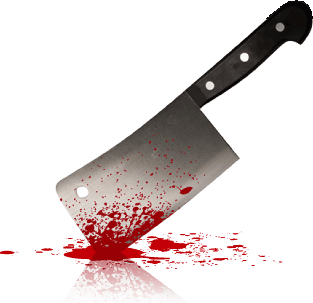
An hour and a half later the Calf was more or less butchered.  Owenie started with the legs and cut off all four just above the knee joint. They then laid a bit of old tarp on the ground and sawed into the stomach, blood and gore flying in an arc until it hit the back wall and spattered the ceiling. Then off came the head and and they sawed the whole way down through the backbone, leaving two heavy hund quarters, which it took all three of them to lift into the barrow. They wheeled all through the back yard and stacked it along the road. It was like an Abattoir, the straw coloured crimson , the walls and ceilings all spattered with blood, a  trail of offal from the back door to the road. 

Tom Pat had already called Nannerys, the knackers yard and they were on the way. When the lorry arrived arrived it reversed in on the street but Tom Pat told them to park on the road. As he lifted the tarpaulin the driver was shocked to see a hairy, bloody pile of of bone, meat and guts, stacked five foot high, there on the side of the road, a decapitated head sitting askew on top with a long tongue hanging out to one side. Those ISIS boys wouldn’t hold a candle to Ownenie Mick and his consaw’  

bloody-knife1I didn’t know whether to laugh or cry, it was like something from a Quentin Tarantino movie, barbaric and funny. The Uncle brought out a tray with a large pot of tea, a bag of sugar and pint of milk on it and laid it before Eddie Joe. One story followed another and the performers came and went, the conversation going through ebbs and flows, intervals and actions. It was like the unscripted performance came together here under this roof, my uncles roof, the last in a long line of publicans, a man who left a good job in Boston to come home to run this bar. His father told him that he had reared ten children out of it and there was no reason why he couldn’t do the same. Now he was the last one, of that there was no doubt, he wasn’t going to marry now at eighty years of age. As his ageing customers drifted off I helped him clean up, I swept the floor, put the chairs on the tables and on the counter. It was nearly 2.00am and we sat down by the last embers of the fire, each staring into the red coals as if it were an oracle. I nursed a crested ten between my hands and then he spoke, ‘How is that girl, Denise, isn’t it? Lovely looking girl …. soft hands …. you didn’t bring her down with you?’. ‘No, I’m afraid we’ve gone our separate ways. Not compatible unfortunately, but better find out now than ….”’Ah that’s a pity……… don’t worry you’ll meet someone else, you will…… I don’t know if she’d like it around here anyway, ya know like when you come back’. I said nothing, just stared on into the grate, and thought I could see her smiling face, ‘Your right I don’t think she would.’ The Uncle lifted a poker and started fiddling with the dying embers, trying to coax the last of the warmth from them. ‘I better be off’ I said to him throwing the glass on my head and swilling the whiskey, letting it warm my mouth before swallowing it, ‘I’m going to make an early start, I’m going to try and get JP out for a shot’ He stayed looking into the embers as I began to let myself out, ‘ I’ll call in after Mass time’ ‘Grand’ he replied and I heard him murmur, ‘Hard to believe it’s the first of November already …… where has the year gone’.
coal-stoves-1

The seductiveness of the simple word

Farage

What has surprised me in the last few weeks is the wonder in some quarters at the outcomes of two, ostensibly at least, very different by-elections. In Clacton-on-Sea, the result delivered to the people of Great Britain its first UKIP MP. Nigel Farage hailed the election of Douglas Carswell as “a shift in the tectonic plates of British politics”. In a very different constituency in the west of Ireland the people, using the PRSTV system, elected Michael Fitzmaurice, who although receiving the second highest number ones, quickly overtook the pre-election favourite to eventually enjoy a comfortable finishing margin. Fitzmaurice may be called by some, the ‘Son of Ming’ but in many ways he is much more reflective of the demographic of the rural, under-developed constituency than his predecessor. Luke ‘Ming’ Flanagan with his typical flair for the dramatic, echoed the UFC Cage Fighter Conor McGregor, when he announced to those assembled in the Count Centre that ‘We are not here to take part, we are here to take over’. Fitzmaurice also has that rare ability to compose melodic phrases that resonate with the wider public; in his acceptance speech he declared that he was ‘a man of the soil’, a simple, powerful and almost pagan expression worthy of Kavanagh or Heaney.

Simple language can be powerful and a powerful message can often hang on its simplicity. The seductiveness of the simple language that Nigel Farage et al use is difficult to counter. Nationalist and Populist parties can thrive in the atmosphere that pervades the political landscape of Western Europe presently. Protests against austerity are springing up everywhere. Where once we had flash mobs we now have flash rebellions

It is perplexing how ordinary people throughout the United Kingdom think they can relate to this privately educated former banker. Are people really politically engaged when they vote for character driven Candidates who trade on their carefully manufactured personas? Surely this new politics is not sustainable? Recently a caller telephoned a radio show in the UK and said he’d voted for UKIP. When the presenter asked him why he had voted for them, the caller couldn’t name a single policy of UKIP. Sinn Fein still make promises here following on from the auction politics that reached its heights in 2011. When Sinn Fein Candidate Cathal King realised he was losing the Dublin SW televised debate on TV3, he hastily promised SF would abolish water charges. Unfortunately this abolition wasn’t part of the Sinn Fein Manifesto. Their policy proclaimed that they were opposing charges, but opposing is well short of abolishing. SF are learning that if you want to be serious about getting into power you have to have more than just populist policies, you must have policies that will survive retrospective spotlight.  Unfortunately Cathal King reverted to default mode when put under pressure by the Anti-Austerity-Alliance Candidate, Paul Murphy.

The results in the Irish By-elections were not good for any of the main parties. Fianna Fail, Labour and Fine Gael combined have less than 30% of the votes in Dublin SW. Fianna Fail on the other hand are not making promises but it’s limited improvements show that in the current climate people do not have the patience to engage with them or forgive them for been at the helm when the country went down the tubes. Michael Martin put in a huge personal effort in Roscommon / South Leitrim knocking on doors all over the Constituency. Unfortunately while he was well received his Candidate wasn’t and at the end of the day it was not Michael Martins face on the ballot paper. Young Emmet Corcoran debated well and showed a passion that was largely absent from the race. He had one or two ideas that unfortunately will never see the light of day. Roscommon has done strange things over the years, electing and dumping Sean Doherty and Brian Lenihan, and for years returning the committed Socialist Jack McQuillan. This time around they elected a man that isn’t even from the constituency.

An absentee TD you might think yet of all the candidates, Fitzmaurice, who came into the race later than anyone, had by far the widest appeal. The Glinsk native resonated with the largely rural area, and whilst people outside Roscommon mightn’t have heard of him, he already had a profile. He had a passion & charisma that motivated a merry band of canvassers, not just constituents, but many from counties such as Longford Galway to take to the few highways and many byways of Roscommon and Leitrim. On the debates he stayed well out of trouble.  One point that he made concerned the River Shannon which defines (and often floods) this area. For many years there have been plans to divert water from the Shannon to Dublin. The point made, a tad clumsily but made nonetheless, was why, oh why, can they not get clean water into the taps of Roscommon, when at the same time they can divert millions of gallons of ‘our’ water to the big City? Maybe the answer is that there isn’t the political will to invest in rural Ireland. Fitzmaurice’s argument pits the classic urban needs v rural necessities. Fitz plays the role of the boy in the ‘Emperor’s New Clothes’ pointing out the obvious to a blinded audience. The seductiveness of the simple answer is very difficult to counter?

‘ALL THAT’S GREEN IS NOT GOLD’

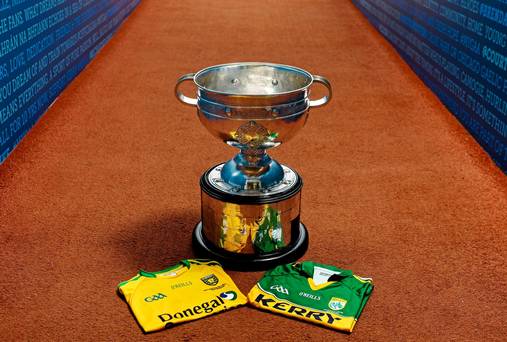
Kerry Donegal

In the GAA there are four Counties who wear Green and Gold for their County jerseys. One is the most successful team in the history of the GAA. Kerry won their 37th All-Ireland Title yesterday. The victory was something that seemed unlikely at the start of the summer. The retirement of several experienced players and a terrible injury to their talismanic forward Colm ‘Gooch’ Cooper had dampened expectations even in the Kingdom. The Kerry team led by Eamonn Fitzmaurice persevered and as the evening light lengthened so did their confidence and belief. Yesterday they were also in the happy position that they were not favourites going into an All-Ireland final. Ever since Donegal strangled the life out of the ‘invincible’ Dubs, the sons of Conall seemed to have had their name already etched on the Sam Maguire Cup. In the semi-final Donegal dictated the terms on which the game was to be played and Dublin couldn’t deal with this dictatorship. Kerry is a different proposition and Donegal simply couldn’t impose their will on the Kingdom yesterday. People say Donegal looked laboured, lacked the usual intensity or aggression but maybe when they analyse the game they will see that for long periods Kerry simply dominated them, holding on to the ball, tackling hard, forcing errors and turnovers, taking their chances when they came. It was not a great spectacle of a game for a neutral but it was intriguing all the same.

This week also saw change in another County that wears the Green and Gold. Shane Ward, a Donegal native, was appointed Manager of the Leitrim Senior team. I’m not sure that many people other than the die-hard anoraks would even have noticed this managerial announcement. If Kerry is the most successful County in GAA then Leitrim occupy the complete opposite end of that spectrum. Leitrim’s paltry two Provincial Titles pales into insignificance compared to Kerry’s seventy six Munster Titles. Leitrim have never won an All- Ireland Senior Championship and never managed to even grace a final day. Leitrim have had three little ‘Golden Periods’ since they first entered the Championship in 1907. In the mid-1920s they were a match for any in Connacht. In 1924 they drew with Mayo and then refused to play in the replay. One Connacht Championship in 1927 was scant reward for this group of players. They had the beating of Kerry in the semi-final, going down by two points in the All-Ireland semi-final. Within a year or two the team had been broken up by mass emigration. It would be sixty seven years before Leitrim would win another Connacht Title.

Perhaps the best Leitrim team of all was that of the late 1950’s led by the mercurial Packy McGarty. They lost four Connacht finals to Galway 1957-60 and without the crucial breakthrough this team too began to break up. In the early 1980’s I also saw some promising teams fail to get the rub of the green. In 1982, ’83 and ’87 they were unlucky against Galway and Mayo. By 1989 though things were pretty bleak again with the County’s finest young men more interested in winning Donnelly Visas than Connacht medals.

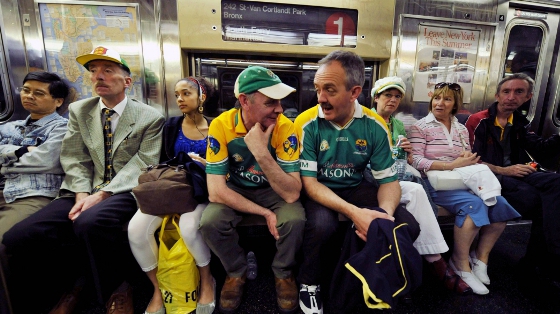
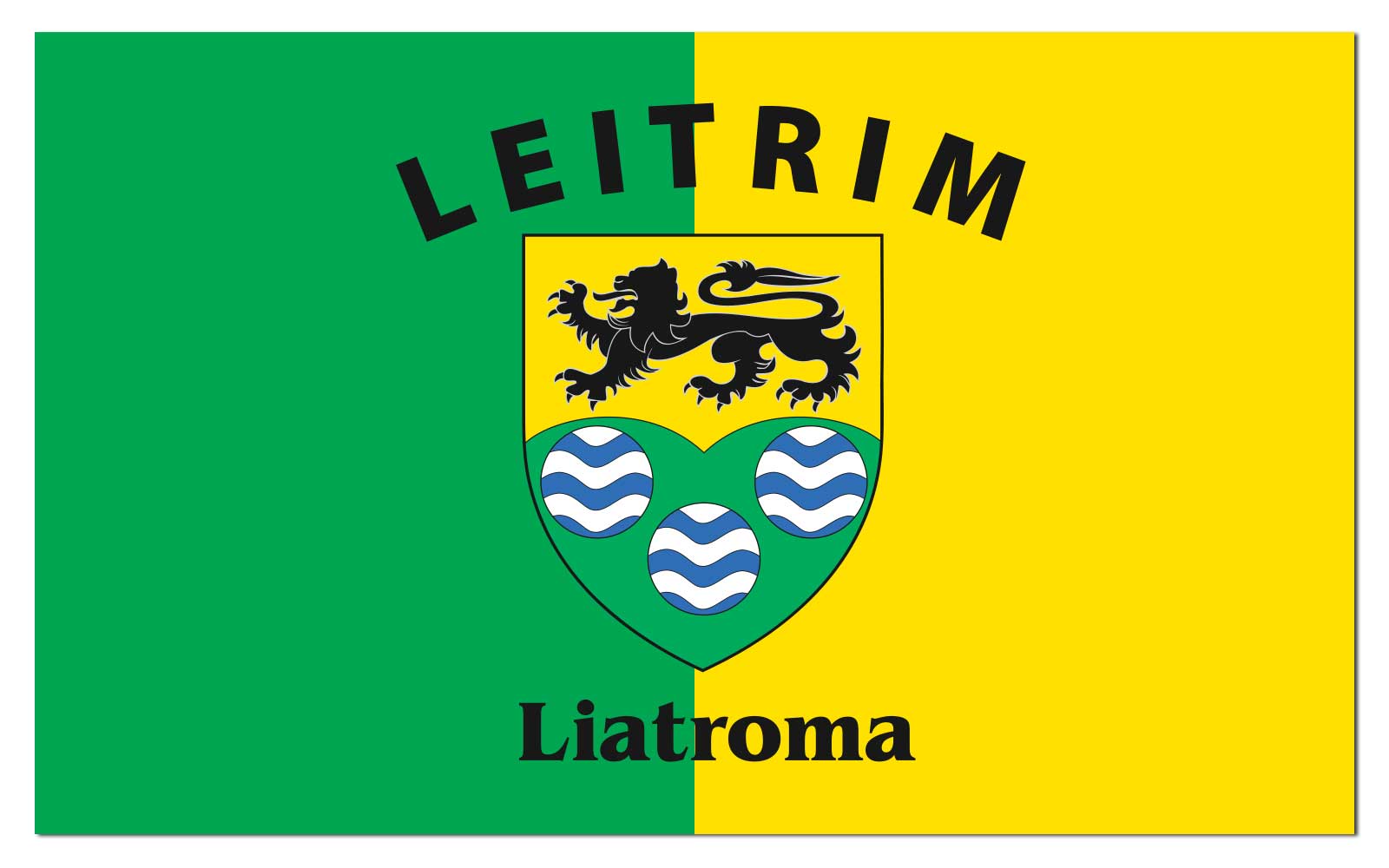
Leitrim_fans_subwayLeitrim Flag

Then along came a Cavan man called P. J Carroll and he took no prisoners. He demanded honesty of endeavour and didn’t countenance inferiority. Soon performances in the pitch began to improve but alas a championship breakthrough proved elusive. By 1993 Carroll was gone, replaced by John Maughan. Beating Galway in Tuam was a huge turning point. The following year Leitrim won a Provincial Title beating Roscommon, Galway and Mayo on the way. They under-performed against the Dubs in the Semi and should have won another Title. In the twenty years since that famous victory in Hyde Park there have been few highlights. The back door system which was designed ostensibly to give weaker counties more games has not worked out for Leitrim. They have an abysmal record in fact and have shipped some very heavy defeats. Their most recent manager Sean Hagan was perplexed by how dis-interested the Leitrim players were in the Qualifiers. Maybe it is because the player’s ambition is to win a Connacht Title and you can’t do that via the Qualifiers.

Leitrim and Kerry operate in two completely different spheres. If anything the gulf is widening. There are only a handful of the thirty three teams that start the year capable of winning the All-Ireland. Making the breakthrough is nearly impossible and behind the scenes it requires incredible resources. Up until recent years, and despite Leitrim’s paltry return of silverware, one always felt that they could compete with any of the Connacht counties and occasionally cause a shock. Over the years these shock wins sustained the County’s supporters and inspired the young. Nowadays the wins are even rarer, resources scarcer and initiatives like the County Centre of Excellence still awaiting completion.

The Garth Brooks debacle and the disquiet over moving the Mayo-Kerry replay to Limerick has further widened the gap between the modern corporate aware GAA and its grassroots followers. The GAA is at a crossroads and it must decide if its future lies in promoting the elite and aspiring to some sort of a global brand or in trying to build a more equitable organisation. It does not seem possible to achieve both. Perhaps the strict adherence of both the administration and the fans to the County and provincial systems means the GAA was hobbled from the start. The primacy of a knockout completion over the league format is also an anomaly in modern TV driven sport. The GAA was founded in ‘Hayes Hotel’ one hundred and thirty years ago. The famous Hotel was sold at an Allsop Auction this week. It is time for us all to realise that even in the history of our beloved national games, everything ultimately has a price commercially irrespective of sentiment.

Leitrim Qualifiers

Blog Entry written in a Country Churchyard

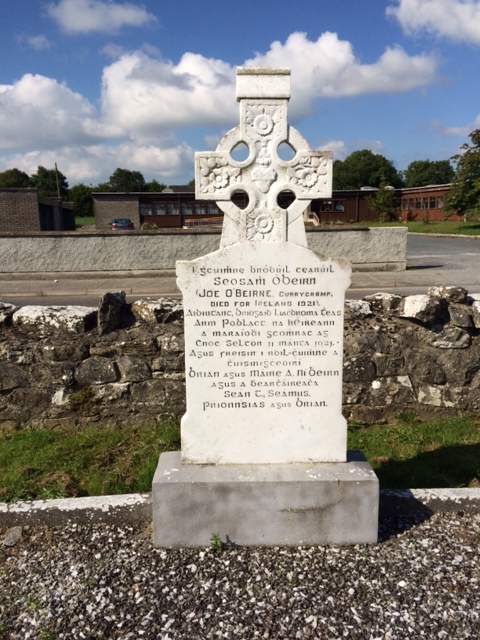
Grave of IRA Volunteer Joseph O'Beirne, Mohill Graveyard

Grave of IRA Volunteer Joseph O’Beirne, Mohill Graveyard

Sunday was a beautiful late summer day and I was back visiting the home turf. Noon found me showing my eldest boy my old Secondary School. The old Alma Mater is now looking very dingy and dilapidated.  The fact that it is overshadowed by the ultra-Modern, uber-cool Community School that replaced it a few years ago probably doesn’t help. Across the road from the dirty Old and the pristine New school is the parish graveyard. I recall one time long ago, when a group of us as teenagers, planned to use an Ouija Board on top of a ‘haunted’ grave here. We never did play the infamous board game there. I think secretly everyone was glad the idea just slowly died away and despite our external bravado, inside we were petrified of what might happen. It illustrated that deep down there is a primal fear of the unknown in us all. Graveyards no longer hold such fear for me. Some final resting places are very peaceful places to spend time in. Glasnevin cemetery is one of Dublin’s premier sightseeing locations and gives one a fantastic tour through Irish History. I have also enjoyed Woodlawn Cemetery in the Bronx where one can easily spend hours walking amid the beautiful manicured parkland-like graveyard. Mohill graveyard is not on the same scale obviously but it has its own little narratives waiting to be discovered. I decided to bring my son for a walk around the graveyard to show him the resting places of his relatives. Soon I was standing amid the old graves beside the seat of learning where I first read Thomas Gray’s famous lines,

‘beneath those rugged elms, that yew-tree’s shade,

Where heaves the turf in many a mouldering heap,

Each in his narrow cell for ever laid’

Soon we were reading the names of my sons Great-Great-Great Grandparents. I’m not sure the Eight year old mind can appreciate the generations that have gone before or the fact that without their existence, we wouldn’t exist. I know that he now knows where his people lie and that is good. I’m sure he will come back some day on his own initiative, and hopefully with the next generation too. We said a little prayer together for these people whom we never met but who gave us their DNA.

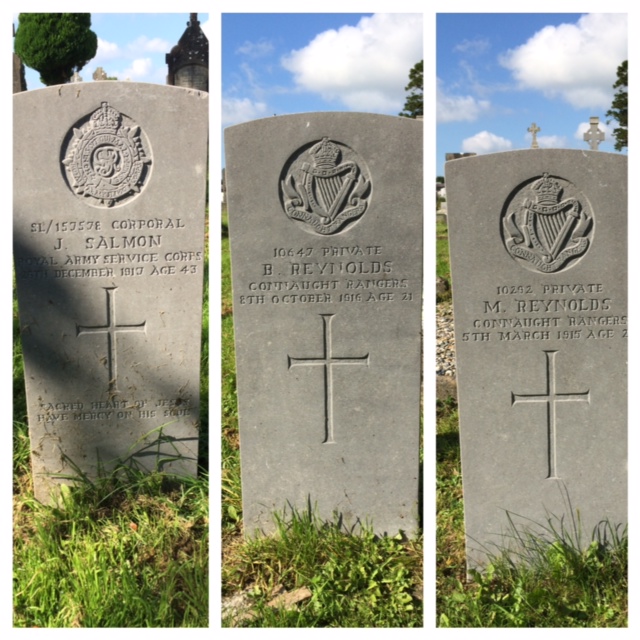
I also came across the grave of Joseph O’Beirne, an IRA Volunteer killed at Selton Hill in the spring of 1921. Selton Hill is about 5 miles north of Mohill on the road to Fenagh and Ballinamore. I had often heard about the ambush as a young boy from my grandmother who was born just a few townlands away. The general consensus was that the flying column of which O’Beirne was a member were betrayed by loose talk which passed to the local GP, Dr. Charles Pentland. The doctor was a popular man locally but he was also loyal to the Crown. He passed the information on to Inspector Gore-Hickman of the RIC and very quickly a British Army Unit was mobilised. The eleven volunteers in Flynn’s house at Selton had no idea that their fate was sealed. Some sat around drinking tea whilst cleaning their guns and others rested up, tired after an early morning march cross country. When they realised that they were found out it was too late. The main body of nine men who were in Flynn’s house spread out across the marshy bottoms. Quickly they were mowed down by two well-placed Lewis machine guns set up on the high ground on the main road above the house. The column was also undone by a small group of British Soldiers who had outflanked them and set up an enfilading position. Been fired at from two sides in mostly open country the veteran troops of the Bedfordshire Regiment had created a killing zone. In a few minutes six of the nine men who were in Flynn’s house were fatally wounded. Two more were badly wounded but survived. Only one, Andy McPartland escaped the bloody scene. Another man, Bernie Sweeney lay undetected in a drain where the cold water must have helped to stop the haemorrhage of blood from his wounds. The two men who were the luckiest of all were Pee McDermott and Paddy Guckian who were posted to a neighbouring house. They escaped around by Selton Lough. Joe O’Beirne hailed from Currycramp in Bornacoola but his family had a plot on Mohill graveyard. One of his sisters later married Ben McGuire who for many years was a Fianna Fail TD for Leitrim until he fell out with De Valera. McGuire and his wife Josephine (nee O’Beirne) are buried beside Joe whose beautiful gravestone proclaims  that he ‘died for Ireland’. Only a few yards away lay three graves close beside each other of men who may also have thought that they were dying for Ireland. These men though died in the First World War wearing the khaki green of the British Army. The first is Joe Salmon who was in the Army Services Corp and died in Belfast; the other two are brothers, the Reynolds from Treanmore. These are the only war graves identified in Mohill cemetery and in many ways they are unique in that they are only three of perhaps up to fifty Great War casualties  who are interred in their native parish. In the Great War the slaughter was so rapid that you were buried where you fell. Some who didn’t make it home are interred quite a distance away. Private John Cunion was from the Green Road where he was the eldest of the seven children of Bernard and Bridget. Bernard worked as a baker in town. John before signing on was an apprentice coach-maker. Today John lies thousands of miles away from his native Mohill. His grave is in a dusty town called Amarah on the bank of the Tigris in Iraq. In 2003 Amarah became a centre of resistance against the US led invasion. Just like in 1915 it was the British who fought their way into the city and took control block by block, street by street. The current instability in Iraq means that the Commonwealth War Graves Commission is finding it difficult to maintain the graveyard in Amarah.

Commonwealth War Graves in Mohill

Commonwealth War Graves in Mohill

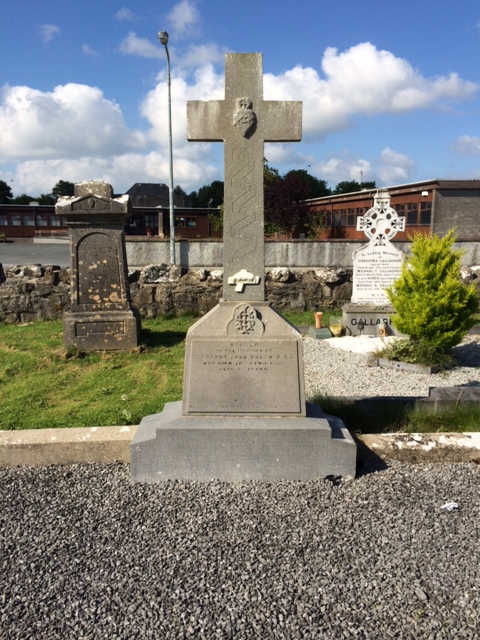
There are men from Mohill lying in Commonwealth Graves all over the World. Thomas Bell is buried in Allahabad in northern India. Francis Canning fell at Gallipoli. John Fitzgerald survived Gallipoli before his unit was later overrun by the Bulgarians at the Battle of Kosturino in modern day Macedonia. John’s remains were never found. and his death is simply recorded on a communal plaque.  John’s brother Patrick had already died in the opening months of the War. Another brother Thomas would die just three weeks before the Armstice that ended the war. In 1923 yet another brother Edward, a private in the Free State Army, died in a shooting incident in Longford. Mrs Fitzgerald was indeed unfortunate to lose four sons in uniform. Another Mohill born combatant, Patrick Nooney died at sea. The majority of war dead from Mohill  lie buried in Flanders or France where most of the Irish Units served. It is certainly unusual for soldiers to be buried in the graveyard of their home town. In Michael Reynolds case it is particularly poignant. Michael was gassed on the front and although he lingered on for months afterwards his demise was inevitable. He did however live long enough to make it back to hospital in Ireland and that is why his remains lie here. The landed gentry were also not immune from the bullets and shell fire. Hugh Crofton, a member of the landlord family who owned the town of Mohill died in Gallipoli. He is buried in Twelve Tree Copse overlooking Cape Helles, where the Dardanelles meets the Aegean Sea. Just another short journey from the war graves is an impressive headstone to a Sergeant Joseph Bruen of the RIC. Bruen was from Drumraghool and was stationed at Henry Street Barracks in Belfast around the time of partition. He was a Catholic in what was an increasingly sectarian force. He was shot in an apparent robbery in April 1922.  This would have been one of the bloodiest months in Belfast at the height of the Pogroms. The atrocities committed around these times are still remembered to this day in that city. Some of the worst acts of violence were committed by the ‘Cromwell gangs’ who killed many innocent people, including children, in an effort to religiously cleanse parts of the City. It was said that many of the gang were members of the RIC and that Michael Collins had managed to get all their details. It is also said that Collins had planned a similar attack to the one that took out the Cairo gang in Dublin. Fate intervened however to these plans in the guise of Beal na Blath. The atrocities weren’t all confined to one side of the religious divide of course but one can’t help but think that this was not a nice place to be for a Catholic policeman in an RIC Uniform.

Sgt Joseph Bruen, RIC Belfast d. April 1922

Sgt Joseph Bruen, RIC Belfast d. April 1922

So as the sun shone down over the rolling drumlins of South Leitrim, and I find myself, janice –like, looking back through the medium of the names engraved on these grey stone slabs, I can’t but conclude that one doesn’t have to go to Glasnevin to experience Irelands troubled past. There is a lot of history to be found in the graveyard of every small town and village up and down this Island.  Alas for the unfortunate actors in this particular play I can only recall one more line from Thomas Gray’s famous poem – “For them no more the blazing hearth shall burn”.

ALBERTUS MAGNUS

Albert peaceLife, like Literature has a habit of juxtaposing seemingly odd ends together. Milton gives us God and Satan in ‘Paradise Lost’ and for some reason the fallen Angel came out of it with an enhanced reputation. This morning I read that a small train station called Dromod, the only train station in all of County Leitrim, was in danger of closing. I have used the Station on many occasions often not knowing when I’d be back.


Many of my forbears also used Dromod Station. Sadly some never saw their native County again. The train meandered behind our home place. It was said that in the late 19th Century my Great-Great -Grandfather climbed a rick of hay so that he could wave goodbye to his New York bound granddaughter on the passing locomotive. Climbing a rick of hay is not exactly alpine in scale until you factor in that the old man was reputedly a hundred years of age at the time. When I was younger I thought this story was nonsensical.  Years later I discovered the date of the grand daughter’s entry into Ellis Island. I slowly wiped the egg from my face.


Another relative of ours who never again saw home boarded the train in Dromod in late 1939. He went to England to work in a munitions factory. He died in Toronto in the 70’s. Word got back to the family who of course were shocked. The shock was not so much that the man had died but on where he had died. His sisters always believed that he was still living somewhere in Manchester. Thankfully, and unlike these family members, every time I took the train I did get to see home again. I know however that one day I’ll leave and that it will be the last time.


I remember also going out to Dromod to see the men from the Hills of Donegal bring back the spoils of war from Croke Park in ’92. That was a great sight and a wonderful occasion for the whole Northwest.


I have many memories of Dromod Station. Sadly a man passed away today that has no memory of Dromod. One time he knew everyone in the Village and everyone who bought a train ticket. Sadly Alzheimers ravaged this sharp mind and confused those precious recollections. I’m sure if he was in good health Albert Reynolds would not overly-nostalgic and perhaps say that it was the best of times, but also the worst of times.


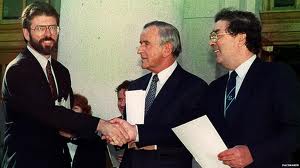
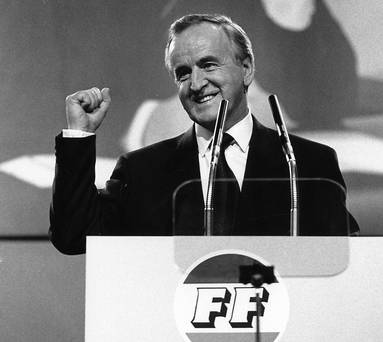
 Albert Reynolds main legacy will undoubtedly be the crucial role he played in bringing peace to this island. That is a noble legacy to what was an intractable problem. Albert may not have ticked all the boxes for the South County Dublin set but he was shrewd man, a person who took risks, who speculated to accumulate, a type of character no longer prowling the halls of Leinster House. Yes, Albert made mistakes, plenty of them and his political demise was full of controversy, yet somehow it is easy to forgive him. It is not simply because us Irish are wont to speak ill of the dead, it’s because Reynolds retained a common touch. He was a man who knew the value in the handshake to the country folk. My mother and father met in the ‘Cloudland’ in Rooskey, just like thousands of couples throughout the Midlands and West who found a partner in one of the many Reynolds Dance Halls in the hucklebuck era.

The Reynolds were said to be ruthless in business, especially with competitors and yet there are plenty of stories citing kind works Albert did for people without any fuss or fanfare.  His passing will be keenly felt in Longford which is suffering badly in the current recession. His home village of Rooskey is also in decline. Where once there was a booming meat processing plant employing hundreds of people from South Leitrim, North Roscommon and Longford there is now a quiet sleepy village where Bus Eireann only stops once a day.


As a young man Albert Reynolds worked as a clerk for CIE in Dromod Railway Station and I’m sure he carried many memories of the place with him throughout his life. I once met a man at a function in the North of England. He told me that when he was emigrating to England he had his boat fare but was short some money for the train fare. Albert let him on the train with a valid ticket and told him he’d see him when he was home again. The man found work but was not home for over two years. When he passed through Dromod Albert was no longer working there. The young emigre could have got away without repaying the fare but he felt he could not renege on the good deed. He made himself known to the Station Master who told him, ‘Ah yes, I remember young Reynolds saying you were from good stock and you’d be back’. The honest traveller told me he had the pleasure of telling Albert the story years later when he met him in Longford.  Reynolds knew immediately who he was and how much he had owed CIE, before saying to him ‘I never doubted ya’.


Albert ReynoldsPolitics has changed and so has Ireland since the Reynolds/Haughey/ MacSharry heydays. It is doubtful that we will ever see another Albertus Magnus. Eugene McGee reckoned the night he was made Taoiseach and returned to the Market Square in Longford was like the County winning the All-Ireland.


It is sad that the news regarding the future of Dromod Station is juxtaposed with the departure of its most famous employee. Sadly this time it’s a one way ticket for Albert. His loss will be keenly felt throughout the villages, towns and parish halls of Longford, Leitrim & Roscommon.

The Show

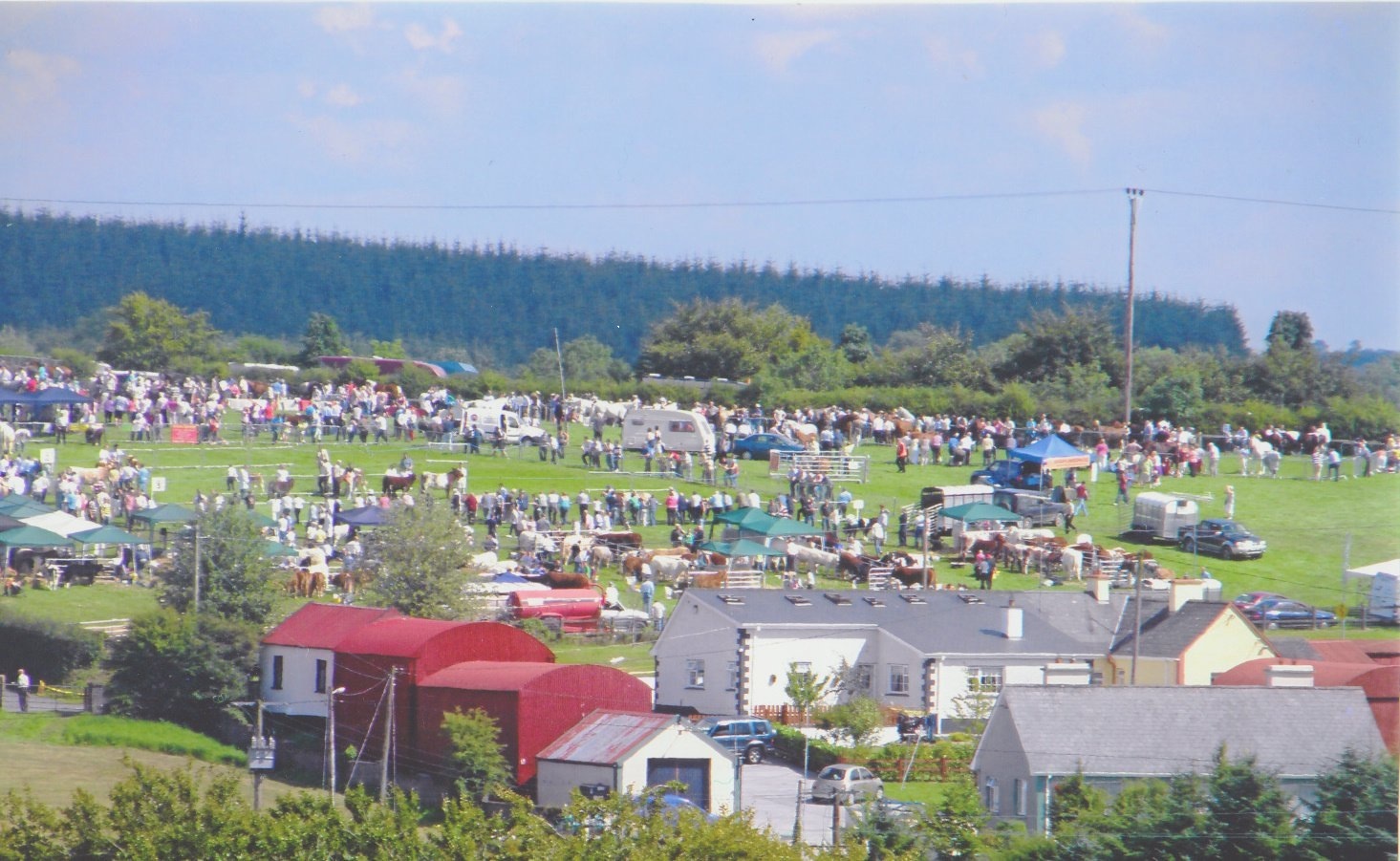
imageIn Ancient times the Celts held their great festivals and gatherings in the month of August or Lunasa as it was then known. It was the month of the harvest when the first berries ripened. It is therefore not altogether inappropriate that the local farming community of Mohill and its hinterland chose this month to host their annual show.

For the farmer August is never quite the same from year to year. Each summer he goes head to head against the elements in an eternal battle between man and nature. It is a struggle that has been repeated again and again over the millennia. While the weather is always variable there is one constant every year, and as August draws to a close and one starts to notice the first drawing in of the evenings, thoughts invariably started turning to the Show. In our house it was never known as Mohill Show, it was simply “The Show”, and at that it was the grand dam of all shows. Its roots dating back to the pre famine times of Lord Leitrim and ultimately revived in the 1920’s by a dynamic Padre known as Canon Masterson. Our Show, for us there really is no event quite like it. There was just something about this particular day when the country folk took control of the town, when they brought out their finest stock and produce and when the world was turned topsy-turvy for a few short hours. The long summer days in the fields or backbreaking hours on the bog were now forgotten.

The Show was more than just a one day event, it was as much about the anticipation, the preparations, the memory of the previous year perhaps, the preceding weeks leading cattle around the back roads, turning mad beasts fit for a rodeo into docile stars of the Show Ring. I can remember one occasion when aged not more than ten or eleven. I was leading a feisty heifer in our front field. As she took flight I stumbled, I held on to the rope as long as I could but she had me beaten all ends. As I let go I noticed I was minus one half of my footwear. Try as we might we could not locate the missing shoe. Ten months later the fate of the lost shoe was known. A trailer load of grass was tipped on to the silage slab, and there it was, my old shoe, tattered torn and ragged from its exposure.

The evening before the Big Day the cattle for showing were brought in from the fields. We haltered, washed, scrubbed and combed them. Plastic buckets overflowing with fairy liquid and warm water. There were several different types of combs for the different animals. The Herefords with their wiry hair, the big Shorthorn cow, her gleaming red hide and friendly polled head. Extra bedding was placed in the byres and with it the hope that the next morning the main actors would still be spic and span. When all was done some one might call into McGowan’s house to get a preview of the show book, hot off the press, from Aideen or Lourda, the overworked Secretaries. The Show Book listed all the classes and prizes and also the entrants, the friendly opposition.

An early breakfast was essential on Show morning as there was a busy few hours ahead. When finally ready we walked the cattle to the show. It was only a mile but what an adventure. Some passing motorists would always stop to say hello and drive alongside, windows down, half tanned arms lazily hanging out the side, commenting on how well our cattle looked and wishing us luck.

Crossing the town was always a bit nerve wracking, hoping the cattle wouldn’t stampede or damage a car, nearing the park, finding a good spot along the wall which would become HQ for the day. When we got into position there began another intense session of grooming and combing. A quick gander around the field to size up the opposition and see what our chances of success were.

The PA would then crack into life and get the show on the road. The classes were called. “When are we on?” “We’re next after that class in Ring two” “Who is judging?” “Get ready”. If not leading then a good ringside seat to watch proceedings. “How is she walking, how does she look, is the judge looking at her, is he calling her in, No?” “He’s calling her in now, where will he place her?” anxious moments, he is talking to my father for the longest time, then the rosettes in his hand, “what colour is it? Its red, yes we’ve won!”

And so the drama went on in pursuit of the Red rosette. The morning would simply fly by. There might get a short break and a chance to visit the horses and ponies. These were always over at the Boeshil end of the Park. Sometimes there was Showjumping and we watched the McGuinnesses with awe clearing the jumps effortlessly. The driving cars were always a highlight with Joe Beirne and family driving in fine style. Then was the Donkey Derby and great excitement and it always seemed to be won by the one of the Mees

Then back for the young stockman class. Some young naturals, unfortunately I wasn’t one of them, others under a little bit of parental pressure, some really looking the part with white coats. The standing of the animals feet was most important and animals were constantly been wheeled around again and their feet poked with sticks to get them standing perfectly, like a bovine Miss World pageant. Some poor devil would be struggling with a little heifer that was prancing around like a ballerina that morning, yet has somehow being transformed into a stubborn mule. A younger sibling is quickly press ganged in to walk behind and “push her on”.

My favourite event was the dog show. I entered a few times but the pedigree of our dogs was, well, questionable. It was still a great day out for the dog and what would he be at home anyway when we were all here. You could tell he wasn’t used to these big days unlike the professional poser dogs, posing nonchalantly, barely casting a sideward glance at our collie cross pulling hard against this strange leash. Don’t worry about it Sammy, we still think you’re the greatest and tomorrow I’ll get a big bag of bones from Paddy Kilrane or Logans to make up for the disappointment of coming last in your class.

The Shows in the 1980’s always seemed to be cursed with wet weather and I can remember people scrambling for shelter in trailers. If it was a long shower it wasn’t long before the air was sweet with the pungent scent of Woodbines or  Sweet Aftons.

The buzz around the field was magical. There were Chip Vans manned by the late Aubrey and Barney, Mr Whippy ice cream, the Photograph Section, the sheep and goats, the prize vegetables. My brother Enda entered three beets one show, which he had tended to all spring under the watchful eye of my granny. “And what would you know about Beets” as we taunted him. But he had the last laugh when he picked up his two pounds first prize. In the sheds the eagle eyed stewards had their hands full trying to keep quick handed urchins from running off with prized buns and mouth-watering cakes.

A quick trip over the town with my grandfather to Sheila McGarry’s Public House was obligatory. The little pub which was usually very quiet the rest of the year was packed on Show Day. Men with sticks and caps greeted each other enthusiastically. Their nicotine stained fingers clutching a half one and a glass of Guinness on the Counter as well.

The day gradually drew to a close and we gathered up our gear and headed across the town with our cattle. This was a trickier proposition; the traffic would be a lot heavier than this morning. As we neared home the cattle started getting excited as they sensed familiar pastures, a few quick lows from the lead cow and then the lows from away off from our other cattle, the ordinary cattle, those not deemed to have royal enough blood to go the Show. The Show cattle now quickened their pace, and when we got to the bottom of our lane we usually took the halters off and let them run up the rest of the way to the farm yard themselves. They knew where to go. They say a good huntsman would not let a morsel pass his lips until his animal was fed, watered and comfortable. We were no different.

A quick cup of tea and then into John James McKeon’s or Caseys where every animal on display at the Show that day was examined, discussed and judged anew. Commiserations for some who didn’t win, but felt should have, while those who did win tried hard to be humble about their success. The Show Dance brought matters to an end but the planning for the next one had already begun.