Category Archives: Uncategorized

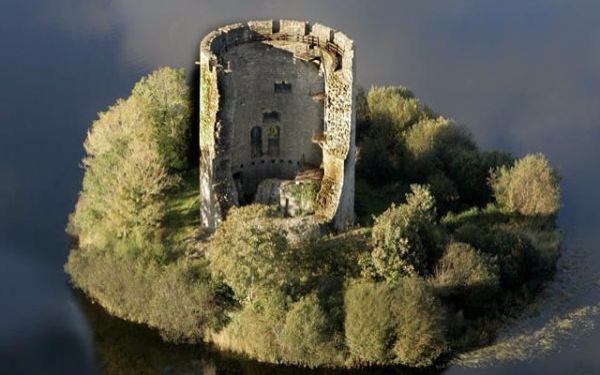
Cloughoughter Castle, County Cavan

Tucked away in a remote corner of the Erne River system, on a tiny island in Lough Oughter, stands the ruined circular tower of Cloughoughter – a modest-sized castle with a surprisingly prominent history. It was probably begun by William Gorm de Lacy between 1200 and 1224, possibly on the site of a crannog, after the Normans seized parts of the O’Rourke kingdom of Breifne. The lower two storeys can be ascribed to this phase; it had loops but no entrance on the ground floor, three doorways and at least two windows at first-floor level and possibly a curtain wall on the west side.

From 1233 until the end of the seventeenth century, the territory of East Breifne, roughly today’s County Cavan, fell under the control of the O’Reilly clan, who built up the castle to its present height. It played an important role in the dynastic power struggles of the O’Reillys and in conflicts with their former overlords, the O’Rourkes of West Breifne, and during this time also served as a grim prison, where some unfortunates were incarcerated for years. When Philip O’Reilly was held here in the 1360s he had “no allowance save a sheaf of oats for day and night and a cup of water, so that he was compelled to drink his own urine”.

After the Flight of the Earls in 1607, the castle was captured by Sir Richard Wingfield and granted to Captain Hugh Culme, who built himself a residence on the south shore of the lake. In the 1641 Rebellion the castle was captured by the O’Reillys and used again as a prison; here the old Bishop of Kilmore, William Bedell, together with his two sons, his son-in-law and Arthur Culme, were kept in irons in a “cold, wet and windy room almost at the top of the tower”. It was the last stronghold to fall in the Cromwellian wars and immediately afterwards, in March 1653, was rendered useless by a massive explosion of gunpowder. During the eighteenth and nineteenth centuries the picturesque ivy-clad ruin was depicted by a number of artists, including William Ashford, whose fine painting of the castle c. 1790 hung at Fota until recently. Excavation was carried out to facilitate conservation works on the walls in 1987, most of the finds were of seventeenth century date, including four human skeletons, three male and one female, all evidently casualties of the final fatal siege of 1653.

Located on an island in Lough Oughter
3 miles SE of Killeshandra and S of Killykeen Forest Park.
NGR: H 863554.
National Monument.
Open access.
The day they lynched the Elephant

Hanging with the Elephanthanging elephant

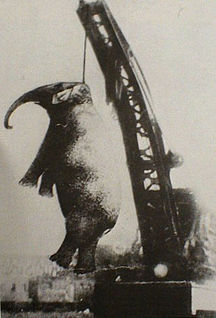
Search Engines have the habit of waylaying me (in the best possible way) and this evening was no different. I was looking up the wonderful Michael Harding’s latest work, ‘Hanging with the Elephant – or how not to meditate’ and simply entered the words ‘Hanging’, ‘Elephant’ and ‘Harding’ and found my target. It was only when I clicked on images in search of the book cover that I came across a strange and macabre sight. It was an adult Elephant seemingly hanging from a crane? Curiosity got the better of me and so I simply had to explore further and this is the harrowing tale that I now share.

The Elephants name was Mary and she was a five ton Asian female. She was part of Charlie Sparks’ revelling circus which was travelling throughout the near west in the summer of 1916. The Circus had just arrived in the town of Kingsport, Tennessee, USA in the month of September.  The circus staff prepared for the usual parade down the Main St., a spectacle that was sure to be the best form of advertisement for their upcoming show. An inexperienced handler called Red Eldridge was put in charge of Mary. Eldridge was a Hotel Worker who had just been hired the evening before the parade.

The parade was going normally when the elephant stopped to nibble on a piece of discarded watermelon. She slowed down and as one can imagine the whole parade had to stop when Mary stopped. Eldridge jabbed the elephant to get her moving and inadvertently hit an abscessed spot just behind her ear. The elephant’s reaction was deadly. The elephant grabbed her new handler with her trunk, lifted him in the air dashed him against a drink stand and as he lay dying on the road, issued the coup de grace by trampled on his head. Mercifully Eldridge was killed instantly. While the terrified spectators screamed and fled, a local blacksmith unloaded five rounds of ammunition into the elephant with little effect.

As Mary recovered her composure the townsfolk encircled her and someone shouted to the Circus people that the killer elephant must be put down.  Before long the crowd had started chanting “Kill the elephant, kill the elephant.” Mary was eventually subdued and brought back to the circus grounds. The only talk amongst the citizens was the murderous Elephant in their midst. Newspaper accounts did nothing but flan the flames of the public’s frenzy. A contemporary newspaper account said that Mary “collided its trunk vice-like about [Eldridge’s] body, lifted him 10 feet in the air, then dashed him with fury to the ground… and with the full force of her beastly fury is said to have sunk her giant tusks entirely through his body. The animal then trampled the dying form of Eldridge as if seeking a murderous triumph, then with a sudden… swing of her massive foot hurled his body into the crowd.” It should be kept in mind that female Asian elephants don’t have any tusks!

Leaders from nearby towns threatened that the Circus would not be allowed visit their communities. Worried that the circus dates would be cancelled if he did not accommodate the crowds call for vengeance the circus owner Charlie Sparks reluctantly decided to acquiesce to the mobs demands. The condemned animal was loaded on a railway car and brought to the nearby town of Erwin. A huge crowd had assembled in the Clinchfield Railroad Yard.

The unfortunate elephant was hanged from a railcar-mounted industrial crane. The first attempt ended in failure when the chain used snapped. Mary broke her hip in the ensuing fall. The second attempt was successful and Mary was buried beside the tracks. A vet who carried out a post mortem on Mary was able to show that she had a severely infected tooth in the precise spot where Red Eldridge had prodded her.

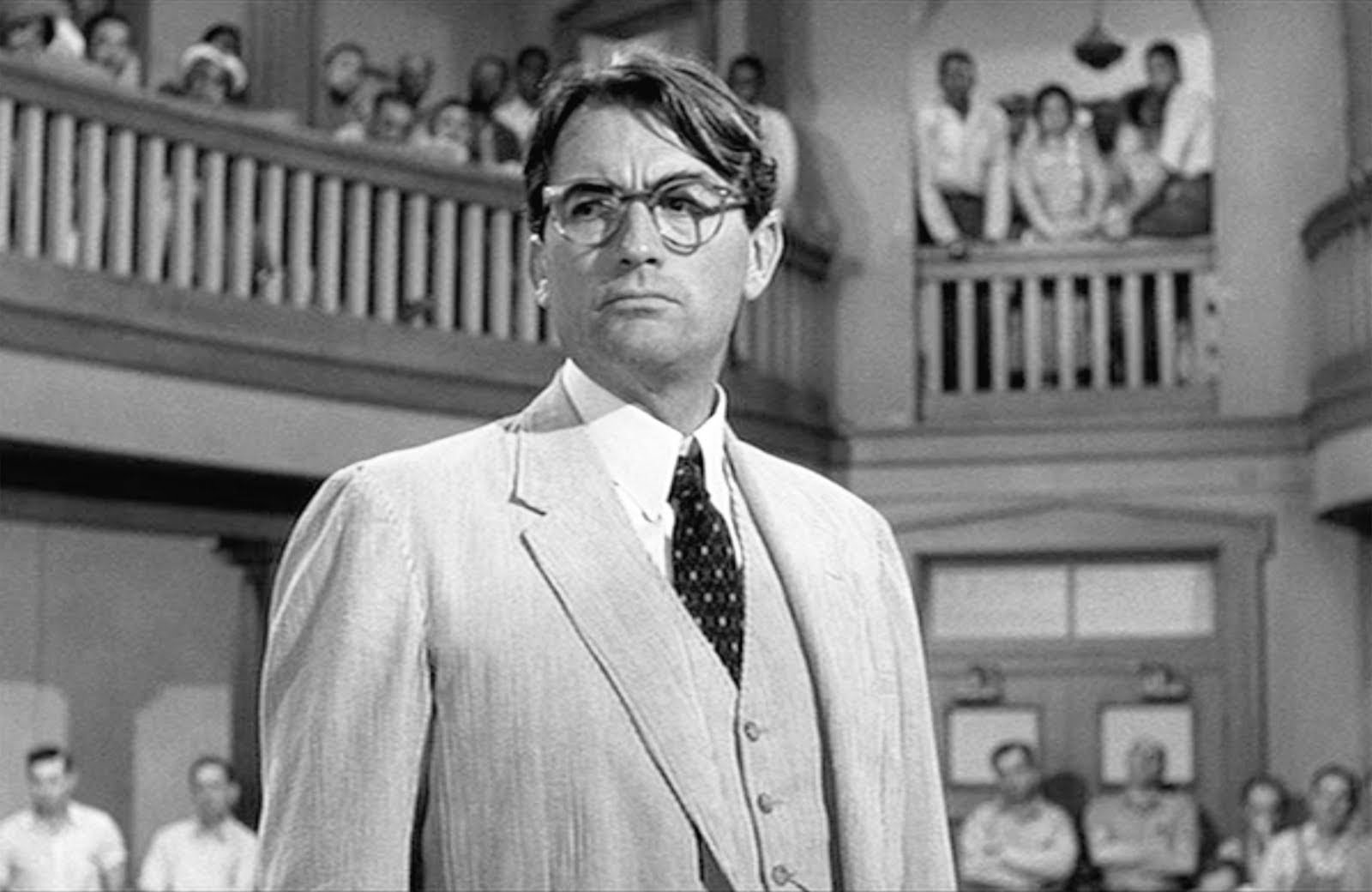
A study by the University of Missouri noted that “Nearly 3,500 African Americans and 1,300 whites were lynched in the United States between 1882 and 1968, mostly from 1882 to 1920.” Mary however was the only Elephant known to have suffered a similar fate at the hands of a vigilante Mob. Sadly there was no Atticus Finch on hand to save her life.

Atticus Finch

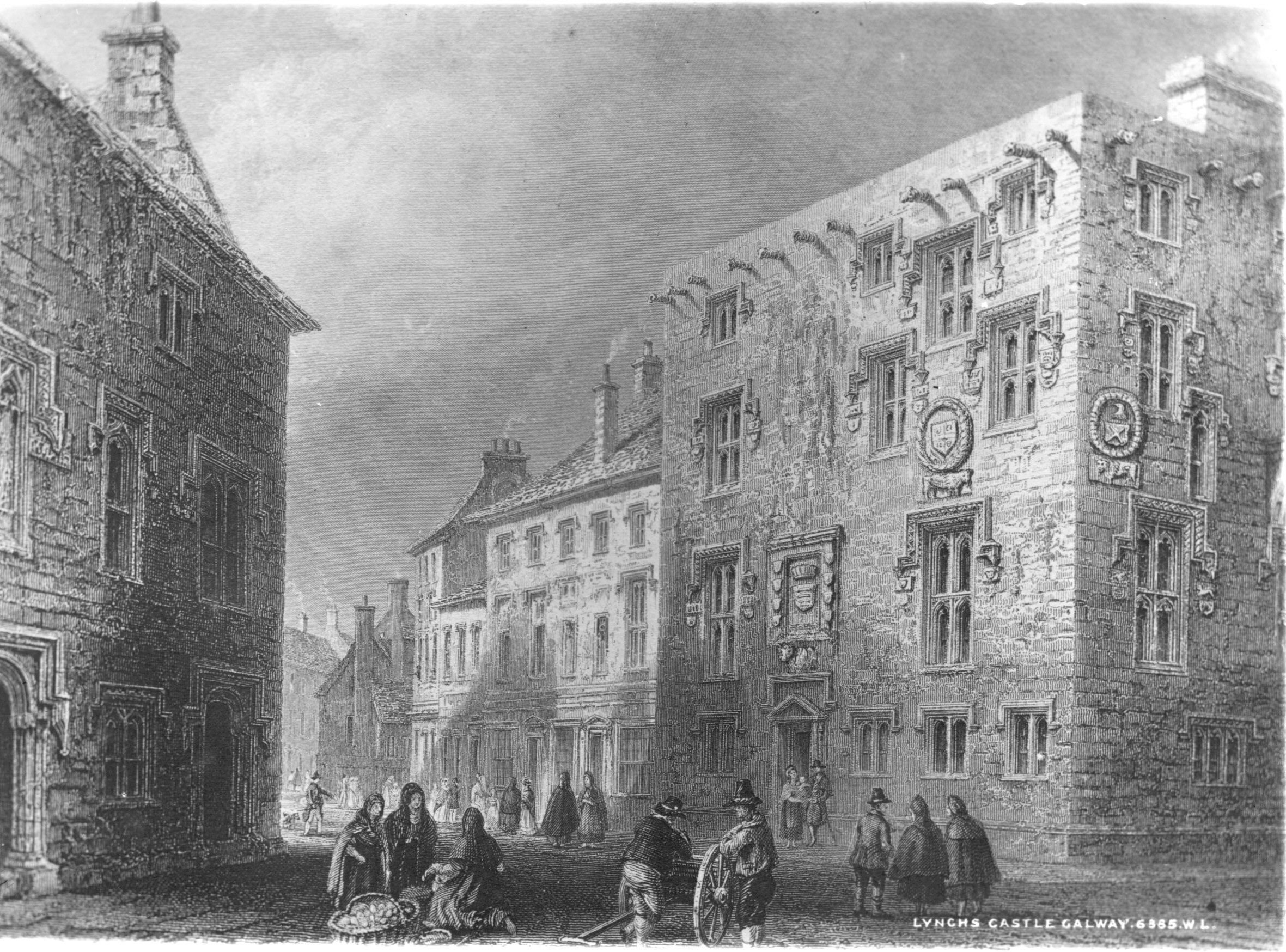
Incidentally the word ‘lynching’ comes from Galway. James Lynch Fitzstephen was the Mayor of Galway when he hanged his own son from the balcony of his house after convicting him of the murder of a Spanish visitor in 1493.

Finally, I purchased Michael Harding’s book and am looking forward to tucking into it; the critics say it is ‘A compelling memoir. Absorbing and graced with a deceptive lightness of touch, [Hanging with the Elephant ] is clever and brilliantly pieced together. Harding writes like an angel’

lynchscastle

Leitrim’s Titanic Victim

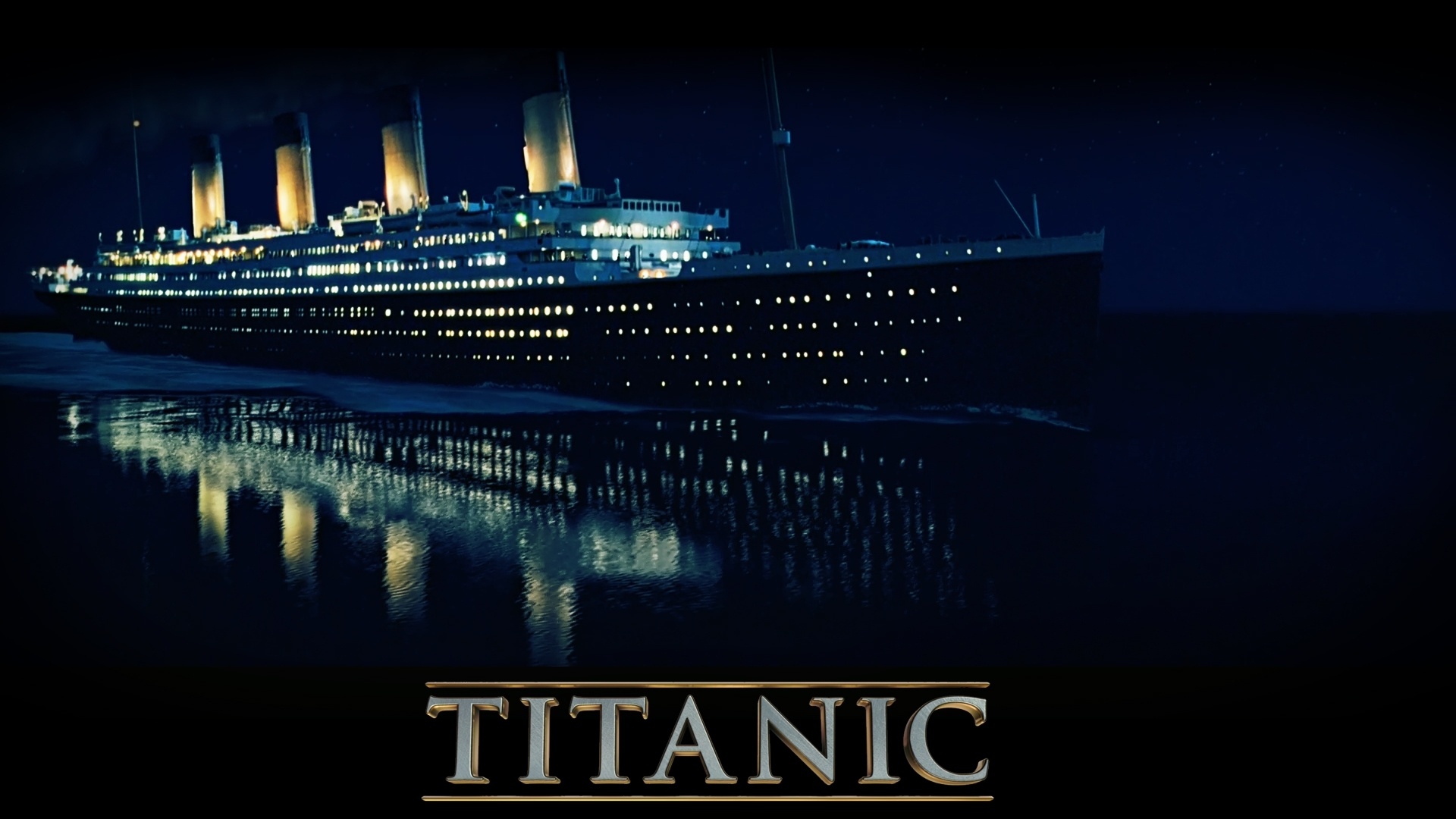
titanic_ship-1920x1080

Matthew Sadlier was born on the Lough Rynn Estate, Mohill, Co. Leitrim in 1892 where after school he took employment as a farm labourer. In 1912 he decided to emigrate and join some family members who had previously settled in Lakewood, New Jeresey, USA. Matthew purchased a 3rd Class ticket (Ticket No. 367655 , £7 14s 7d) and embarked from Queenstown, Co. Cork on Thursday the 11th April, 1912. The name of the ship was ‘Titanic’ the pride of the White Star Line enroute to new York on her maiden voyage. The rest  as the saying goes is History.

When the iceberg hit Matthew was in the wrong place at the wrong time. Matthew Sadlier died in the disaster. His body, if it was recovered, has never been idenitifed.

I came across this link which goes a little way to remembering the young lad.

http://www.titanicattraction.com/titanic-stories/titanic-stories-week19.php

Local media reports that a Committee has been set up with Mohill Foroige Group and other people interested in commemorating the short life, and tragic end of young Matthew Sadlier, on one of the most iconic ships ever built.

Parkes Castle

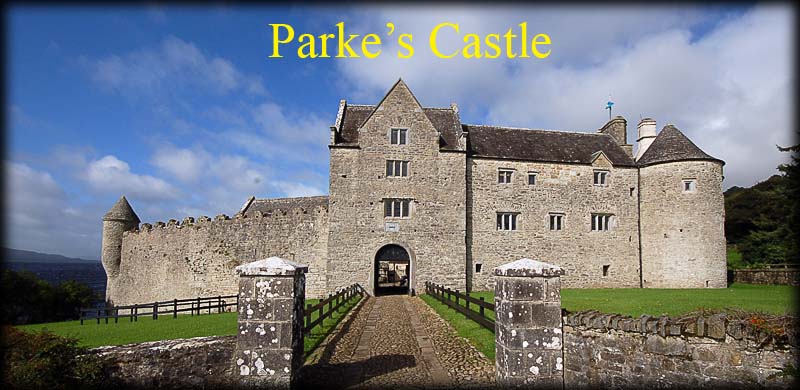
Parke's Castle

Parkes Castle is one of my favourite places in Leitrim.

As the scion of a dispossessed native family, this Planters home shouldn’t really hold much enjoyment for me. I think it is perhaps because it has a picturesque natural setting. The soft lapping waters of Lough Gill provide a fitting foreground and the beautiful Glens of North Leitrim give it formidable background. You couldn’t fault the planter for picking such a fantastic site to set up home.

Parkes Castle isn’t in fact a Castle at all. It is a restored plantation house dating to the early 17th century. It was once the home of Mr. Roger Parke and his family but the site also once boasted a Manor House owned by Sir Brian O’Rourke or Brian na Murtha (Brian of the Ramparts). The O’Rourke Manor at Newtown was where O’Rourke entertained the famous survivor of the shipwrecked Spanish Armada, Francisco de Cuellar.

In his memoirs De Cuellar said of his host “Although this chief is a savage, he is a good Christian and an enemy of the heretics and is always at war with them.” O’Rourke was the son of Brian Ballagh O’Rourke and he became the Chief of West Breifne in 1566 after disposing of his chief rivals, his elder brothers. He was well educated in the classical fashion and was regarded by the Tudor Administration in Dublin as being proud and insolent. The president of Connacht, Sir Nicholas Malby, described O’Rourke as ‘the proudest man living in Ireland today’.

O’Rourke was knighted by the English in 1575 but his relationship with them was fraught as they extended their control into his territory. He just about survived implication in the doomed Desmond rebellion (1579) but by the mid 1580’s he was complaining bitterly about harassment by the President of Connacht Sir Richard Bingham. O’Rourke took his complaints to Dublin Castle and seems to have enjoyed, for awhile, the friendship and protection of Sir John Perrot, the Lord Deputy. Brian entered negotiations to surrender his lands and receive a royal title but does not appear to have ever taken up the letters patent.

In 1588 he was condemned for providing assistance to over 80 survivors of the shipwrecked Armada and helping most of them return to Spain. Tensions rose throughout 1589 and all talks between Bingham, O’Rourke and the new Lord Deputy, Fitzwilliam failed. Bingham invaded Leitrim in 1590 and occupied several of O’Rourke’s Manor houses. O’Rourke fled to Scotland where he was the equivalent of a political refugee seeking asylum. Queen Elizabeth seeking to rely on the recent Treaty of Berwick sought to have O’Rourke extradited and the Leitrim noble became a cause celebre. The Scots eventually did have him extradited and he soon found himself in the Tower of London. O’Rourke’s Trial for treason attracted a lot of attention but the sentence of death was inevitable.

O’Rourke was brought to Tyburn on the 3rd of November, 1591where he was hung, drawn and quartered. His final request to the hangman was reputedly to be hung in the Irish Fashion with a willow rope but this was refused.

By now Ireland was in rebellion in what became known as the ‘Nine Years War’, it would end in defeat for the Irish at the Battle of Kinsale. Brian son, Brian Og played a prominent part in defeating the English at the Battle of the Curlews in 1599. Brian died in 1604 and was succeeded by his brother Tadhg, the last ‘Lord’ of Breifne who died the following year, probably poisoned. The heirs to these last two ‘Lords’ were declared illegitimate and the family lands confiscated. Robert Parke received a grant of the lands and Manor at ‘Baile Nua’ and within a couple of years he had demolished the O’Rourke tower and built his house within the original protective walls. The house was rebuilt in the late 1600’s and was occupied until the late 1700’s when it was abandoned permanently.

The Office of Public Works has carried out a sympathetic and impressive restoration. The ‘Castle’ is definitely worth a visit and is close to the village of Dromahaire and convenient to Sligo also.